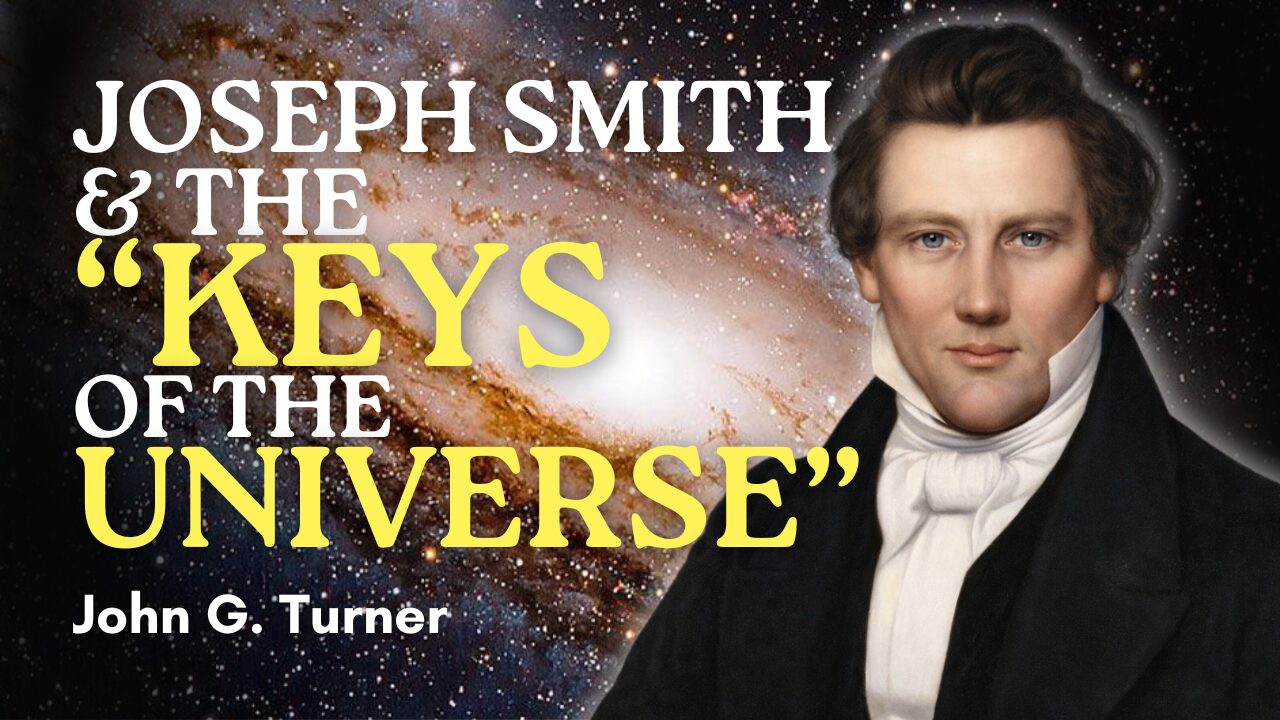
Joseph Smith and the Keys of the Universe
Listen on Apple Podcasts Spotify YouTube Download MP3
About this episode
In today’s episode, we dive into Chapter 21 titled “Keys” from Dr. John Turner’s new book “Joseph Smith: The Rise and Fall of an American Prophet.” This chapter cover the pivotal years of 1839-1840, as the Saints leave behind the trauma of Missouri and begin building a new gathering place in Commerce (soon to be Nauvoo), Illinois.
We pick up the story right after Joseph Smith escapes Liberty Jail, exploring how he reclaims leadership, rebuilds momentum, and introduces new theological ideas that will shape Latter-day Saint doctrine for generations.
Dr. Turner –writing as a never-Mormon historian –gives us a clear-eyed look Joseph’s rapid return to power, the purchase of Nauvoo lands, the arrival of the mummies and papyri, early missionary ambitions in Europe, evolving doctrines about angels and theosis, and Joseph’s bold claims about “keys” –including what Turner calls “the keys of the universe.”
We also get into the politics: Joseph’s 1840 trip to Washington, his audience with President Martin Van Buren, and the Saints’ ongoing fight for redress. And yes –we discuss everything from healings during the malaria outbreak to phrenology, patriarchal blessings, lineage theories, dynastic sealings, and even the perennial question: Was Joseph Smith actually good-looking?
If you enjoy this deep-dive series, please like, subscribe, comment, and consider donating to support future episodes. Donate to this series by clicking here: https://donorbox.org/josephsmith
Thumbnail Credits: Main image of Joseph Smith by Unknown painter, from Community of Christ Archives (public domain); Background image of Andromeda Galexy by David Dayag
Originally published on mormonstories.org.
Transcript
Machine-generated and lightly edited. Click any timestamp to jump the audio to that moment. The audio is authoritative; please check it before quoting.
Introduction and Episode Overview
John Dehlin Hello, everyone, and welcome to another edition of Mormon Stories podcast and the Joseph Smith Podcast. I am your host for today, John Dehlin. It is December 8, 2025. We are here to discuss again Joseph the Rise and Fall of an American Prophet with Dr. John Turner. Today we're covering Chapter 21, which is called Keys, which comes on the heels of our Liberty Jail episode. We're covering the time period of 1839 to 1840. Lots of fun things to talk about today. We love John Turner because he's never been Mormon. He's a top notch US Historian, scholar. He wrote a biography on Brigham Young before he wrote a biography on Joseph Smith. And we love that he's good natured, knowledgeable, willing to call balls and strikes. And before we jump into today's episode, we have to talk college football. John Turner, you were a little too gleeful at the prospect of BYU not making the playoffs and your alma mater, Notre Dame making it. What say ye? On December 8, 2025.
John Turner Even Joseph Smith got some things wrong. I don't, I, I. And he never apologized. At least hardly ever. So I guess I don't need to feel too badly either. I feel certainly, I feel that Notre Dame got screwed by the committee. I feel like the Irish were definitely one of the top 10 teams in the country. I don't think other teams in the field this year would have relished playing them. Maybe we should just get the Cougars and the Irish together for a bowl of the excluded or something like that.
John Dehlin Well, I hear Notre Dame declined to even go to a bowl game, which is a little bit spicy, don't you think?
John Turner It is a little bit spicy. I presume they got player input before making that unusual decision. And I'm sure they're giving up some, some money in order to, you know, take that stand. I don't know.
John Dehlin Well, I like the idea of a holy bowl and having BYU and the Irish just play each other every, every bowl season. I like that idea. Let's, let's start a petition.
John Turner Yeah, we won't get too far. But I, ironically, I, I, I, I like byu, so I, I root for the Cougars a bit, just not when it's at the expense of the Irish. I did think them losing was going to help my Irish this time, and maybe that came back to bite me in the rear.
John Dehlin Tell us about the button on your sweater.
John Turner So this is Zion's Camp, Summer 1834. It's courtesy of the B.H. roberts Foundation. They do a lot of fun stuff related to Mormon history in addition to Supporting scholarship and research. This was from their booth at the Mormon History association meeting a few years ago. I meant to wear it when we did our Zion's Camp episode. And I'm about 10 weeks off, but I'm still proud to support Zion's camp, summer 1834.
John Dehlin I mean, I don't mean to get too heavy. That is a slightly dark joke given a couple dozen people died as a part of Zion's Camp.
John Turner Well, okay, fair point. But as I emphasized, as I emphasized in the episode, Joseph Smith, I think at least until the very end, a lot of the time he had, you know, he enjoyed the adventure, he enjoyed the roughing it and the travel. And yes, we won't talk about cholera or anti Mormons or things like that
John Dehlin or his dog or Old Major.
John Turner Well, I mean, Old Major. He. He. Yeah, Old Major survived a couple of rounds of Missouri, so that dog was tough.
John Dehlin Is it fair to say Joseph's biggest concern coming out of Liberty Jail was whether Old Major was still around?
John Turner It was. It was high on the list.
John Dehlin It's like Emma, my kids, and Old Major.
John Turner Right, right, right. I didn't. I find that very endearing. Alex Baugh. I'm not quite sure how to say his last name at byu. A historian there in religious education. He wrote a really charming essay on Joseph and Old Major a number of years ago. So that is. That is an indisputably important subject.
John Dehlin All right, well, let me just quickly say, and remind everyone, please subscribe and like this episode, please share it. We really. Please comment. We really love the comments and the feedback and the emails. We want to remind everyone that these Joseph Smith episodes exist at the generosity of the donors to the Mormon Stories Podcast and also to the specific donors to the Joseph Smith Podcast Project. If you value this series and want to see it continue, and if you want a chance at convincing John Turner to occasionally appear with us after we complete this series, you can go to donorbox.org Joseph Smith and become a donor to this series. And we're contributing. We're definitely making sure John Turner feels generously compensated for his support. So that's donorbox.org Joseph Smith. All right, John Turner, where do we begin? Chapter 21 with keys. 1839.
Regrouping After the Missouri Expulsion
John Turner So the starting point is Joseph Smith and his people regrouping after the expulsion from Missouri. One thing I emphasized at the outset that I think is quite typical of Joseph Smith, he just didn't miss a beat. So he was allowed to escape from. From the law. In April of 1839, he and his associates made their way to Quincy, Illinois. And I think within a week or so, Joseph was headed north to investigate land that the church was purchasing on either side of the Mississippi river, including parcels of land that eventually became the city of Nauvoo. So Joseph. And this was also true after the debacle and flight from Kirtland. Joseph just plunged right back into the task of gathering the saints, trying to move forward, trying to build something bigger than the last, last attempt at gathering.
John Dehlin All right, well, the one. One thing that I found interesting is that chapter 21 begins describing a corrupt physician who was roguish, who was not named John C. Bennett.
John Turner Right.
John Dehlin That. That surprised me.
John Turner Yeah. So the individual you're talking about is Isaac Galland.
John Dehlin Correct.
John Turner Who was. He was more of a land speculator than a physician, but I guess he had at least done a bit of medicine on the side. That was all pretty unregulated and loosey goosey, not professionalized in the first half of the 19th century. And yeah, another similarity between him and John C. Bennett is he had a complex marital past. He divorced his first two wives, which was pretty uncommon, in the 1830s, and he married a third before this, before the second divorce was finalized. What he offered church leaders was, well, a number of different parcels of land, including 20,000 acres of land in Iowa, so on the west side of the Mississippi River. And it was a really good deal for the church. It was 20,000 acres at $2 an acre, but payments spread out over 20 years without any interest. So that was attractive. It was a sort of an easy way financially for the church to get the gathering started again.
John Dehlin I was just confused how Joseph can, like, spend half a year. I'm exaggerating. In jail. All this scandal, all this disaffection. He immediately gets out of jail. And people are like, he's able to just buy land and have a cabin to live in with Emma. Where's all this money coming from after all the debt and all the scandal and all the calamity?
John Turner So that's a good question. So Joseph is personally in debt at this time. He has a lot of legal fees that are unpaid for from Missouri. He certainly doesn't have even $1,000 of cash on hand. But people like Galland and quite a few other people in the years ahead are very willing to extend credit to Joseph Smith because the church is growing. There's going to be a flood of. Of Mormon settlers from the. From Missouri, from the eastern United States, from the British Isles. It's going to be a flood of Mormon settlers to Wherever Joseph has the saints gather. So it's actually not a bad bet that Joseph and the church could be in a position to make these payments in the years ahead.
John Dehlin But the money comes from where? Just. Just ongoing donors.
John Turner Yeah, no, precisely right. Ongoing donors, but then also when it came to land. So Joseph knows that as his people move to Iowa and Illinois, the value of any land that he purchases or that the church purchases is going to increase exponentially. So there's also an expectation that these are eminently good real estate investments.
John Dehlin Yeah. Okay. All right. So there's a report that, at least from Wilford Woodruff, that Joseph looks truly happy to be reunited with Emma and his children. And then, of course, to stay on brand. Joseph immediately plans to leave again and travel to another state and leave Emma behind with the kids. I have a hard time not being salty about that, but tell us what was going on there and why I shouldn't be. Feel salty.
John Turner Well, John Dehlin, if you want to feel salty, I'm not gonna stand in your way, but I would recommend you save the saltiness for a little bit later in this episode. And if you really want to feel salty, we have some. We have some episodes coming up. So in this case, Joseph. Yeah, I'm sure Emma didn't find it easy for Joseph to make the trip up to Montrose, Iowa, not long after his arrival in Quincy. But he's actually. He's. He's back with her again in a few days. So later. And then he moves with her and the children to what is then Commerce, Illinois, in the middle of May, 1839. So they're not separated for very long. There's a longer period of separation that begins later in the fall of 1839, and that's much more difficult on Emma and the family because it's at the tail end of a substantial wave of sickness among the Saints. And so that was more difficult. This, I suppose, in context, is not. Not a terribly long or difficult separation. Yeah.
John Dehlin Okay. And. And, yeah, it looks like the mummies and the papyri somehow made it. Made it to Commerce or Quincy or ultimately Nauvoo. I guess that's good, right?
John Turner Yeah, That's. That is also a bit of a minor miracle in that Joseph had nearly lost possession of the mummies and papyri during the end of Mormon Kirtland. But then they made it to Missouri. They make it to Illinois. So they and the dog are survivors.
John Dehlin Old Major is not. Is not done and out yet. Okay, so let's see. Galland, The. The Roguish Galland is baptized. I loved your little play on words there. Do you want to, do you want to, do you want to give us that little fun joke?
John Turner Yeah. So In July of 1839, Joseph, Joseph and Galland had sort of cultivated a relationship over the previous four months or so. There was some correspondence between them that began while, I think, while Joseph was still in Liberty Jail. Galland sees this relationship as, I think, first and foremost financially valuable. He has a number of parcels of land that he wants to sell, investments that he thinks might finally pay off because of this association with the Mormons. And we don't know to what extent he was genuinely interested in the church spiritually. But while Joseph is examining some land in Iowa, he baptizes Galland in July of 1839. What I think is interesting is that Galland has a pretty clear eyed view of what's going to transpire once the Mormons start moving in large numbers to Iowa or Illinois. This is what he wrote just a few weeks after his baptism. They will probably continue to buy out the settlers until they again acquire a sufficient quantity of honeycomb to induce the surrounding thieves to rob them again. So in other words, what happened in Missouri, it's going to happen again because once the Saints begin prospering and growing in number, their enemies are going to want to take it all away from them again. And they're going to have two options. Galen says, renounce their religion or submit to a repetition of similar acts of violence and outrage. And so, yeah, it didn't really take a prophet to foresee a repetition of what had happened in Missouri. Joseph is bounded and determined to avoid that. We know how that ended. I don't think I'm really spoiling it for listeners by alluding to that. And I think it turned out that Galen's interest in the church was not, you know, it either was passing or insincere.
John Dehlin Yeah. So you write that he was more interested in prophets than prophets.
John Turner Correct.
John Dehlin But I think he kind of was a prophet and clearly he saw the saint's future more accurately than the actual prophet. And I don't mean to be ungenerous in that estimation, but I think that is not uninteresting.
John Turner No. And I mentioned at the outset of the chapter that a militia leader in Missouri, General John B. Clark, who had played a role in the surrender and prosecution of the Mormons in the fall of 1838, you know, he basically told church members after the surrender that they should scatter abroad, that they should stop gathering together because it excites the jealousies of the people. That's how he put it. And clearly, when Joseph is free from captivity, he doesn't have any intention of taking that advice, but outsiders can. And I'm sure Joseph was well aware of the potential for future trouble. I think he, in his own mind, he took steps to mitigate it. But both Gallant and John B. Clark, they could certainly put their finger on the fundamental problem.
John Dehlin Absolutely. All right. So speaking where Joseph Smith was a prophet, he. He decides that he wants to make a push for what your book describes as a long planned mission to Europe. Now, there had already been missionaries in Europe, but. But there's another push, and I think in this case it was probably wildly successful. Do you want to talk about that and why Joseph wanted to do this?
The Apostles' Mission to England
John Turner So. Yeah, no, that's true. So Apostle He Excuse me. Apostle Heber C. Kimball had traveled to England in 1837, and he and other missionaries had had some initial success in England. But there had been a plan for the quorum of the twelve Apostles together to go overseas to England. They eventually depart in the fall of 1839, maybe delayed a bit by what has transpired in Missouri that ultimately does become a tremendous success, and it's very significant for the future growth and trajectory of the church. I write more about it in my Brigham Young biography, because as one of the 12 and its leader, Brigham Young played a significant role in England in 1840 and early 1841. But to make that story short, the mission is fabulously successful and leads to thousands of converts, many of which emigrate to Nauvoo if they come by 1845, or ultimately to the Utah Territory if they come after 1845. If you went to Nauvoo in 1844, 1845, you'd hear a lot of English accents. So this was very significant for the church's growth.
John Dehlin Yeah. And I'll just say that my. My ancestors on my mom's side primarily came, were converted in the British isles in the 1830s, 1840s, and migrated to the United States. So, I mean, I'm literally a product of these missionary efforts.
John Turner Yeah, no, certainly a significant decision and undertaking that proved really successful. And I think there's a lot of intersection between North America and Europe among a wide variety of religious movements. And so it's not really super unusual that early church leaders would think about things on a transatlantic basis. I think what's surprising is the extent of the success and its significance for the growth of the church.
John Dehlin I was going to ask if this was unique for a United States based church to send missionaries to Europe. And it sounds like that wasn't unique to the Latter Day Saints, but the success was
John Turner correct.
John Dehlin So Orson Hyde had apostatized in a previous chapter episodes, you write that he reconciles that Joseph takes him back. I think we might have even referenced this last episode. Do we know why he left, why he returned and why he was forgiven? And I just thought it was pretty remarkable that he apostatizes, is reinstated, and immediately gets readmitted to the Quorum of the twelve Apostles.
John Turner Yeah.
John Dehlin Also, would he have been the successor to Joseph and not Brigham if he had never left to begin with? Or do we know?
John Turner So great questions. The. So I don't know. I'm gonna have to check his date of birth or maybe, maybe you want to do that. I forget. So he, he apostatizes because he objects to the church's offensive operations in October of 1838 against non Mormon communities in Davies County. He more broadly doesn't like the martial spirit of Joseph's leadership that month. He and Thomas B. Marsh, who had been president of the 12, they abandon Joseph and the church at the same time. I think they might have even signed an affidavit together or separate affidavits against Joseph. That was very painful for Joseph to have two apostles abandon him at that particular moment. I think the simplest thing to say is that by the next summer, Orson Hyde is contrite. He, he regrets that abandonment. I think what transpires after his apostasy gives him pause in terms of his fellow co religionists being so bitterly oppressed and persecuted. It's not a long process of readmission. I know that during some of the meetings with the apostles in the summer of 1839, I remember that Joseph reflects on Hyde's return. I don't recall him really putting the screws on Hyde or humiliating him. Say the way that Brigham Young later humiliated Thomas Marsh upon his return to the church.
John Dehlin All right, well, I do think it's. I think I noted this last episode as well. I think, I do think it's worthwhile to note how forgiving Joseph Smith could be because I think that's a trait that people associate with Christianity. And in that, in that case it could speak positively towards him. Is that fair?
John Turner That's fair now. I mean, we'll get into it in later chapters. There are some additional twists and turns in their relationship, particularly surrounding polygamy. I, I don't think, I don't think those are necessarily connected to his apostasy and return and you also asked if he would have become president of the quorum of the 12 had he not apostatized. The answer is no. Brigham Young was older, and age is how they settled it in early 1839.
John Dehlin Makes sense. All right. So one thing that I thought was interesting, at the bottom of 235, you write. Well, the first thing that is actually a little bit, I don't know, for me, comical. Joseph receives kind of a revelation on how to distinguish between angels and devils. This is actually something I was taught as a seminary student in high school. It seems almost silly to a modern sensibility, but it made the Doctrine and Covenants, so it's probably worth you mentioning it to us.
Joseph Smith's Teachings on Angels and Demons
John Turner Sure. So essentially, Joseph, this is before the quorum of the 12 is going to depart on its mission to England. He spends a number of days instructing them in spiritual matters, revealing what he called keys to the kingdom of God. Keys, in this case, not being symbols of ecclesiastical authority, but being teachings that if people understood them correctly, they would unlock spiritual power. So one of those keys was, how do you distinguish between angels and devils? And Joseph had a really pragmatic, simple how to for that. If you encounter what you think it might be, a spirit, good or bad, you should offer to shake hands, and an angel would be able to shake your hands. An angel, Joseph taught, is a saint with his resurrected body, whereas Satan or a devil or a demon might appear to look like a man, but lacks a physical body. Joseph elsewhere comments on how other Christians misunderstand angels. He says in one discourse, you know, angels don't have wings. They don't look like a lot of Christian artwork. So they are advanced, progressed, immortal human beings, righteous individuals who have progressed beyond mortality. That idea in and of itself wasn't completely original to Joseph Smith, Emmanuel Swedenborg, the Swedish mystic who also envisioned an afterlife with different realms of great glory. He also understood angels as more progressed human beings, but that was different than the way that most Protestants and most Christians generally thought about angels. More typically, angels were thought of as a separate species, a separate class of beings who also might appear in the guise of humans, but were not corporeal. So that was a long answer to your question.
John Dehlin No, it's important. The stuff I was taught that I think is in the Doctrine of Covenants is that if an allegedly celestial being appears to you, you reach out your hand, and if they shake it and you feel it, then it's a resurrected being. If they refuse to shake it, then they're legitimate, righteous spirit angel that has not yet been resurrected. But. But you can know they're a demon how? John Turner, do you. Do you remember this? It's a little bit nerdy.
John Turner I, I do not recall.
John Dehlin If, if the spirit goes to shake your hand and tries to shake it, but you don't feel anything, then you know it's a demonic spirit because they can't not try to deceive. And that's how you know if an angelic visitor is from God or from Satan. What do you think?
John Turner I think, I hope I would remember that should the situation arise.
John Dehlin What do you make of this sort of revelation? As. As someone who has studied a lot about Christianity and even has observed it, just this whole discerning of demons and angels and that sort of thing.
John Turner I mean, honestly, my first reaction is I just sort of love it because it seems kind of folksy and sort of in. Also in keeping with, I mean, we sort of take for granted the social ritual of shaking hands. In some ways that was very customarily American in the early 1800s. And I love that Joseph extends that social ritual to celestial beings, if you will. I think that's fun. Joseph, the historian Ben park wrote an essay on early Mormon angelology. Hope I'm saying that correctly. Quite a few years ago, back when I think Ben even had some hair. Yeah. Which I. Most of us think that was never the case.
John Dehlin Oh my gosh.
John Turner Yeah.
John Dehlin Ben park is going to write a scurrilous comment or email, but it's great.
John Turner He wrote it a long time ago and it's already customarily good Ben park work.
John Dehlin You write at the bottom of 235 that these new teachings about angels and Satan reflected Joseph's belief that angels and humans, and perhaps God and Jesus Christ were the same sort of being, albeit at different stages of progression. I wrote in my comment, is this sort of the beginning of Joseph's evolution towards a doctrine of what I'll just call theosis? I don't even know if that word applies, but the idea that God was once a man and that men can become gods, are we seeing as early as 1839 the beginnings of that evolution, or am I making too much of that?
John Turner So I think the beginnings of that are actually a bit earlier. So back In, I think, 1833, in what is now, if I'm not mistaken, DNC 93, Joseph, that's the revelation in which Joseph reflects on the fact that human intelligence, human spirits are eternal, just as Jesus Christ and God are eternal. He also reflects on the fact that Jesus was not born with the fullness of God's glory, but progress breast into it, and that humans have a similar divine potential for progression. I don't think at that point you quite see Joseph's teaching that God the Father also progressed from mortality to divine glory. But I think you see, you see this, you see Joseph slowly thinking about contemplating fleshing out these ideas, and he'll do that more in the years ahead. I think what's really an open question for Joseph that doesn't really get settled until the Nauvoo time period is what precisely do humans have to do on earth in order to progress toward becoming God or becoming like God? It takes Joseph a long time to give really concrete answers to that question.
John Dehlin All right, so stay tuned, Stay tuned on that front for a future chapter. You also talk about Israelite blood and Gentile blood, and we're not meaning spiritual blood here. This has been one of the. I don't know, this is one of the few disturbing things that, that for me, I wonder if it borders on almost racial superiority. That may be an unfair interpretation. But if God on the one hand doesn't look on any of his children as better or worse, why do we care about whether someone's blood is Israelite or not Israelite or Gentile? But why don't you just kind of explain to us this blood lineage stuff that I think isn't favorable in my opinion.
Race, Lineage, and the Second Anointing
John Turner Sure. So Joseph taught that the saints had Israelite blood in their veins. Now that seems, that seems a pretty strange idea. How could that be the case? What Joseph taught is that when the Holy Ghost came upon a Gentile, a non Jew, at the time of his or her baptism, the Holy Ghost purged out the old blood and made him actually of the seed of Abram or Abraham. So sort of a spiritual slash physical blood transfusion. Joseph also taught that, you know, that was kind of a jolt to the system. And so that explained some of that ecstatic physical behavior that was so associated with the church during its earliest years in particular. And so Joseph needed some sort of explanation as to how it was that non Jews could actually be of the seed of Israel. And that was his explanation.
John Dehlin Is it, should it be disturbing? Is this a form of racism? Even if it's white? You know, white racial superiority? Am I applying excessively modernistic sensibilities? I just don't like the idea of blood lineage racial superiority, even if it's white on white.
John Turner Okay, well, neither do I, but I much prefer to take people as individuals. That's not. That is not how Joseph or Many Americans thought, at least that's not the only way they thought at this time. So cursed lineages were very significant to both Joseph and some of his successors in the 19th century. So Joseph dictates in what becomes the Book of Abraham that an early figure referred to as Pharaoh is of that lineage that could not have the priesthood. And that's a matter of blood descent from one of the grandchildren of Noah. The descendants of Cain were also cursed, a curse inherited in some way by blood. And so, conversely, many, many, many Saints believed that it would be advantageous to have Israelite blood. There were Latter Day saints in the 19th century who thought it was particularly beneficial to be a descendant, a blood descendant of Jesus Christ. I can sort of understand how that idea would have some, you know, would have some appeal. I certainly share your general discomfort with this way of thinking. In a way, it's rather different from the way that many Americans think about race because sort of claiming that members of a particular church are themselves, in a way, a separate, peculiar people, partly based, you know, partly based on blood. So it's, it's an, It's, It's, It's a belief that in some ways intersects with some other American ideas about race and lineage, but in ways that are. That are quite unusual and distinctive.
John Dehlin Yeah. All right. You know, when, when we get our patriarchal blessings today, even as Latter Day Saints, where there's a remnant of this. Because in one of the most important parts of a patriarchal blessing, which is like a rite of passage for Mormon teenagers or young adults, is to have our lineage declared. And we're where often us white Latter Day Saints are often declared to be the lineage of Ephraim from the twelve tribes of Israel. And again, I think the church would want us to believe that that's kind of just a spiritual adoptive lineage. But I wonder if. If in the roots of. Of that practice are these teachings that. That we're literally the blood of Israel, that the blood of Israel courses through our veins. And by the way, my roommate at BYU in 19, you know, 90s, was taught that Joseph Smith was a literal descendant, blood descendant of Jesus Christ.
John Turner Right.
John Dehlin And that many Latter Day Saints were or are too, which I don't think makes a lot of sense. But. But you can call the ball or strike. John Turner.
John Turner Ah. Was Joseph a descendant of Jesus Christ? Well, definitely not prior to his baptism. Let's just say that.
John Dehlin I love it. All right, well, if that weren't enough, then the next, the next paragraph on 236 talks about the emergence. I Don't remember this is for the first time or not of this idea of a first comforter and a second comforter, which. Which sounds to me a lot like the second anointing that now is secretly practiced in Mormon temples. But tell. Tell us about this idea of a comforter, second comforter and how important, and I think I remember some fistfights in previous episodes between Joseph and his brother William over how important it was to see Jesus in this life. So it sounds like this is continuing, but am I getting that wrong? John Turner.
John Turner So this is again just to remind listeners this is in the context of keys teachings that Joseph is revealing to the apostles in the summer of 1839 before their planned mission to England. So another of those keys is that if the apostles, and by extension perhaps other church members, if they humble themselves, their calling and election would be made sure in that they would receive a second comforter who would be Jesus Christ himself, the first comforter being the Holy Ghost that they would have received at the time of their baptism. But this, through this second comforter, they would be blessed in the ways that figures like Moses and Paul had been blessed. The Savior would teach them face to face, even reveal God the Father to them, show them visions of the heavens. They would receive the spirit of revelation. In a way, this. This tracks with some of Joseph's earlier promises to the apostles and to church members in general that if people are righteous and faithful, they should have an expectation of seeing the Savior. Joseph had particularly emphasized that in the run up to the Kirtland Temple dedication, in which some church members did report seeing the Savior and Joseph later did return to that language of having one's calling and election made sure. Which I think is why this 1839 key is making you think of later developments. I think really the next time Joseph returns to this theme at length is in the spring of 1843, in which he connects it, I would say, not explicitly with the second anointing, but with plural marriage, that being sealed for eternity is a way in which church members can make their calling and election sure and therefore ensure their eternal glory.
John Dehlin Hmm. So is it an evolution? Is this part of an evolution leading to that culminating doctrine?
John Turner I would say at this point, it's more in keeping with what Joseph was teaching in the mid-1830s in Kirtland. That, and maybe it's amplified a bit here in that if you're faithful, if you humble yourself, if you remain righteous, you should anticipate an encounter with the Savior and a sort of gift of heavenly mysteries and you know, I think this is, you know, this is maybe a bit of a spicy, spicy topic in recent years, in part because Denver Snuffler wrote a book with the title of the Second Comforter, I think, about a dozen years ago in which he, you know, lifts up this teaching of Joseph Smith that, you know, church members should anticipate an encounter with the Savior, a personal encounter.
John Dehlin Yeah. Well, it's fun and it's fun that you're com that you're covering it. And, you know, I almost I think I've reached out to Deborah Snuffer to have him back on the podcast because I want to hear his thoughts on the evolution of this teaching. And I've never really had him come on, especially on camera, to talk about it. So viewers and listeners, if you're interested in that, let me know. All right. Well, let's dive into the topic for which this entire chapter is named. Talk to us about keys. John Turner.
Keys of Priesthood Authority and the Universe
John Turner Sure. So, you know, we've been talking about keys in the sense of mysteries and teachings. Keys also symbolize priesthood authority, and Joseph teaches about this when he talks to the apostles as well. He teaches that he holds the keys of authority in a chain that stretches back all the way to Adam, who had received the first presidency and the keys from God. So this is a really long chain, starting with Adam and extending to other famous biblical figures like Noah and Moses, Jesus's New Testament apostles, Joseph teaches. And this is it's probably reiterated in a number of places, but including in what became Doctrine and Covenant Section 132, only one man or group of men holds this authority at any given time. And so right now, that's Joseph and his counselors in the first presidency along with the apostles. And Joseph anticipates that still in the near or nearish future, there's going to be a grand council convened by none other than Adam, who with his posterity, all of these key holders over time will, you know, sort of hand back these keys of authority to Jesus Christ. So there's this grand chain of priesthood authority and Joseph, his counselors, the apostles, they will return to Adam on diamond and reign as priests and kings over a millennial earth. In a way, I would say this is slightly, slightly off topic for Joseph in 1839. You know, his millenarian fire burned the brightest in the early 1830s. But I think Joseph teaches it to the apostles now. He's, you know, he's about to send them out on this mission to England, and he's reminding them, I think you could say of their cosmic importance.
John Dehlin What I'm curious what you as a historian, and as a, let's just say historian of Christianity or 19th century Christianity, I'm wondering what you make of this idea of keys. On the one hand, it almost feels like this franchise concept because what grows out of it is this idea that there's only one true church and that no one's ordinances matter other than Mormon ordinances. So non Mormon baptisms, even Christian ones, don't count, Non Mormon marriages don't count. You know, just no other churches have God's keys, authority, franchise approval. That's probably a harsh way to interpret it. But you know, once I, as a latter Day saying, once they started contemplating the ramifications and I started realizing how discriminated Latter Day Saints often felt, then I realized, well, wait a minute, we seem similarly disrespectful to other traditions if we won't even acknowledge their baptisms or marriages as legitimate in heaven and denounce their churches like the Catholic Church is the great abominable church. So are these unfair sort of, sort of interpretations from this doctrine of keys? And then also I'm curious if this is unique to Joseph or if this concept of keys was Swedenborg's or Campbell's or, you know, if he got that from someone else as well. That's a lot of questions there.
John Turner Yeah. So first of all, I associate keys, with all due respect, I associate them first and foremost with the Catholic Church, not with the Latter Day Saints. So yeah, as you know, if you're familiar with the history of Christianity, I think that would be far more common. And if you, particularly if you go to Europe, though I'm sure you can see it elsewhere. It's not uncommon to see Peter, say, atop a cathedral, you know, holding a key, symbolizing, you know, his role in, you know, binding and sealing and, you know, exercising authority. So it's not a unique idea in that more general sense. Here's one other thought, John, in a slightly different vein, I think it's helpful to think about the context. On the one hand, it seems really hubristic to claim, you know, you are the individual appointed on earth with keys of authority. You and maybe your group and nobody else. You can see that in DNC132, you've got to be sealed by the authority of, I think the, I think the explicit language of keys is there, and only one person on the earth has that authority and he can delegate it, but only one individual. That is a remarkable claim. Right for, for a man to make and I would grant that. But also think about the context. Joseph is meeting with these people not in some grand palace in the Vatican. He's not in the Sistine Chapel or anything like that. He's in some log cabins in Iowa. And he's. He's with people who are regrouping after having been kicked out of Missouri. And so I think in a way,
John Dehlin Joseph punches above his weight.
John Turner Way above his weight. Right. And, you know, I had. I've had historians, I've read historians who write about the Calvinist teaching of predestination. You know, that God has selected usually your people for salvation and pretty much everybody else for damnation. And, you know, that's. That doesn't sound very charitable toward the rest of the world. But that idea really takes root among Huguenots in France who are bitterly persecuted in the 16th century and amid persecution, the belief that one is predestined for eternal glory, that has an understandable appeal. And you can understand the consolation. And I think, in a way, crazy, prideful, hubristic as it may be, there's a little bit of that dynamic when Joseph's teaching this to the apostles in June of 1839. You know, you're from. You're supposed to go on this mission to England and you've just been kicked out of Missouri. You know, you can't possibly think you have a glorious future, but you do. You've got a really important place to play in the whole history of the world.
John Dehlin Not just that, the keys of the universe. You write like I. I used to think it was. King of the world was over the top. But, but, but on page 237, we've got keys of the universe.
John Turner Yeah, yeah. I mean, you couldn't have. You couldn't have a greater significance in God's. God's plans for everything. And I think that in some way. I think that in some way is a bit consoling and motivating for these men who are given, I think, a pretty daunting task after a really discouraging couple of years.
John Dehlin Yeah. And I do think if we want to be, give due credit or even generosity to Joseph, his ability to make people feel like they were part of something huge and big and important, Celestial, eternal, Godly. That's a feature, not a bug.
John Turner Definitely.
John Dehlin Humans need meaning and purpose and energy and excitement, and Joseph gave it in heaping portions.
John Turner Yeah, no, that's absolutely true. This is all pretty lofty and heady stuff. And I think most of these teachings, they're recorded in a small notebook by Willard Richards, who sometimes worked as a scribe and historian for Joseph. And I could just envision. I envision Richards just writing these down with great enthusia. I think he sometimes drew pictures of keys amid them. And these apostles, at least who. I think Latter Day Saints are pretty used to thinking about them as luminaries in their own right. They are lapping. They are lapping this stuff up.
John Dehlin Yeah. When you talk about the keys, there's a sentence you have of Joseph, sentence or two, where Joseph says, we cannot be made perfect without them, meaning ancient prophets, nor they without us. The prophets, his counselors, and the apostles would return to Adam on diamond and reign as priests and kings over a millennial earth. What this starts to give me a sense of, of or calls to for me is the eventual teachings around dynastic ceilings and then eventually eternal ceilings and then eternal families. Is. Is that what we're seeing emerge here? I know I keep trying to read tea leaves chapter by chapter, but that's what I'm. That's what I'm taking from this chapter.
John Turner Well, we'll see that language again in the next chapter. Very similar, I believe, with respect to baptism for the dead. So if you. I would immediately read the tea leaves in that respect. Joseph. Joseph is thinking about these chains, these welding links among generations and, and how to establish and maintain them. So that's, you know, in a way that's. It's very related to this idea of a chain of priesthood.
John Dehlin And then later in the next paragraph, actually, you write that, basically you write, they would stand firm against persecution. Win many souls. This is the missionaries he's talking to now. Win many souls as seals of their ministry and find their families safe upon their homecoming. And also that if we were faithful, we had the promise of again returning to the bosom of our families. I. I wasn't sure if that was starting to hint at this idea of eternal families or is that too early?
John Turner Well, Joseph is, or has already thought about marriage as extending beyond death. So that's been on his brain since at least 1835. But I, I think here, it's just these apostles are worried about leaving their families, especially in the midst of duress. They're worried about what might happen to them. And so I think it's simply, if you're faithful, you're going to be successful, you're going to get a lot of converts, you're going to come home to your family safely. They're going to be okay while you're gone. I think some of this is, is a little Bit more ordinary in terms of promises.
The Malaria Outbreak and Nauvoo's Founding
John Dehlin Okay, the next section of this chapter, chapter 21, called Keys, we talk about the malaria outbreak in what becomes Nauvoo. Do you want to talk about that? And the questions that I had are, was it irresponsible or normal to settle in a city where a massive malaria outbreak would ensue? Should we be hard on Joseph for that? Or is that just like what happens when you try and settle in the Midwest in the 19th century and then you're going to talk about healings? And my question is, was Joseph able to actually heal people or not? So talk about malaria if you want to.
John Turner Great question. So, yeah, these are sort of low lying, swampy flatland and you know, in commerce, right by the banks of the river. And if you go to Nauvoo and you go down in those areas, you then look up at the temple on a bluff. But especially down by the river, things were swampy, bred a lot of mosquitoes, and those mosquitoes carried malaria. A lot of church members got very sick in the summer and fall of 1839. There's sort of another wave of sickness the following year. It eventually subsides as the Saints drain the land and sort of develop. Develop the area. You're right. You know, could this have been avoided? Well, this area hadn't really taken off before the church buys property there. So other settlers did have a sense that you should avoid, avoid the area. Should Joseph have been aware of that? I haven't really thought about that too much. I mean, I think it's easy to say yes in that maybe instead of rushing into developing this new place of gathering, maybe Joseph and his associates should have done a bit more due diligence. I'm sure it affected things that Joseph visits the area in early May, late April, early May of 1839, when it's perfectly fine time to be there. On the other hand, the church needs somewhere it can buy land on the cheap and move people on the quick. And so this works for that. I do write about Joseph tending the sick, both in terms of brewing tea for them, also in terms of laying on hands and anointing them with oil. According to Wilford Woodruff, many of them are restored, made whole, made healthy by Joseph's ministrations. I. I can't really quantify that. I do think that, you know, that issue. I don't. I don't have anything really intelligent to say on the issue of spirituality and healing in general, except to say that I do think it's true that belief in the mind has a powerful impact on the body. I think that's well documented. I'm also just generally open. I don't like to be reductive. I don't think we can readily explain everything in our world. I'm not open. I'm not closed to the idea that some individuals are healed in this and other churches. Yeah.
John Dehlin Because, I mean, there's a part of my brain that's like, wait a minute. If Jesus did healings and, you know, the world turned Christian or a quarter of the world or whatever, like, if Joseph's really healing people, that should. That should lead to mass conversions to his brand of Christianity. So, you know, that's. That's the question that came to my mind.
John Turner Well, I do think, in general, healings and other claim miracles were really important to the spread of the church in the 1830s and beyond. So when Joseph ordained people into the high priesthood in 1831 and sent them out, the fact that people were healed and demons were exorcised and people spoke in tongues, all of those things were really significant for conversions.
John Dehlin Yeah. Yep. All right. Well, I guess that's a matter of faith. We'll leave people to draw their own conclusions there. But there are reports of significant healings, so y' all have to deal, y'.
John Turner All.
John Dehlin You'll have to confront that.
John Turner And significant deaths. I mean, this is a. This is, again, a really tough time for the Mormon people. A lot. You know, there are a number of parents. They watch their children grow ill and die in the summer and early fall of 1839. It's. It's tough. I think it's. Healing aside, Joseph seems to have done what he could to comfort, you know, comfort his people. Yeah.
John Dehlin Yeah. I guess it's fair to say that some. There were reports of him blessing people who did die, and there's going to be some people that heal from malaria. So clearly there could be some false positives. Right?
John Turner Absolutely. And I. You know, I don't have a bunch of individual cases at my fingertips. I think. I think it's certainly the case that Joseph and his people both believed in the possibility of divine or spiritual healing and also recognized this was not going to be a 100% success rate. And, you know, that wasn't how the world. The world, or God worked.
John Dehlin Yeah. Yep. So he ends up naming, renaming. Does he rename Commerce to Nauvoo? Is that fair to say that Commerce was renamed?
John Turner That's correct. I think it was Joseph's. Joseph's idea. I could be wrong about that. He could have gotten the idea from another church member, but the new name, Nauvoo, Joseph explained that it was a Hebrew word meaning a beautiful situation or place, carrying with it also the idea of rest. I actually once, way back in the day, emailed a professor of Hebrew about that, and she thought, well, yes, you could Anglicize a particular Hebrew word, nawu, which does have the meaning of beautiful.
John Dehlin Yeah. Okay, so it's not. We shouldn't necessarily dismiss it as a total miss.
John Turner No, no. And, you know, Joseph had learned something from his Hebrew instructor back in Kirtland.
John Dehlin Yeah. All right, well, the next phase of this chapter is Joseph, Mr. Smith goes to Washington. Wait, am I the first person to use that pun? I just thought of that. You should have named your chapter Mr. Smith goes to Washington, John Turner.
Joseph Smith's Memorial Trip to Washington D.C.
John Turner Well, I have to disappoint you, John De Lynn. You are not the first person to stumble upon that idea. And so I didn't want to be the. The 10.
John Dehlin Well, let's talk about it.
John Turner Yeah. So I think one thing that is hard for us to remember, or that I think people sometimes struggle to remember is after the Saints were expelled from Missouri and over an objective of overriding importance was seeking redress for their Missouri losses in. In the form of financial compensation, you know, from. From Missouri authorities. And so very soon after Joseph reaches Illinois, a church conference deputizes Sidney Rigdon to go to Washington, D.C. to seek redress to file a petition with Congress, essentially asking Congress to intervene on behalf of the Mormons. Joseph decides to join Rigdon on that trip, and he and Elias Higbee head off on that very unique mission in the fall of 1839. Rigdon is suffering from malaria at the time of their departure, so they have to leave him in Columbus, Ohio. I think he. He goes back to Nauvoo. Joseph and Higbee keep going to the nation's capital. I think the whole undertaking is a mix of optimism and naivete. So Joseph hopes that either President Martin Van Buren or Congress will advocate for his people and do something to provide them with financial relief. They have gathered all sorts of affidavits about the persecutions and losses they have endured in Missouri. They are asking for $2 million in compensation. And I think Joseph is also asking, you know, he's asking for national politicians to come out and make statements supportive of the Mormons and sympathetic to what they have. They have suffered.
John Dehlin How does it go?
John Turner Well.
John Dehlin And did Joseph Fat Shame Van Buren?
John Turner Yes, on the last one just does Fat Shame Van Buren. So, yeah, so it. It. There Are some signs of that, that things could go all right. The Illinois congressional delegation, they recognize the significance, I think, of future Mormon votes, and they make friendly overtures. One of Illinois's senators actually loans Joseph $500 to finance his stay in Washington. And a congressional representative takes Joseph and Higbee to what later becomes known as the White House. At the time, Americans simply call it the President's House. And he doesn't have any trouble getting an audience with Martin Van Buren. It is a lot easier to get an audience with the president in 1839 than in 2025. It's not quite like knocking on the door and having Thomas Jefferson open it, but things are. Things are more open. So Joseph has a. Has a conversation with Van Buren. And Van Buren, according to Joseph's account, is sort of mildly sympathetic, but not encouraging. He basically says, I can do nothing for you. If I do anything, I shall come in contact with the whole state of Missouri. So what Joseph was hoping was that Van Buren would say something in favor of the Mormons in his annual message that might have induced Congress to act on their behalf. But, you know, Van Buren is willing to extend some curt sympathy, but that's it. And yes, Joseph very much resents Van Buren's unwillingness to. To become personally involved
John Dehlin and calls him fat, basically.
John Turner Well, Van Buren apparently, well, vampire Van Buren was rotund, okay? So he's, you know, if. If you did a. A painting of the two men next to each other, you know, Joseph would have towered over him. So Van Buren is a good bit older. He's considerably shorter, and he's. He's a lot heavier. And so Joseph, back. When he's back in Nauvoo, he doesn't. He doesn't insult Van Buren to his face, but when he's back in. In Nauvoo, he jokes that Van Buren would continue to grow fat and swell and before the next election, burst. Am I.
John Dehlin Am I wrong to say that's not becoming of a prophet of Jesus Christ to say such things?
John Turner Well, I don't know. I don't know what. I don't know what.
John Dehlin I guess Peter. Peter probably would have said stuff like that, huh?
John Turner I don't know what. I don't know what a prophet of Jesus Christ should say, but you're not the first to raise that sort of objection against Joseph Smith, that he. He wasn't, you know, he lacked the appropriate decorum for a prophet. He didn't act like a holy man. He was way rougher and more jovial and sometimes not Serious enough. So it's in keeping with that. But I think that, you know, that that's one of the thing. Things that his detractors would point out and his followers just loved.
John Dehlin Yeah, well, I did, I did find it interesting that Joseph visited a phrenologist or two and that he found. He, he, he ended. He sort of ended his experience with phrenology or bump reading on the head as a skeptic. So I thought it was cool that Joseph showed the ability to be skeptic to supernatural or superstitious sort of or unscientific behaviors. He at least had some capacity for, let's just say, secular skepticism.
John Turner Yeah. I want to make one final comment. You know, Joseph was right about Van Bur. Van Buren sort of bursting before the next election. I don't mean in terms of physique, but, you know, I guess. I guess Joseph called that one, called that one correctly since Van Buren lost. So no phrenology. I think it's hard to. It's hard for us to understand just how popular that was in the early 1840s in the United States because, I mean, first of all, it sounds totally ridiculous to have one skull examined in terms of its shape and like you said, it's bumps or protrusions. But most people, even if they thought it was bunk, a lot of people just did it for fun. It was sort of fun to get a phrenological reading. Brigham Young also got several readings. He once said that a phrenologist was just as much of an idiot as a man could be. But that didn't stop him from paying a famous phrenologist to read his head. So I think it was similar with Joseph Smith. Like, hey, let's see what you think my skull says about me. And, you know, as I comment in the book, this particular guy thought that Joseph scored high for individuality and low for order. And I don't know. That's partly, Partly correct.
John Dehlin Even a broken. Even a broken clock is right twice a day. Is that right?
John Turner Exactly. Apparently. Apparently so. So I, I think, I think Joseph got several readings between then and the end of his life. I think some Americans, definitely, there are some Americans who believed in this, but it's. I think it's a way that. It's sort of akin to the way that a lot of people have fun with horoscopes and astrology, even if they don't fully accept it. It might be fun to, you know, fun to dabble with it once in a while.
John Dehlin Yeah, I thought that was a fun little expedition in the book I noted that at least one journalist found Joseph Smith to be handsome. The journalist said that Matthew Davis said that Joseph described the prophet to his wife as what you ladies would call a very good looking man. I've heard that Joseph Smith's looks were often described as plain. So I'm confused. Was he hot? Was Joseph hot or not?
John Turner John Turner, is that an appropriate question for a historian? I mean, I can't call balls and strikes on that. Yeah, I mean, I think that's, that's interesting. You know, I have a feeling that even after the rigors of the last couple of years, I think Joseph did cut a little bit better of a figure in Nauvoo when he was a little bit older than he might have earlier in his life. He's a strong, tall, strong man. So there's that. Other than that, I, I'm not weighing in on Joseph's hotness or lack thereof.
John Dehlin All right, well, how did the church's memorial on Capitol Hill fare? And was this just a money, an attempt at a money grab? Was basically just Joseph trying to get, get a bunch of money to pay off debts? Was it a reasonable application given US historical context? What was the verdict? And was the verdict reasonable or unjust?
John Turner So great question. So I, you know, I don't, I don't know how readily one could accurately quantify what the Saints lost in Missouri, but we're talking about the expulsion of 10,000 people. And I'm not going to hazard, to do the math quickly, but if you divide 20 million by, excuse me, if you divide 2 million by 10,000, it's actually probably not that unreasonable. As I said in the last chapter, I think the, you know, the Saints unjustly, you know, lost, lost a great deal in Missouri, obviously in terms of lives lost, people wounded, some women raped, you can't really quantify those things. But simply in terms of losing property, losing homes, it's significant. Whether it was really a just $2 million claim or not, I can't say. I do think the petition is the memorial is dead on arrival, despite its harrowing details of things like Hans Mill. So, and, and it really, it, it fizzles. In the end, Joseph seems optimistic, but what happens is the Senate essentially remands a question about jurisdiction to a five member committee and there's a hearing about the church's memorial. Only three of the five members of that Senate committee even bother to show up for the hearing. So Joseph thinks he might have some people sympathetic to his cause in Washington, but in reality this is of supreme importance. To the Saints and not important at all to pretty much anybody in the nation's capital. And so the committee concludes that redress can only be had in Missouri in its courts and legislature. The national government cannot intervene in a state matter. Now, Joseph and his people, I think they are justly outraged. Right? They're not going to get redress from the state of Missouri's legislature executive, Lilbourn Boggs, who issued an exterminating order demanding their expulsion or from Missouri courts. They can't safely go back to Missouri and sue for redress. Missouri courts failed them in the aftermath of their expulsion from Jackson County. So there's no redress to be had in Missouri. And the Saints are correct to say we can't get it unless it be awarded by the Congress of the United States. For Joseph, this is simply proof that the American republic permits local and state tyranny and that you need a national government that is vigorous enough to intervene when people are persecuted. I think that's a. That's an argument a lot of Americans have embraced in other contexts. For the Saints, this is an ongoing source of concern and resentment that extends for the rest of Joseph's life. They want a national politician who will. Who will help them obtain redress for what they have suffered. They never find it.
John Dehlin And do you see it as a just or an unjust decision? It reminds me of the old states rights. All right, you know, if. If you don't like a policy and it's at the federal level, you just conveniently say it's. It's an issue of states rights, and then you can discard it, whether that's slavery or abortion.
John Turner Right.
John Dehlin Is this just another one of those instances of. Of avoiding a difficult decision by saying it's a state issue, or is that an unfair.
John Turner No, I think that's characterization. I think that's totally fair. I think it is broadly accepted at the time that this is a state level issue. And in terms of procedure, the national government could intervene, but only if in this instance, Missouri's executive requested it. So I don't think Joseph's. I don't. I think Joseph and his people, they're understandably outraged and also, I'd say a bit perplexed that there's nowhere they can go to get redress. And I think in, you know, if you fast forward a hundred years or more, you would have many Americans sympathetic to the idea that the national government needs to intervene and should intervene. At least its court should intervene or that its national guard should intervene. When a people within a State are deprived of their rights and that state refuses to help.
John Dehlin Yeah, I mean, it just doesn't seem, it doesn't pass a logic test that Missouri should be the one to decide if Missouri was unfair to the Latter Day Saints. That just seems ridiculous. So the only reasonable judge would be a federal judge in that case. So it doesn't seem, it doesn't seem like punting was the right move down to the Missouri level. But, but maybe that just is a sign that they didn't see the Mormon claim as credible or worthwhile. One of the two, it either wasn't credible or it wasn't worthy of their political capital. Do you know if, if Missouri or Illinois went with Van Buren? Because I thought that would be an interesting question to ask is to what extent was Van Buren influenced by past or future political considerations on a state by state basis? Does that make sense?
John Turner No, that is a great question. So in 1840, Van Buren won both Illinois and Missouri.
John Dehlin Interesting.
John Turner I'm pretty sure that's the case. He lost the election overall to a Whig candidate, William Henry Harrison, whom Joseph endorsed shortly after his return from Washington, after he, after he got this news. So I think it was close in, in Illinois. I can't remember how close it was in Missouri. Now I do think, and I'm getting this idea from Spencer McBride, who wrote a good book on Joseph's later presidential campaign, Joseph, I do think he was a bit naive in the way that he went about this. So when he met Van Buren, he was counting on Van Buren's sympathy leading him to intervene. Van Buren was a cold political pragmatist. So excuse me, Spencer suggested, well, Joseph might have been wiser to say, look, if you support us, I'll deliver, you know, 5,000 votes for you in Illinois in 1840. Van Buren might have been more, more sympathetic to that. I think also Henry Clay gave Joseph some encouragement. And Joseph, you know, heard that from a number of congressmen and senators and thought, oh, if these influential men are supporting us, we're going to get what we deserve. The reality is those people just didn't care about the Mormons very much. There's just a difference between sympathy and political action.
John Dehlin It was, it was surprising to me to see Joseph pass up an opportunity for wielding his electoral power as the leader of thousands or even tens of thousands of Latter Day Saints. At this point, knowing how much he had done that previously and how much he's going to be doing that in Illinois, I kind of couldn't believe that he didn't make that offer. Slash Veiled threat to Van Buren.
John Turner Well, and that's a great question. Maybe there was more to their conversation that we don't know about. Maybe. Maybe Joseph did say something along those lines. He certainly. When he gets back and the dust settles and the Saints hopes are dashed he says he's all in for the whig candidate in 1840. And that's a reversal for what's customary in terms of Joseph's politics.
John Dehlin Yeah. And then I thought it was weird that he comes home, he goes to all this trouble to leave his home, go to D.C. you know, fight for this. But then he leaves early. It doesn't stay around to kind of finish the job. But it says he missed his family, which I want any father to feel. It just made me wonder why he went in the first place. But I guess talking to the president was worth a shot. So.
John Turner Yeah, overall, it is. It is a little bit of a strange episode. So Joseph leaves at a not great time. The people are still dealing with malaria, and he's then in and out of D.C. he. It's easy to say, well, if he had, he should have tried to do things differently. He should have tried harder to drum up public sympathy. Maybe he should have given 10 speeches, you know, denouncing Missouri in the nation's capital and in Philadelphia and elsewhere. I think also the wheels of justice in D.C. they turn really slowly. And so Joseph got tired of waiting for this committee to meet and so he heads back to Nauvoo. At least when he heads back, things are much better than when he left. The sickness has abated. There's been a lot of construction. Saints are building homes, they're settling in. The city's growing.
Closing Reflections on the Keys Chapter
John Dehlin All right, well, this kind of brings us to the end of the chapter. Are there any other thoughts or events or stories or reflections that you think are necessary as we finish out the chapter called Keys? And I don't think we're done with 1840 yet because the next chapter is Savior's on Mount Zion, which covers 1840. But any final thoughts on this chapter? Any final reflections? John Turner, I. I, as always, you never disappoint to make the chapters interesting. Even when I think I'm going to be bored because we're not quite yet a polygamy I still found this chapter interesting and important.
John Turner Well, hold your horses, John Delenn. I guess we're getting there. Yeah. So this is. Yeah, I'll just frame it like this, you know. Joseph undertakes this trip to the nation's capital. Once he gets back to Nauvoo Nauvoo is the. It's the center of everything. For the last four years of Joseph's life, the pace is going to become fast and furious. Next week, among other topics, we're going to talk about the introduction of baptism for the dead and the arrival of John C. Bennett. And then, like I said, the. The pace of Joseph's activities in Nauvoo, his introduction of ritual, the expansion of his own family, the pace of all of those things becomes intense and crazy. So we'll be having a lot to discuss in the weeks ahead. I appreciate, appreciate people listening to these episodes, appreciate them joining us on this deep dive into Joseph Smith's life and look forward to keeping it going.
John Dehlin Yeah. And if people are looking for things to heat up a little bit, I believe next chapter includes the introduction of John C. Bennett to the picture. And that's when things start getting really spicy.
John Turner Well, I can't wait.
John Dehlin All right. Well, John Turner, thank you so much for your willingness to continue appearing on this podcast. The book is Joseph Smith the Rise and Fall of an American Prophet. It's a great Christmas gift for yourself, for friends and family. It's not, it's not an anti Joseph Smith or an anti Mormon book by any stretch. It's quality history. It treats Joseph Smith very fairly, even compassionately and thoughtfully so. Make it an international bestseller. You could buy it in paper form or in audiobook. And I'm not getting paid to plug it. It's just because I love the book I want. Again, please ask everyone to subscribe and like this channel. Please forward and share these episodes far and wide. Please comment on them. That helps with the algorithm. Please ask questions or comments, criticisms. We welcome all that. John reads the comments, as do I, and we'll discuss them if it makes sense to. We always welcome your emails@mormonstoriesmail.com we thank the Mormon Stories donors that make all this possible and also the donors to the Joseph Smith Podcast. If you want to donate to this podcast, to see it continue, you need to go to donorbox.org Mormon stories and sorry, donorbox.org Joseph Smith and donate to the project. And we've promised John Turner to pay him generously for his participation. So that's it for today. Be good to each other. Be kind to each other. Thanks again, John Turner. Go Cougars. Go Irish. And we'll see you all again soon on another episode of Mormon Stories.
Transcript © 2026 John P. Dehlin. All rights reserved. Brief quotations are welcome with attribution and a link to mormonstories.org; all other use requires written permission.