Extermination Orders in Mormon Missouri
Listen on Apple Podcasts Spotify YouTube Download MP3
About this episode
Welcome to Part 23 of our Joseph Smith the Podcast series with Dr. John G. Turner. Today we are continuing our discussion of Chapter 19 of his new book “Joseph Smith: The Rise and Fall of an American Prophet” that covers the years 1838-1839 in Missouri.
Today we will dive deeper into one of the most volatile and consequential moments in early Latter-day Saint history: the escalating conflict between the Mormon settlers and the Missourians in the late 1830s. In this episode, we examine how political tensions, misinformation, vigilante actions, and religious absolutism collided to create a crisis that would lead to the infamous extermination order and some of the darkest events of the Mormon-Missouri War.
We explore the political landscape of Missouri, Joseph Smith’s rising militancy, the Danites, the allegations made by Thomas Marsh and Orson Hyde, the tragedy at Haun’s Mill, and the forces that brought both sides to the brink. From mob violence to theological justifications, from desperate settlers to governors refusing to intervene, this chapter shows how a religious movement and a frontier state found themselves locked in a spiral neither could escape.
If you’ve been following the series, this episode continues directly from Part 22 and sets the stage for the next chapter: Liberty Jail.
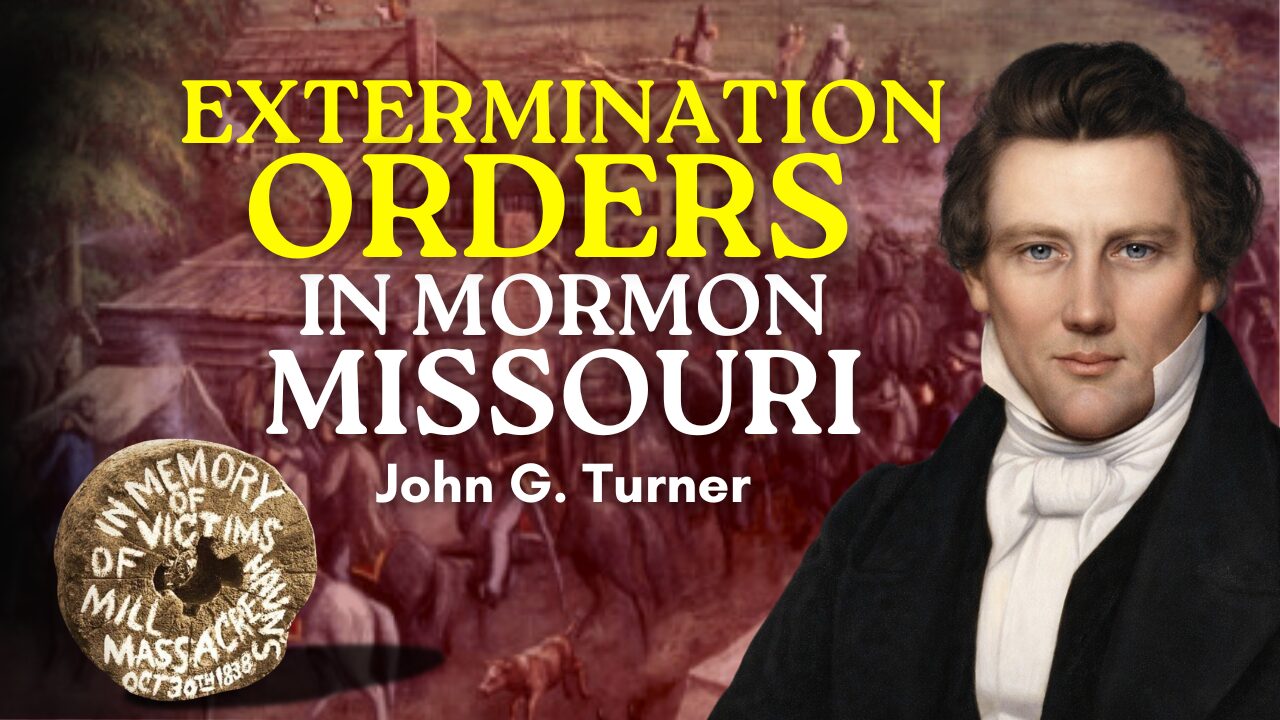
Thumbnail Credits: Main image of Joseph Smith by Unknown painter, from Community of Christ Archives (public domain); Background image of Haun’s Mill Massacre by C. C. A. Christensen (public domain); Image of millstone by George E. Anderson (public domain)
Originally published on mormonstories.org.
Transcript
Machine-generated and lightly edited. Click any timestamp to jump the audio to that moment. The audio is authoritative; please check it before quoting.
Introduction and Episode Overview
John Dehlin Hello everyone, and welcome to another edition of the Joseph Smith Podcast, brought to you by Mormon Stories Podcast. I am your host for today, John Dehlin. It is November 19, 2025, and today we are on the second half of chapter 19 of this very important book, Joseph Smith and the Rise and Fall of an American Prophet by Dr. John Turner. Last episode we covered the Danites, or as John Turner likes to pronounce them, the day nights. Is that right?
John Turner It probably is day nights. I. I have noticed in several comments that my failure to pronounce things correctly is sometimes addressed. And I am a lifelong learner, so I'm here to try to do better.
John Dehlin You know, it's Zion, not Zion, right?
John Turner I'm good on that one.
John Dehlin Okay. Anyway, we're not picking on you, John Turner. We're grateful for you. Really quickly, I got to shout out my. My buddy Ben Benjamin Halaf. He's been on Mormon Stories podcast. He's a huge Toronto Blue Jays fan. He came on Mormon Stories this year and felt like there might be a correlation between him coming on Mormon Stories and how well the Blue Jays did. So we had a deal where if the Blue Jays won the World Series, he'd send me a hat. And they almost won, but he sent me the hat anyway. So shout out to my Canadian buddy, Ben Benjamin. We love you. Go Blue Jays. Sorry, Dodgers fans. No offense intended. All right, as you know, this is the Joe Smith podcast. This is part 23 in the series. This podcast is available on Spotify, on Apple podcasts, and on YouTube. We've got our own playlist on YouTube under the Mormon Stories Podcast channel. And so you can enjoy this podcast as a series or integrated into the Mormon Stories podcast feed. We're doing our best to bring on a world expert in Joseph Smith who has never been lds. And we're bringing as much facts and as much objectivity as we can. And we're AB and John Turner call balls and strikes, but mostly just tell us the stuff as Mormons and Latter Day Saints that we never learned in Sunday School. So again, last week we left off. Do you want to tell us where we left off last week, John Turner?
The Danites and Their Role in Missouri
John Turner Sure. Good to be back, John. So last week we talked about the establishment of the Danites. This secret society of individuals who swore their loyalty to Joseph Smith and to the Church's first Presidency, who tried to kind of put the brakes on dissent within the church. Sort of originated by driving some recently ex communications communicated individuals out of Far West. We talked about the sort of the general mood of Mormon settlement in Missouri by the early summer of 1838, which was, in short, we've been driven from our homes in the past. We declare that mobs will not molest us, molest us in the future. And unfortunately, that proved, you know, you could, you could be publicly defiant, but the Saints had determined and ultimately well organized and numerous enemies in Missouri. And that's the subject of our conversation today.
John Dehlin And all of. And Joseph and Emma's arrival in Missouri comes on the heels of the Kirtland bank scandal and the Fanny Alger adultery scandal or affair scandal. Sidney Rigdon, you know, a lot of these figures that we associate with the early church. We're spending a lot of time in Kirtland, but because Kirtland imploded, we've got this incursion of Latter Day Saints into Missouri because Kirtland imploded. So that's also an important dynamic that precedes today's episode. So I think one major theme for today for me is political machinations, if that's. If that's a word. So why don't you tell us the political difficulties that the Saints and Joseph Smith got into in Missouri?
Political Landscape of Missouri in 1838
John Turner Sure. Well, and maybe, if I may, John, I would. I would frame this around sort of two important themes. And I think there's a little bit of a struggle. And you alluded to this last week. There's a little bit of a struggle for anyone examining this history in that it's pretty complex. The Mormons have a number of different settlements in Missouri. They're in a number of different counties. There's a lot of places and people to keep track of. So if we know, if we kind of cut through some of that detail and think about key takeaways from 1838, the Mormon experience in Missouri, I would point to two things at the outset. Number one, there wasn't any place in Missouri for the kind of settlements that Joseph Smith and the Mormons intended to create. They envisioned, you know, publicly politically engaged settlements, Zion communities that were based on the. The principle of gathering that very much alarmed any non Mormon settlers in the region. So wherever the Mormons began to gather, they stoked opposition just on the basis of their presence and the way that they gathered. So that's number one. And then number two is we can talk about Joseph's response and we will talk about Joseph's response to the challenges that the church encounters and sometimes creates in Missouri. At the end of the day, the Mormons are they. They suffer bitter, persistent and fierce persecution and they take it on the chin and they Suffer. You have settlers who are killed. You have homes that are pillaged. You have women who are raped. Ultimately, you have, you know, thousands of people who are expelled. So I don't want to. I don't want to lose sight of that basic dynamic. I think Joseph, he's sort of a new arrival. He's made a couple of quick trips to Missouri previously. Now he's on the ground. He's trying to deal with the challenges that his people have been dealing with for seven years. There aren't any good solutions. He tries retreat, he tries fight back. He tries political alliances. In the end, nothing works.
John Dehlin Thank you for setting that context. That's really valuable. And again, we have to, you know, if, if we have criticisms of Joseph Smith or early Mormonism, we also have to just never excuse mob violence as, as justifiable. And, you know, in my opinion, and sometimes when we're feeling frustrated or angry at maybe at things we weren't taught, we have to check ourselves because never does someone deserve to be pillaged and, and, and murdered and driven, you know, from their homes. So. Yeah. All right, well, John Turner, give us a quick understanding of what the two political parties were in the day, because I think there's probably some listeners who, who think there's always been Democrats and Republicans. No, I'm just kidding, but sure. Tell us the basic political structures in Missouri and the election dynamics that were going on in 38.
John Turner Well, there. There were Democrats, so. And often simply referred to as the democracy. So the Democratic Party, which in the 1830s, even though Martin Van Buren is now the president, it's still very much, in a way the party of Andrew Jackson, generally quite popular on, on the frontier. Then there's also the Whig Party. So that's the, that's the second party, the Whigs. They tend to favor a more active national government with internal improvements. They tend to be a bit more moralistic and associated with Protestant churches who favor things like stricter observance of the Sabbath. Joseph Smith, for reasons that actually aren't entirely clear, he favored the democracy, the Democrats, and actually church leaders. And this is an election year, 1838. Church leaders remind the saints that their. The politics of this, this church are that of the democracy. So we support the Democratic Party and this is a big deal. As we head into the 1838 election, there are candidates for Congress and other offices who come to far west and seek Mormon votes.
John Dehlin And we talked about the number of Mormons in Missouri being, I think, estimated at somewhere between 8 and 10,000. If I remember right, Is that enough of a swing vote to determine an election in Missouri at the time?
John Turner So not in the state as a whole? Most likely it's not a presidential election in 1838. I am trying to remember if there was a gubernatorial election that year or not. But locally, the Saints do have the power to swing elections. So in Davies county, which is north of Far west, church members are maybe about a third of eligible voters. So you have, you know, you have local candidates who are concerned about the Mormon vote. I can't remember what percentage of the congressional district church members comprised, but they were enough that candidates for a House seat in Congress were also concerned to secure Mormon votes.
The Gallatin Election Riot and Its Aftermath
John Dehlin All right, well, should we talk about White and Penniston? Are those the. Are those the fellows to talk about?
John Turner Sure. So. Well, I think the. The, yes. And I think as particularly as it relates to the election that was held across the state on August 6th of 1838. So on that day, Joseph gets word that. That church members had been killed in Gallatin, which is the. The county seat in Davies County. And apparently the individual who fomented the violence was a candidate for the House named William Peniston. He was a Whig, and apparently he had supported earlier efforts to expel the Saints from Davies County. So he was sort of a known anti Mormon. Nevertheless, as he began his campaign for a House seat, he had approached Lyman White, who lived in Davies county, asked for his endorsement. White turned him down because of his, you know, first and foremost, because his. Because of his past anti Mormon statements, probably also because he was a Whig. So when the election took place, Penniston apparently had climbed atop a barrel, which is the sort of thing a local politician did in 1838. He had denounced the Mormons. He had proclaimed that they had no more right to vote than the N word. And a fight broke out. Really not clear exactly what started it, but those were sort of fighting words. Perhaps an anti Mormon struck one of the church members who had showed up to vote, and a brawl broke out. The Mormons apparently fought back effectively, and Joseph Smith gets word that a few church members have been killed. Turns out not to be true, but fog of war. Fog of war. Fog of politics and war, I think you could say.
John Dehlin And I. That's a curious thing to do on. I don't know if it was exactly election day for Penniston, but why in the world would you want to further alienate potential voters during election time? That doesn't seem super smart.
John Turner Well, true, but I think Penniston's calculation is church members are Going to vote for the Democrat. And so if I can stop the Mormons from voting, I have a greater chance to win.
John Dehlin So by standing on a barrel, decrying a group of people that are less likely to vote.
John Turner Well, the, the point is he wants. He wants essentially a mob to stop church members.
John Dehlin Oh, it's like voter intimidation.
John Turner Voter intimidation. And. Absolutely.
John Dehlin Okay. Because you can also motivate people to be more likely to vote to make sure that guy doesn't win.
John Turner Yeah. Okay, so the mob. Right. The point was to drive them away from the. The polling place. I'm pretty sure it doesn't work. I think he loses the election anyway.
John Dehlin Okay. So it backfires, but there's a brawl. What does Joseph do when he. When he learns that allegedly some of the Saints had been killed?
John Turner So Joseph rushes to Lyman White's house. So he comes from far west to Davies County. Now, what the Mormons choose to do is they go to the house of a man named Adam Black, who's a Davies county justice of the Peace who lives near what church members call Adam on Diamond, or diamond. And so there had been some rumors that Adam Black had been supporting the formation of a mob to drive out Mormon settlers. So a group of church members went to Black's house. They asked him to sign a statement promising that he would uphold the law. Black refused. And, you know, they have words with each other. And then Joseph and a larger group of Mormon men returned to Black's house. And he ends up being invited inside, has essentially a chit chat with Adam Black and apparently Adam Black's wife as well. Black, in the end, wrote a statement of his own, signed it, gave it to Joseph, essentially promising to uphold peace in the county. It's a pretty curious episode because getting this guy and in the end, a few other officials to sign statements sort of pledging peace and law and order, it's not really very worthwhile. And essentially what Joseph has just participated in is, you know, sort of an act of intimidation against a Davies county official. And even though he signed the statement when Joseph and the other men were there, he wasn't going to become their friend because of this sort of action. And so after the Mormon sleeve, Black signed an affidavit in which he alleged that, you know, 100 armed Mormons came to my house to intimidate me. Essentially accuses the Mormons of engaging in a mob action against him. And that persuades a judge to issue a warrant for the arrest of Joseph Smith and Lyman White on charges of rioting.
John Dehlin Wow. Yeah. And if I'm thinking about a modern analog just in 2025. And this isn't being partisan. I'm just trying to be descriptive of what's going on. I believe the Republicans in Utah are trying to redistrict the congressional voting districts to some would call it gerrymandering, but to try and make it more favorable for all four potential House seats to remain Republican. And there's this judge in Utah who is rejected, I think, on multiple occasions, the attempts at gerrymandering. I'm just trying to imagine 100 armed, you know, Republicans showing up at the doorstep of a, of a Utah judge, district court judge, making them sign anything. I mean, that, that would be outrageous if it happened today. So I don't know if it is any less outrageous because it's over 100 years ago, but that seems deeply problematic. The other thing that's deeply problematic, I, I, we forgot to mention, or at least I forgot to mention that in that brawl, in that election day brawl that we just mentioned, there were some Danites involved. So to tie in the previous episode, this group that made solemn covenants to protect the Saints by any means necessary, there were some skulls that were cracked by the Mormons who were Danites. Is that right?
John Turner That's correct. According to John Loeb Butler, who was a church member and a member of the Danites. And his recollection is that he saw one of his, one or more of his fellow Danites get hit by anti Mormons. And in his recollection, he remembered the covenants that he had made to defend his fellow Danites. And so he grabs a stick and he starts fighting back. He, he claims he was really good at fighting back too, that his opponents fell as dead men. They weren't dead, but there were some cracked skulls and some serious injuries on both, both sides.
John Dehlin And, and so first of all, I just have to ask. Patrick Mason suggests, and I haven't vetted, but he, I trust him, suggest that any revelation given by God as it relates to the Missourians pretty much says, peace, peace, be peaceful, be peaceful, don't be violent. Would the Danites be technically operating against God's revelations through Joseph Smith that end up in the Doctrine and Covenants? Because it seems like God was, according to Patrick Mason, God was pretty clear to Joseph Smith that peace was the only path in Missouri. Or am I either misinterpreting Patrick Mason or is he oversimplifying what God said about the Missouri Saints?
John Turner So I'm trying to remember the particulars of the revelation that includes the phrase Proclaim peace. My recollection is that, and maybe other revelations, they say that one should make repeated efforts to seek peace. They don't say that under no circumstances can you resist evil, or under no circumstances can you ever fight back. I think if you follow the logic of Joseph Smith and Sidney Rigdon in 1838, this is the way they're assessing the situation. Our people were driven from Jackson County. Our people were driven from Clay County. Now people are organizing to drive us again, and we're not going to be driven again. We're going to defend ourselves. Now, I think the problem for Joseph Smith is there's, you know, there. There's an outrage against his people on election Day, Penniston and his supporters try to prevent them from voting. That's, you know, that's. That's outrageous. So what's an appropriate response? Well, there might not be any effective recourse. Probably you would. You'd want to find a justice of the peace. You would want to get a warrant for Penniston's arrest, and then there'd be a hearing and a charge. Well, I think Joseph doesn't have any confidence that local officials are going to hold Penniston to account, so he tries to intimidate them, and, of course, it totally backfires because you can't take a mob to a Justice of the Peace's house and intimidate him into upholding the law. And so Joseph immediately, by doing that, he puts himself in the legal crosshairs. He's got to answer this charge of rioting. Fortunately, he gets some good legal representation that's able to be kind of sorted out and sort of kicked down the road for a couple of months. But now anti Mormons in Davies county, you know, this has been, you know, fuel on the fire, really. You know, they become more outraged against the Mormons, begin organizing themselves to take action against the. Against the Mormons and maybe drive them out.
John Dehlin Is it pretty safe to assume that some of the Danites, and maybe even some of the Danites who were involved in that violence on election day were amongst the group that shows up at Judge Black's house?
John Turner Quite possible, because, I mean, that would
John Dehlin add to the intimidation, right?
John Turner Yeah. I mean, I think ultimately there are, I don't know, 15 or 20 men who in some way are charged for having participated in going to Black's house. But I don't know. I'm not exactly sure other than John Low Butler, who was in the election day brawl. But, yeah, there's probably some crossover.
John Dehlin And I have to read at least a sentence or two from that exchange. It says in your book, in the middle of 212, it says, black. The judge. Judge Black warned them not to spread lies about him. And then it says, quote, you mob. You black son of a. Close quote. A Mormon man responded, quote, shut your head or I'll cut it off. Close quote. And then Black ordered the men to get off his land. That's a death threat. That's not just like, sign this piece of paper. That sounds like a death threat.
John Turner Yeah. Let's just say it wasn't a productive conversation.
John Dehlin Okay. All right, so. So what happens next?
John Turner So in terms of that, you know, legal outcome, as I said, Joseph gets some good lawyers. David Atchison, Alexander Doniphan. The latter is in particular known to people who study early church history as someone who is a sympathetic defender of the church. Ultimately, Joseph and Lyman White post bond. They promised to appear before a circuit court in a couple of months. The problem for the Saints is by this point, there's organized opposition to them in both Davies county and then to the east in Carroll County. And I think we should talk about what transpires in Carroll county next. This is. This is perhaps less well known to those who know something about the Missouri Mormon War, but it sort of sets the stage for what happens next. So everything happens pretty quickly. Joseph orchestrated the purchase of land for Mormon settlement in the township of DeWitt in Carroll county back in June of 1838. Non Mormons are not pleased about this development. And almost immediately, they organize themselves and hold meetings and issue statements demanding that the Mormons leave. And by September, mobs form in Carroll county to demand that the Saints clear out. It's maybe about a hundred members of an armed mob. And they tell church leaders in DeWitt that if they're not gone by October 1, they face extermination without regard to age or sex. And we're going to destroy your property. So this is. This is pretty serious. Pretty quickly, the Saints ask the governor of Missouri, Lilburn Boggs, to disperse the mob, essentially to send militia, state militia, to disperse the mob. Boggs doesn't even send a response, so he's. He's not interested in intervening. There's some effort at negotiation. There are some state militia on the scene. Ultimately, the Saints agree to leave. They decide not to fight. They. They do exactly what those revelations you're alluding to suggests they. They should do.
The Siege of DeWitt and Carroll County Conflict
John Dehlin So.
John Turner So in the end, several hundred Mormons abandoned De Witt and head back to Far West. You know, there's some talk during These negotiations that the Saints will get compensation for their property, you won't be shocked to learn that they never do.
John Dehlin Tell me. I'll draw on your. Your knowledge of American history in the 19th century. Other than Native Americans obviously being displaced in mass, are there other examples of, you know, one. One group of people in a. In a, let's just say, US county, basically declaring that another group of people, and let's just say whites, for the sake of trying to find an analog need to abandon their homes and get out? I. It's probably impossible for you to know across all states and all counties across, you know, a century, but do you have any idea of whether this was super rare, kind of rare, relatively common, or super common?
John Turner Yeah, so that's a great question. I think I probably could find some examples of free black settlers being driven out of particular locales in the 19th century. I'm sure that's the case later in the century. That's definitely the case. So after the Civil War, there are instances in which black farmers are driven off of their land and forced to clear out. There are some instances of Jews in the American south being driven. Driven out of communities. I do think the Native American example is the most pertinent, though, in this context, partly because you can find examples of groups such as the Delaware that are repeatedly driven from place to place. And there are some Mormon settlers in the 1830s and 1840s who are repeatedly driven from their homes and that sort of series of expulsions. I think you'd be hard pressed to find another parallel other than the Native American examples.
John Dehlin Wow. Okay. So this is really kind of exceptional. Lilburn Boggs is a name that pretty much every Mormon will. Will have been raised to know because eventually he signs an actual extermination order. I don't mean to get ahead of ourselves, but I wanted to look up when he became governor really quick. And it looks like it's 1836, so basically two years before. And it looks like he becomes governor because Duncan, the former governor, resigns. Do we know if Duncan's resignation had anything to do with Mormons or. Or what?
John Turner No, he. I think he resigned. He wanted to get out of politics and open up a donut shop, which he called Dunkland Donuts. I'm just kidding.
John Dehlin Dad joke. Judd Turner for the dad joke. Love it. I'm here for it.
John Turner Yeah. And I, you know, I think Boggs, you know, Boggs, at first, mostly like a lot of statewide officials in the 1830s and into Illinois in the 1840s, they. They they don't really want to engage in conflict between the Mormons and other settlers. Boggs does. I think, you know, he does have suspicions about the Mormons. He hear rumor. He hears rumors that they're fomenting an Indian uprising. So I think from the start, he's pretty cool toward them, certainly not interested in intervening on their behalf.
John Dehlin Okay, thanks for that. Certainly, he becomes one of the most hated enemies of all time of the Church. All right, so where do we go next?
John Turner So the saints abandon DeWitt. And so at that point, attention shifts elsewhere. So just to recap, the main place of Mormon settlement is now far west in Caldwell County. The Saints also have settlements in diamond, in Davies county, and, you know, elsewhere in Davies County. And the retreat from DeWitt, it emboldens the enemies of the Mormons. So basically, mobs have forced the Saints to clear out of one county. So a lot of people are now thinking, you know, let's finish the job. Let's.
John Dehlin Well, I guess Jackson technically, too, right?
John Turner Jackson, Jackson and clay. But for 1838, you know, the. The anti Mormons, they now have a sense of momentum. Joseph, on the other hand, he immediately pivots to defending Diamond. And, you know, he makes a bit of a distinction. He's declared that that is a Stake of Zion. And so it has a sacred significance that DeWitt didn't have. And so Joseph, essentially, before a church meeting in Far west, he preaches what I would characterize as a war sermon. He wants his people to get ready to defend their remaining settlements. And it's pretty blunt. He insists that everybody really needs to fall in line. He even says that those who are not willing to fight the mob should have their property taken to support those who would. And so he tells his people to turn out and be ready, be ready to fight. And there's another then sort of almost, you could say almost, a war meeting on October 15, 1838. And Joseph's message, it's pretty serious. He notes that the Saints have appealed to Governor Boggs for help. They've appealed to militia officers for help. They've looked to anyone who might be willing to help them, and it's been fruitless. All our mobile, Joseph declared. The governor is mob. The militia is mob. The whole state is mob. And so church members have to defend themselves. We have yielded to the mob and DeWitt, Joseph told the crowd, but I'm determined that we will not give another foot. And Joseph's next strategy is the opposite of what he employed in Carroll County. He now wants to take the fight to the enemy to clear the mob out from Davies county in particular. And so that essentially leads to some offensive operations against the church's enemies.
John Dehlin Okay, really quickly. I don't know if I'm behind her ahead exactly, but on. At the bottom of 2013, there's a hearing. Did. Is that the hearing you already referred to?
John Turner It is.
John Dehlin Okay. Okay. So the legal stuff, Joseph's not necessarily a vigilante. You said it was just delayed for a couple months. Is that right? Final.
John Turner Okay, but now if. If you flip a little. Little. A few pages ahead, John, what Joseph does in mid October is he authorizes raids against non Mormon communities in Davies County. And so the Saints essentially take to the field and they drive out non Mormons from several communities. They pillage stores, they burn homes. They essentially take plunder and bring it back to Diamond. And that operation, in military terms, it's successful. The Saints drive non Mormons out of Davies county. And it's essentially at Joseph's. You know, it's essentially at Joseph's orders.
John Dehlin You mentioned. You mentioned that someone, I think, within the Mormons ordered a shipment of Jaeger. Is it jogger or Jaeger? Jaeger. Rifles.
John Turner Jaeger. I don't know how Americans pronounce it.
John Dehlin So, like, Missourians intercept a shipment of rifles I presume, are ordered by Joseph Smith. Is that fair?
John Turner So it's actually the other way around. So it's. So when I. It's a Caldwell county militia that intercepts these rifles.
John Dehlin Who ordered them, though?
John Turner What's that?
John Dehlin Who ordered the. The rifles?
John Turner Well, apparently they're being sent to the mob in Davies County.
John Dehlin The non Mormon mob.
John Turner Correct, the non Mormon mob.
John Dehlin And so who gets the rifles?
John Turner The Mormons? I don't know. I don't know if they ever use them, but they.
John Dehlin I misread it. So rifles are being sent to anti Mormon mobsters and the Mormons intercept the rifles.
John Turner Correct.
John Dehlin That's going to cause some stress.
John Turner Yeah. I mean, as you can see, everything really quickly spirals out of control. So, you know, to sort of recap, there'd been this election day brawl in early August. By September, there's this standoff in DeWitt. The Mormons abandoned DeWitt by the end of September, and then by mid October, the Mormons are undertaking offensive military operations against the mob, Davies County.
John Dehlin Okay. Yeah. One of the questions that I wrote before we get to the Mormon violence is, wouldn't this have been an amazing time for Joseph Smith to pack up all the Saints and just leave Missouri? In other words, if. If, you know, for someone who would want Joseph Smith to be a prophet who communicates with God, who could keep his people safe and foresee the future? It seems like once. Once Boggs doesn't respond. They've been driven out of a couple of counties and, you know, a prophet might have a chance to see the writing on the wall of how this is likely going to end for the Latter Day Saints in Missouri. Is it fair to say that that was. There was a moment in 1838 where Joseph could have said, it's, I hate to do this, I hate to turn tail, but it's probably going to get worse. So maybe we should just find a new place. Maybe go to Utah, maybe go to Texas, but, like, probably not stay and fight. Would that have. Was there a place for that sort of revelation possibly to be received?
Should the Saints Have Stayed or Left Missouri?
John Turner Well, sure. I mean, I think ultimately the Saints organize an exodus from Missouri when they're forced to do so and do the same from Nauvoo in 1846. I think there are reasons, though, to understand why Joseph and church leaders don't do that. I mean, nobody just wants to be driven from their homes. And it's asking a lot of people and a prophet to simply pack up and leave whenever they encounter opposition. I agree. The writing. The writing is definitely on the wall. I mean, Joseph, by this time, he's sort of seen this play before. And the ending's always bad.
John Dehlin Yeah. Like when I just, as someone who's tried to study a little bit about emerging religions, whether it's David Koresh or Warren Jeffs or Jim Jones, like, if a new. If a new religion starts to make a surrounding population uncomfortable, but there's too much conflict, it often ends apocalyptically for the emerging religion. And so I'm starting to feel like if I don't know the ending, as I'm reading your book, I'm starting to feel David Koresh, Jim Jones like endings for the Saints. And so my newly reading self is sort of saying, Joseph, just take it and run, because it's going to get bad if you stick around. But obviously he doesn't do that. When you talk about Joseph Smith and an extermination, like, obviously the Mormon narrative is nothing about Joseph Smith and the Saints ever initiating violence. It's the governor Boggs issued an exterminating order against Mormons. It sounds like before Boggs issued an extermination order, it almost sounds like Joseph Smith issued an extermination order against Missourians. Is that not a fair conclusion? Because that's what I wrote as I was reading and it's not the history I understood, but I also don't want to over interpret what, what I'm reading from you, John Turner.
John Turner So I think I would just parse that a little bit differently. Before Boggs issues his extermination order, Joseph has himself ordered some offensive military operations against the mob. Joseph doesn't talk even of exterminating non Mormons. And ultimately there, there are some casualties on both sides. But the Mormon operation in Davies, Davies county, it drives out non Mormon settlers and Mormon vigilantes plunder the homes of their enemies. They are not going around, you know, killing non Mormon settlers. So I do think there is a distinction to be made there. I wouldn't say that it's a parallel.
John Dehlin So it's not an extermination order, but it sounds like Joseph. I think it's really important to say Joseph threatens the Latter Day Saints, that if you don't join the fight, you're going to have your property taken.
John Turner Yep.
John Dehlin Like he's not, he's basically conscripting the Saints into a war after a war sermon and threatening them that they'll lose their land if they don't take up arms. Yeah, and that's not. Mormons teach a victim, a purely victim narrative. They don't teach that it was mutual escalation, including violence, aggressive, offensive violence on our part. I don't mean to belabor that point, but war sermon Mormons are never taught that Joseph delivers a war sermon threatening his own members that if they don't take up arms they'll lose their land. That's pretty shocking. John Turner.
John Turner It is shocking. I mean, well, I mean, I think what I see is throughout this whole year, Joseph is grasping for a solution. Some of the things he tries are super provocative and even disturbing. You know, and I think once, once this, once the situation in Missouri descends into conflict, things do get, they get dangerous really quickly. I do think that, you know, with the benefit of hindsight, there, there would have, I don't know if there were any other options besides clearing out as you suggested. It probably would have been a very good idea for Joseph to have done anything he could to have, to have avoided giving political provocation. I mean, I don't think it was necessary for church leaders to trumpet their support for the Democratic Party. And you know, in advance of the election, if, you know, you're likely to encounter opposition from non Mormon settlers, maybe take greater pains as you're establishing Mormon settlers to try to establish good terms with non Mormons. I think in the end though, everybody Else in western Missouri simply objected to the presence of large numbers of Mormons. And I think by 1838, there wasn't much that Joseph or the Saints could do about that, about that dynamic. And then when they encountered persecution, their options are basically take it clear out, fight back. None of those are good options. And fighting back, ultimately, I agree it's the worst of those options, especially because we talk about 8 or 10,000 Mormon settlers. Mormons are still massively outnumbered in western Missouri. And when they engage in any kind of offensive operation, when they fight back, I mean, that just kicks everything up to, you know, 11 out of 10 in terms of opposition to them.
John Dehlin Well, it's a fair point that there's no good option for the Saints, but there is the least bad option. And I think violence is not only the least bad option, obviously with hindsight, but also it's the most Christlike option. Because doesn't Jesus say in the New Testament, forgive your enemies, turn the other cheek, forgive them 70 times seven. So like, if they're really studying, I don't, I don't mean to be judgmental, I, I, But I am interested when Christians sort of conveniently ignored literally Jesus's advice when it comes to enemies. And Jesus is saying forgive 70 times 7. Now, maybe, maybe in their minds they had had more than 490 offenses by the Missourians towards them, but like Jesus did give a little bit of a playbook here. And I was going to make another point, but I guess I want to give you a chance to respond to that. Or I could just make the final point.
John Turner Well, you make the final point and then I'll respond.
John Dehlin Okay. Yeah, because what I read is shocking. Because what I read is, you know, and this is at the top of page 217, the saints pillaged, they plundered, they burned, they pillaged stores, burned homes and other buildings, captured a cannon, they plundered. And then, and then they burned outlying. Sorry, some fought back and burned Latter Day Saint Holmes. But ultimately it was a rout. And John Smith wrote, quote, we have driven most of the enemy out of the county. And then it says, someone else wrote, at this time there is not a citizen in Davies except Mormons. That sounds a lot like an extermination. You know, that, that's, and I just don't know how Jesus, how Christians are justifying an extermination order. And again, I'm just going to say the church doesn't ever teach its members that the Missourians enacted their own extermination order in effect.
Boggs's Extermination Order and Its Context
John Turner Well, I mean, yes, so, I mean, I get your point. So you're, you're comparing it because it's basically clear out or be exterminated. You know, I don't know that the, I mean, I wouldn't, I wouldn't call it an extermination campaign. It's, it's sort of an expulsion and theft operation. Definitely bad. And I don't, I don't mean to, I don't mean to split hairs.
John Dehlin I think that expulsion versus extermination, I guess there's a meaningful difference there. But when there's no one left, no non Mormons left in the county, right?
John Turner I mean, yeah, they drive, they drive them out. I think this is the way I, I do feel that, you know, it's hard for me on some level though not to be sympathetic to the Saints in this scenario. Not in the sense of it's okay to pillage and burn people's homes, because of course it's not. But I don't think Joseph is incorrect when he points out that his people have sought help from the governor, from, from state militia officers. And there's this mob, there's this, you know, these anti Mormons are trying to drive us out. So we're going to drive them out. I mean, of course, I get it.
John Dehlin Except for the Christ part.
John Turner Yeah, no, I get it. I think the, the only thing I'd say partly in defense of the Mormons here is that in general, I think we, we wouldn't normally tell oppressed people that they shouldn't fight back, you know, that they should just take it. You know, if we were, if we were talking about Native Americans or Black Americans who are suffering oppression and chose to fight back, I think our instinct would be to be sympathetic with Mormons. You know, there's just, I think there's less built in sympathy, but I get, I get Joseph's complaint about oppression and a failure to receive help from elected officials, judges, militia officers. So I don't think the first choice here is to pillage and plunder and to burn homes. However, I agree. At the same time, if you step back and you look at the broader dynamics, what are the odds the Mormons can drive out their enemies from Davies County? And that's going to solve the problem, you know, there, you know, what are the odds? There aren't going to be severe repercussions from this? Those are really long odds. Everybody else in Missouri is not going to just say, oh, the Mormons are defending themselves, we better leave them alone. It's going to be entirely the opposite.
John Dehlin Now, from a human standpoint and a historian standpoint, John Turner, your response makes all the sense in the world. There's one aspect that I know I'm kind of belaboring, but I do think it's really important and I think it's come up before and I think it'll come up again in my mind. There's a difference when, number one, your church is named after Jesus Christ. Number two, you claim that your prophet literally talks to Jesus. Right. And it just so happens that Jesus. I'm not aware of Jesus ever saying, take up your arms and fight the government that comes after you. Maybe I haven't read that part of the New Testament, but it just seems like Jesus is pretty clear about what to do with your enemies, forgive them 70 times 7, turn the other cheek. And so I think it's fair to say if you're going to name your church after Jesus Christ and claim that your prophet literally has visits from Jesus and talks to him on multiple occasions, that you're likely going to make decisions as a prophet that seem to conform with all of Jesus's advice around enemies, including the peaceful ones that come up in the Doctrine and Covenants. So I think there's a. It's fair to give a higher expectation of Joseph than. Just like any other church that might be discriminated against in the 19th century in America. I, I'm sorry, I belabored that point. You don't even have to answer it. But I had to voice it because I think it's different when you claim to talk to Jesus. I just think it's. There's a different standard that, that is fairly applied.
John Turner Yeah, well, I'll. I guess I would. My first response is to quip it's a shame that Jesus wasn't more forthcoming with either political or military advice in 1838. Maybe, maybe Joseph was reading the Gospel of Matthew. I have not come to bring peace, but a sword got a little sideways. Should have stuck with the Sermon on the Mount. So I agree with you in the sense of what should a Christian leader have done in this circumstance? Because violence. I'm not going to say that historically violence never brings about good outcomes, because that wouldn't be true. But a persecuted minority usually struggles to better its situation through violence. And, you know, so, I mean, I don't disagree that Joseph should have found, should have searched for any solution other than authoring, authorizing violence, even just in the form. And I don't just mean killing people. Although we'll talk about another Operation in a minute. This is a distinctly. Even if understandable, it is an unwise decision.
John Dehlin Yeah. Okay, let's move. I've mentioned Thomas Marsh in the past. There's your book mentions. I mean, I guess I can say there are some Latter Day Saints who kind of might be feeling what I'm trying to express now, might have been feeling then what I'm trying to express now. And I believe one of them was Thomas Marsh. Let's take a second. John. John Turner, are you, are you aware of like the common narrative that the Mormon Church has given to the Latter Day Saints about Thomas Marsh's disaffection from the church?
Thomas Marsh, Oliver Granger, and Defections from the Faith
John Turner Yeah, I'm trying to refresh my memory. It's about something rather petty. I don't know if it's like milk curds or something like that.
John Dehlin Yeah, milk strippings. Yeah. So basically we're taught that growing up there was always this lesson. Oh, people leave the church and they often leave for petty reasons. Once upon a time there was this leader in the church named Thomas Marsh and his wife got into a fight with some other woman about some milk and who got the cream and who didn't get the cream. And Thomas Marsh, poor guy, gave up his salvation over a petty dispute around milk strippings with his wife. You know, is that, is that what happened with Thomas Marsh? And more importantly, what did happen to Thomas Marsh at this moment in the story?
John Turner So I forget exactly how that story originated, but that is not what caused this Thomas Marsh, along with fellow apostle Orson Hyde to break from Joseph in October of 1838. Essentially what happens is Joseph goes to Davies county during these offensive operations. By the time he get. When he gets back to Far west, he learns that Marsh and Hyde have abandoned him and the church. And they sign an affidavit that the biggest complaint I think is Joseph's authorization of these raids on non Mormon settlements. There are other charges or criticisms as well. They criticize the, the Danite Company and they're taking of an oath to support the heads of the church in all things. There's also the suggestion that Joseph and other church leaders have appointed what they call a destruction company that might come and destroy larger non Mormon communities such as Liberty and Richmond. And Marsh and Hyde also claimed that Joseph's overarching plan ultimate goal is to capture the whole state of Missouri and then the whole United States and ultimately the whole world again, as was commonly done in the 1830s and 1840s. They compare Joseph to the Prophet Muhammad and claim that he is going to unleash a wave of bloody conquest on North America.
John Dehlin John Turner, I don't know if you saw this in the comments. We actually have a Muslim listener who wrote in, we made a reference, I think to Muhammad in a previous episode and he was like, I'm pretty disappointed that Mormon stories and John Turner and John Dehlin are perpetuating a false myth that Muhammad was violent. Because you're basically talking about Muhammad as if he was a violent guy. Do you. And again we're mentioning here that, that Joseph Smith was compared to Muhammad in reference to potential violence. Do, do you have a response about that? Because I, yeah, I wanted to hear if you had a response.
John Turner So I did. I did see the comment.
John Dehlin Yeah.
John Turner I essentially only reporting on the fact that Joseph Smith was sometimes caricatured as an American Muhammad. You know, 19th century Americans who made those sorts of statements were of course not super familiar with, with early the, the early history of Islam. I actually think despite that, and I don't want to get into much of a digression, but it's interesting to me that the Prophet Muhammad and his people, they encounter a long stretch of perspective. Persecution in Mecca in which God counsels them not to fight back, to repel evil with that. Which is better. Wow. Sort of like turn the other cheek. That's a verse in the Quran. When they finally flee Mecca and take refuge and provide leadership in what becomes known as Medina, God's advice actually does change that they, that persecution can be worse than fighting and they are justified in fighting back against their enemies. I do so I mean Muhammad does then become a military leader in the end, you know, there's also, it's also significant that once you, he gains the upper hand, he makes peace with his enemies in Mecca. So very different prophet, very different circumstances. But Americans in the 19th century, you know, people like to make, you know, quick and easy comparisons. And so the specter of Joseph as a pope, which you also get Pope Joseph the first or as a second Muhammad, you know, that's a way for Americans to make sense of something they don't like.
John Dehlin Well, shout out to our Muslim and Jewish and secular and Catholic and all our listeners. It's super fun to know that we have Muslims and even Muslims and Jews listening to our podcast. Thanks for reaching out. Hope that was clarifying. Okay, so going back really quickly to Thomas Marsh and Orson Hyde, they signed this affidavit, as you mentioned, claiming that the day nights, you know, are basically creating a destruction company that are going to raise various towns. That's. And even claiming that this phrase is being bantered about Joe Smith or the sword. What it reminds me of is it's, it's almost like a foreshadowing of the William Law Nauvoo expositor debacle where, where someone really, really close to the prophet sort of goes public and gives away sort of inner, inner conversations and inner plans. And I guess I want to ask, is it fair to say that Joseph Smith was truly speaking in terms of sort of like king, like almost treasonous type language and violent language? Do you think, do you have a way to call balls and strikes in terms of whether Marsh and Hyde were deceiving or trumping up or exaggerating what was really being discussed and planned within the Danite slash Mormon circles? Or were they accurately reporting plans of violence and megalomania on Joseph Smith's part? And if so, that's pretty disturbing if those were things Joseph Smith was planning with the Danites. What's your, what's your call in terms of balls and strikes on Thomas, Marsh and Hyde?
John Turner You know, it just. Your talk of balls and strikes makes me wish that historians had instant replay for, you know, to, to try to sort everything out.
John Dehlin I am wearing a baseball cap, by the way.
John Turner Yeah. So, I mean, Martian Hyde, they're correct that Joseph authorized these offensive raids. They're also correct about the secret society and the oaths of loyalty. So they're correct about that. Now, do I think Joseph Smith had any plans to send destruction companies to Liberty or Richmond or really had a plan to conquer the country and the world? No. Could Joseph had said. Could Joseph have said something along those lines during one of those war sermons? Yeah, he definitely could have, but. But I don't know. I. I mean, I don't know. I don't know why Marsh and Hyde would necessarily need to exaggerate, but it could be their hyperbole, it could be Joseph's hyperbole. The stuff that definitely is true is already disturbing enough, especially as non Mormons get wind of these allegations. So whatever Joseph has said or planned, he's definitely authorized these raids on a number of communities in Davies County. That's a serious escalation. So that in and of itself, I think, is sort of the biggest provocation in October of 1838.
John Dehlin To me, what makes Martian Hyde's allegations believable is that eventually we know that with the Council of 50 in Nauvoo, Joseph Smith was ordained King of the world. So, like, that makes, that makes these claims more believable, right?
John Turner It's. Yeah. I mean, it's true. I mean, if Joseph said anything along those lines, it's still a complete poppycock. I mean, keep in mind this is somebody who's just had to have his people retreat from Carroll County, Missouri. They're not on the cusp of, you know, conquering Missouri, let alone the world.
John Dehlin But Joseph's never been accused of lacking vision, Right. Incompetence.
John Turner That's true. I say he was a very audacious prophet.
John Dehlin Okay, so what happens? I think there's more Mormon violence to come. Is that right?
John Turner So now there's a. There's a bit of a back and forth. So Joseph has authorized these raids in Davies county in response non Mormons to the south of Caldwell County. So from the other direction, they start harassing Mormon settlers who sort of live south of Far west in southernmost Caldwell County. Apparently, they seize a few captives. Some of those captives might have been engaged in some surveillance operations outside of the county. There's all sorts of recriminations back and forth. In response to the taking of those prisoners, church leaders launch essentially what they understand as a counter attack. So the individual who had, whose men had taken those captives was a man named Samuel Bogart. Bogart, who, who was both a Methodist minister, speaking of people who should have been Christlike and also a militia captain. So what church leaders do is they send a company of about 60 men led by Apostle David Padden to attack Bogart's company and to set those Mormon captives free. Free. And Patton's men locate their enemies near the banks of the Crooked river. And Patton leads a charge. And it works, but, you know, they're able to drive off Bogart. But a few Mormons get shot, including David Patton, and Patton ultimately dies of. Of his wounds.
John Dehlin All right, so you. Yeah, you write in the book on page 218 that several were wounded by gunfire. Eight. Eight other saints, including Patton. And then it looks like you write that Joseph Smith tries to heal Patton using his prophetic power and the gift of healing. Right?
John Turner Yeah. So Patton is basically taken away from the field of battle. He's brought back toward Far West. Joseph comes to meet him. He lays his hand on Padden, prays for healing, but Padden succumbs to his injuries. And by the way, if listeners want to read something fun, this is a bit off topic, but the historian Matthew Bowman wrote a sort of famous Journal of Mormon History essay on David Padden's purported encounter with the biblical Cain a few years before his death. Apparently he met a dark and hairy and large man who is sort of either the biblical Cain or maybe the Mormon Bigfoot. So if people are getting tired of violence and persecution, they can investigate the Mormon Bigfoot, believe it or not.
John Dehlin John Turner, of all the things I wasn't taught in my Mormon seminary class in high school growing up, I was taught that a man was riding on a horse and he looked to his right and he saw a man, a hairy black man, Bigfoot looking man, the same height as this man on the horse, as he was sort of trotting his horse through a forest or whatever. Is that the same story?
John Turner That might be the same story there.
John Dehlin The cane was as tall as a man sitting on a horse.
John Turner Basically. Yeah. No, that's. That sounds right. It's been a while since I read Matt's. Matt's essay. You know, there's no shortage of crazy stuff in early Mormon history.
John Dehlin Well, of all the. I just have to say, of all the things my seminary teacher didn't tell me, he really wanted to make sure I do that stuff story because he also taught me about the curse of Cain and the priesthood band being legitimate and a literal, you know, 6,000 year Earth and a literal Adam and Eve and which would have been a literal Cain, et cetera. And by the way, if, if black people are descendants of Cain, why aren't they 10ft tall and hairy? I mean, it doesn't make sense that they're descendants of Cain and he looks like black super tall, giant Bigfoot. And yet that's not how his descendants turned out. But I don't know, maybe you have a good explanation for that, John Turner.
John Turner I cannot help you there. Okay, you're on your own.
John Dehlin Also, I'll just say, I guess I can sympathize with Joseph Smith performing a priesthood blessing that fails because I was taught I had the power as a Mormon priesthood holder to heal the sick. And it never seemed to work in any way that I could discern. So I guess I'm consoled that even the prophet Joseph Smith did a healing that failed, but also that I guess it makes people wonder how real that power actually is. Although you've told us about accounts that he did heal people. And I'll think that there'll be more in Naboo. So that's something maybe to explore at a later date. But yeah. So there are at least two dead. At least two people are dead as a result of, you know, this escalating violence. Is that right?
The Battle of Crooked River
John Turner Sure. So three, including Paddon.
John Dehlin Okay.
John Turner There is both a Mormon and a non Mormon who died in the battle. It's known as the Battle of Crooked River. You know, it's really, you know, I think in military terms you might think of it as a more of a skirmish. Patton, his death actually is pretty significant for the church, you know, for the years to come. He's very much understood as a martyr. He'll come back up again. Actually, when we talk about the origins of baptism for the dead, there's a, you know, there's some things to keep track of. Thomas Marsh. He eventually rejoins the church in Utah, where Brigham Young welcomes him back, but at the price of public humiliation.
John Dehlin Oh, wow. Are we going to cover that or do you want to tell that story now?
John Turner While it's timely, I don't remember the details. I just know that when he, when he rejoins the church, Brigham Young publicly sort of makes a spectacle, spectacle of him at a church meeting. And he's like, you can come back, but I'm going to humiliate you on your way back in. It's kind of, kind of rough.
John Dehlin Yeah. All right. Well, after this battle, again, in my mind I'm writing in the book, this is another opportunity for Joseph to say things are getting gnarly. We probably should follow Christ's admonition, turn the other cheek and maybe run away. But now we've got Hans Mill that's up to bat, to use the baseball metaphor. And we know that that is a tragic. And by the way, having never been taught about the Mountain Meadows Massacre as a Mormon seminary student in high school, I was absolutely taught about Hans Mill, of course, because that fits the narrative of us being victims. So should we go there next?
The Haun's Mill Massacre
John Turner Sure. And you know, I think it is actually interesting to think about what bits of history are remembered and resonate with different people. So the Hans Mill massacre is something that Mormons are familiar with for sure, but it's still grim and chilling. And part of the tragedy is this is a small settlement. It's in eastern Caldwell County. It's near the line of Livingston County. Apparently there had been pretty good relations between settlers there and their, you know, non Mormons in the vicinity. But that all turns source after sort of the outbreak of violence and mobs across Missouri in 1838. It's called Haun's Mill for a church member named Jacob Hahn, who, who owned the mill there. There are around 50 Mormons living in the immediate vicinity. Also, believe it or not, in the midst of all of this violence, there are still Mormon settlers who are moving into Missouri. So you have folks coming into the state, some of which who. Some of which take refuge at Haun's Mill in mid to late October of 1838. So then what happens is there are some mobs from Livingston county who are reinforced by anti Mormons from other places in the state who organized themselves in late October. And there had been some negotiations between the Saints and non Mormons in the vicinity. So the Mormons at Haun's Mill were not expecting any sort of attack. And what happened is on October 30, two or three hundred vigilantes ride into the settlement. Women and children flee into the woods. One woman is actually shot in the hand when she raised her arms to surrender. And while a lot of the women and children are able to get away, about three dozen men and boys, Mormon men and boys take shelter in a small blacksmith shop. And they are surrounded by the mob. And it's an indefensible situation. They at least don't have much in the way of firepower to shoot back. So some of them flee from this little blacksmith shop. A number of them are shot down or captured and they're just grisly scenes. So I'll just mention a couple of instances. A 62 year old man named Thomas McBride was wounded while trying to escape. Then he was captured by vigilantes. He was shot in the chest after he had surrendered. And then someone used a corn cutter to mutilate him as he died. And then when all of the Mormons had surrendered, the vigilantes discover several Mormon boys cowering inside this blacksmith shop. Boys and young men. So there's a 19 year old man named Charles Merrick, he ran outside, the mob shot him, took him a month to die. That must be terrible. And then a young boy, Sardius Smith, not any relation to Joseph smith, he was 10 years old, he didn't try to flee. The mob had already shot his father. One of the vigilantes raised his gun, pointed it at Sardius Smith's head, fired and blew off a portion of his head. And you know, some of the other vigilantes objected. You know, it's just, it's just a boy and damn the difference. Someone responded. Nits make lice, you know, a phrase I think is probably familiar to a lot of listeners. In the end, 17 Mormons were dead. You know, we've been talking a lot about acts of violence on both sides in Missouri of 1838. There's nothing else like this in the Missouri Mormon War where a mob simply comes in and slaughters a large number of people.
John Dehlin And, and I guess I, I have to think about, like, I don't know, the, I mean, obviously the brutality against African slaves. You know, there, there'd be what, tens of thousands of murders or deaths. And then I think about, like the Civil Rights movement, where the church was firebombed and everyone inside died. Like, it's hard to think of. Maybe it's harder. Maybe it's easy to think of instances where mob violence led to the death of so many people in one event. Right, sure.
John Turner So you mentioned the Mountain Meadows Massacre, which is.
John Dehlin Yeah.
John Turner You know, there, there aren't that many examples of, you know, white on white massacres in American history. And that doesn't make it worse. I'm just, you know, it's, it's unusual. It points to the level of, of hostility there, There isn't really a shortage of massacres of Native Americans. And there are, you know, you know, quite a few post Civil War vigilante slaughters of groups of African Americans. You know, one, one thing that strikes me about Hans Mill, and I don't know if this is a provocative statement, but I don't think Netflix would ever make a series about the Hans Mill Massacre. You know, I'm thinking of American Primeval, which I actually found rather gripping about, among other things, the Mountain Meadows Massacre. Now the Mountain Meadows Massacre, it really, you know, in a way, it has a certain resonance in which Mormons are the villains. I think, you know, Americans don't really know what to do with something like Hans Mill. And I'm not suggesting anybody needs to make a miniseries about it. You know, it's a terrible, tragic historical event. But I can understand why some church members, you know, contemporary church members resent the fact that Mormon violence, that seems to be a good subject for books and movies and Netflix series, but anti Mormon violence, nobody, nobody wants to do anything with that.
John Dehlin Yeah, I hope that changes. That is fair. I think there have been multiple movies depicting the, the Mountain Meadows Massacre, and I can't say I think the church has made depictions of the Haunts Mill Massacre. Yeah, I'm probably never made a depiction of the Mountain Meadows Massacre.
John Turner No, it's fair.
John Dehlin That's fair too. But yeah, hopefully that'll change in both directions. How's that?
John Turner I think that's fair for sure.
John Dehlin Obviously, what a horrific event Hans Mill was. You write in the book that the survivors, the dead bodies were stuffed into a nearby well. Imagine throwing dead bodies down a well. Yeah, that's. Anyway, what a horrific culmination of little catastrophes and moderate catastrophes into a massive one. And again, if people are Tired of me saying, should Joseph have, have quit and run earlier? It, it really was in the foreshadowing of knowing that Hans Mill was about to come. If Joseph had, or if God or Jesus had told Joseph to turn and run and to go to Illinois or go to Texas or go to the Utah Territory or whatever earlier, this massacre could have been prevented. And I actually googled like, let's think about the most horrific experiences in 20th century American history. Again, it's David Koresh, it's Marshall Applewhite, and Heaven's Gate, it's Jim Jones. If you think about all the deaths or murders that happened as a result of Joseph Smith's decisions, you could come up with a number of 80 or more. And that's not counting Mountain Meadows. And that's just why I wish if God really was leading the Saints, God and Jesus, I wish they would have, I wish they would have given some revelations that could have prevented this violence earlier. Or maybe God and Jesus did. And as Patrick Mason likes to sort of suggest, Joseph and the Saints ignored God's revelations for peace at their own peril. But either way, if this were to have happened in the 20th or 21st centuries, it seems like the government would have just shut this religion down. Like they would have the FLDS church or the Branch Davidians or Heaven's Gate. Or maybe they wouldn't have because it would have ended in a catastrophe in modern times. I guess this just goes to show how religion can, can quickly become really violent when it's an emerging religion that gets too countercultural too quickly and too big too quickly. New religions are pattern, are kindling for outbreaks of very significant violence. I don't know.
John Turner Yeah, I mean, you know, I mean, I think, you know, I'm rather critical of Joseph at a number of points of his life. And I think in terms of the whole Missouri Mormon experience, Joseph's revelation set things in motion which he doesn't have the foresight to understand and to which there aren't ready solutions. I will say that the main problem in Missouri isn't Mormons being violent. Mormons are sometimes violent and they do sometimes fight back. But, and I'm not saying that their rhetoric is never provocative or they don't have any other provocative actions, but the basic dynamic is starting all the way back in 1832, 1833, non Mormons organize themselves to drive out the Mormons. It happens again and again. And it gets to the point where you have hundreds of non Mormons in Missouri being willing to ride into a Small settlement and slaughter, mostly defenseless people. It's, it's just, it's just really horrible.
John Dehlin Yeah. Yeah. Well, it's a tragic part of our history. It's a tragic event. It's a uniquely tragic moment in US History. If we asterisk it as a white on white act of violence, obviously it pales in comparison of what happened to African slaves and Native Americans, but what a horrific thing. And you go on to write in the immediately following paragraph about Governor Boggs basically issuing his extermination order. Can you clarify whether he knew about Hans Mill before he issues the extermination order or whether that was after he knew about Hans Mill?
John Turner Yeah, so I think it's easy.
John Dehlin And anything else you want to say about the extermination order?
John Turner Yeah, I mean, it's easy to get misled because you think extermination order, which Boggs signs a few days before Hans Mill, and then you have anti Mormons exterminating a group of Mormons. But the sequence is actually like this. So Boggs gets reports of those raids that the Mormons carried out in Davies County. For him, that is evidence that the Mormons have made war upon the people of this state. And at that point, Boggs issues this order. The Mormons must be treated as enemies and must be exterminated or driven from the state. He signs that before Hans Mill, but the order hadn't reached the vigilantes there. So technically the order and the massacre are not connected. What, what, what it does set in motion is you now have a number of militia generals who, on Boggs's instructions, march their units to and toward far west.
John Dehlin Two things like, would it be fair to say that Hans Mill was the type of extermination that Boggs envisioned when he signs an extermination order?
John Turner So, I mean, I don't really want to defend Boggs, but I'd actually say probably, probably not. So, you know, I think usually when people, you know, when you say something like you must be exterminated or driven from the state, what anti Mormons and ultimately Bogs want is for the Mormons to leave. It's like, leave or we're going to kill you, but you want them to leave. And in the end, you know, Boggs and anti Mormons accomplish that objective. I don't think Boggs wants vigilantes to go in and slaughter Mormon boys or, or anything like that. Of course, it's super dangerous rhetoric to use, actually. I think in the end we'll see. It's, it's Sort of effective in the sense that when Joseph sees Boggs's extermination order, he realizes that fighting back is no longer an option.
John Dehlin Okay. And so the next question I had is why was there not national outcry at a sitting governor of a US State literally issuing an extermination order against a religious minority group, given our founding principles? And why didn't the President of the United States send federal troops into Missouri to protect the Mormons in response to this outrageous act by, by a sitting governor?
National Response and Federal Inaction
John Turner So great questions. So I actually don't recall specific national reaction to Boggs's order. I should, I should double check sources on that. It is the case that nationally, a lot of people are sympathetic to the Mormons. In the fall of 1838, and particularly the next year, when there's reporting on the expulsion of the Saints from Missouri in the fall of 1838, there's all sorts of news, which takes days to reach places, about the twists and turns of everything that we've been talking about. For the most part, outside of western Missouri, other Americans are sympathetic. They do understand the Mormons have been unfairly persecuted. That's one reason why the Mormons are initially welcomed in Quincy, Illinois and other parts of Illinois. They are, they are to some extent welcomed as persecuted refugees. In terms of why President Van Buren doesn't intervene, he sees this as a state problem. If the, the state. So if Boggs had requested federal intervention, that might have been a different story. But otherwise, this is a state matter in which national authorities are not going to interfere. Van Buren tells Joseph Smith words to that effect when Joseph goes and meets with him a couple of years later. And repeatedly, other national politicians tell the Mormons the same thing right through 1844.
John Dehlin Yeah, got it. Really quickly you mentioned that eventually Joseph decided he didn't want his people slaughtered and that he wasn't going to keep, you know, trying to match their aggression with, with Latter Day Saint aggression. But you note that there was at least an evening where he's quoted as saying, we will play hell with their apple carts and promising the Saints that angels would fight alongside them.
John Turner Yeah.
John Dehlin And that they spent their night erecting breastworks around the city. And it's, it's, it's a reminder that Joseph's very human. He's very affected by his emotions. And if the wrong historical act would have happened during the time he was feeling more violent, things could have been very different again than after he cools down. So I guess it's fortunate that even though he started with the inclination. Joseph Smith started with the inclination to return more violence in response to the violence of Hans Mill. I guess it's really fortunate that he, some would say chicken out, others would say he backs down. The other thing that I just want to note is this is one of the problems, I believe, with the claim that your church is led by a prophet who speaks to God in this sense is that if you create revelation from God, you're kind of stuck with it. Or if you change it, then it either looks like God changes his mind or you're not really a prophet. Because what I'm realizing is one of the reasons Joseph is just so hesitant to abandon Missouri is because he's produced revelation multiple times promising the Saints that their settlements in Missouri are going to usher the second coming of Jesus. So I can see why that revelation would bind. I'm answering my own question from like 30 minutes ago. I can see why that revelation or those revelations that Joseph Smith receives sort of back Joseph Smith into a corner to feel like he can't abandon Missouri, else he makes God look dumb or he makes himself look like he's not a prophet. And that leads to potentially, like in the case of the priesthood ban and black people in Mormonism, that leads to 150 plus years of racism because you don't want to overturn what Brigham Young did, or in this case led to dozens of deaths and turmoil for the Saints because Joseph was hesitant to want to backtrack on the words of God and Jesus. Is that fair?
Joseph Smith's Surrender and Imprisonment
John Turner So, I mean, I think that is at least partly fair. I'll just say something. It's not sort of directly in response to that, but that's maybe interesting about Joseph's leadership in 1838. If people have been listening to prior episodes of this podcast, they might remember that back in 1831, Joseph's revelations are coming fast and furious. They are really detailed into kind of the nitty gritty, you know, how you should, how and when you should head back to Kirtland from Missouri. Sometimes there's a revelation every other day. Sometimes those revelations change plans. In 1838, there are some revelations earlier in the spring and the summer. But in the midst of these very dramatic events, as as far as I can remember, Joseph doesn't dictate any written revelations. So there is no immediate guidance from the Lord about what the Saints should do. Now that I don't know whether to what extent Joseph felt, you know, the Lord was directing his actions every step of the way. But it's sort of an Interesting thing. When the Saints are facing a really dire situation, I would think that church members would have been both comforted and guided by Revelations, and Joseph is not leading that way at this time.
John Dehlin All right, well, that's good to know. That's good perspective. And again, I don't mean to be unfair to Joseph. I do think the. The Mormon promise or the Mormon doctrine of direct revelation and scripture can sometimes lock the church in to what would otherwise be more prudent decisions. But I also get your point that Joseph was very willing to be flexible and the modern church often is, too.
John Turner Yeah, well, what I would say, John, is that by this point, the end of October, I mean, the situation couldn't be more grim. So Joseph has tried retreating from DeWitt. He's tried fighting back in Davies County. Now you have militia converging on far west. And as I point out in the book, there are only a few hundred armed Mormons. There are thousands of non Mormon militia troops. So if Joseph had chosen to fight back at this point, it would have been a bloodbath. And so he doesn't want to. He doesn't want to surrender and abandon everything in Missouri. And so he does make a show of digging in briefly, but then he correctly sizes up his people's chances and he sends a delegation to meet with militia leaders and ask, you know, basically ask for peace. Ask what the terms are going to be.
John Dehlin Did I read something like to beg like dogs? Is that. Was there language to that effect?
John Turner Yeah, I don't know. That might be from. Might be from John Corll, but essentially, yeah, we've got to sue for peace. And so a delegation that includes, I think, maybe five church members, they go and meet with a militia general named Samuel Lucas. And Lucas obviously knows he's got the upper hand. He shows the Mormon representatives the extermination order. And his terms are that Joseph and other top leaders, church leaders, need to give themselves up to be tried and punished, and everybody else needs to give up their arms and prepare to leave Missouri. Then there's sort of an interesting situation. The Mormon representatives aren't sure whether or not Joseph will agree to those terms. And so they ask for a knight to respond. And General Lucas says, okay, but only if Joseph Smith, Sidney Rigdon, and a few other men essentially agree to be held as hostages while the negotiations proceed.
John Dehlin It's a weird thing that the church members are slaughtered at Hans Mill. It must have been weird for them to have so many of their members slaughtered. And the outcome is, is that the top church leaders have to give themselves up as hostages. That must have hurt and felt like a real miscarriage of justice, that they're being punished and not the actual mobs who were literal murders.
John Turner Yeah, no. No question about it. Like, you feel. You feel like your people have been persecuted and now you're going to be the ones who have to suffer, But.
John Dehlin And yet Joseph turns himself in along with. Is it Sidney Rigdon, Lyman White, Parley Pratt and George Robinson?
John Turner Correct.
John Dehlin Okay.
John Turner And, you know, there's a little bit of conflict about what happens next. Essentially, a church member named George W. Hinkle accepts General Lucas's terms. The Saints surrender their arms. Joseph feels that Hinkle, or at least later, states that Henkel has betrayed him and sort of decoyed him into being taken captive. There are other church members, though, who simply insist that Joseph understood the situation, voluntarily made himself Lucas's prisoner. And I tend to think that's. That's the case. Joseph does decide to save his people from certain destruction at the hands of state militia troops.
John Dehlin So while Joseph, after Joseph turns himself in, he asks for a night with his family. What's the response?
John Turner Response is no.
John Dehlin Is that pretty inhumane or pretty normal for the day?
John Turner So that's a good question.
John Dehlin I don't expect you to know.
John Turner Yeah, I don't know, but I think what Lucas. So General Lucas, who's sort of, from the Mormon perspective, he's a villain in these proceedings. I'm sure part of his calculus is he doesn't want Joseph to escape.
John Dehlin Yeah. And this is obviously reminding me of Carthage jail. It kind of feels like a Carthage moment. I. I think I read that there was a. There was some talk or risk of mobs storming the jail and, and murdering the prisoners. Is that fair to say there was at least some fear or talk of that?
John Turner Yeah. In this case, the, the story is that apparently Lucas. General Lucas wants to just summarily execute Joseph Smith and the other Mormon prisoners apparently organized some sort of court martial, which didn't really make a lot of sense because Joseph and the other prisoners were not, you know, they didn't hold any military office. But according to some reports, Lucas wanted to basically mete out military justice to the Mormon prisoners, including Joseph Smith. Fortunately, another militia leader, Alexander Doniphan, who had been sympathetic to Joseph and the Saints and had been one of his lawyers, he told Lucas that, you know, you can't do that. That's completely illegal. Apparently that protest halted the planned executions. But, yeah, it's pretty dicey for Joseph Smith. He's essentially in the hands of his enemies. And those enemies, you know, their blood has been boiling against him and his people.
John Dehlin And I noted, I noted at the bottom of page 221 that this, this, you know, while the Kirtland bank scandal led to a defection of up to like a third of the Saints and a large percentage of the quorum of the 12, it doesn't seem like this catastrophe led to a massive defection of, you know, of Latter Day Saints. Is that, is that true? Because what a calamity. You would think if anything was going to cause people to bail, it would be this, but that's not what I'm reading from your book.
John Turner So you do have some defections. We mentioned Thomas Marsh and Orson Hyde. There are other defections, like Samson Avard, the Day Night leader. There are some other people who are kind of wobbly at this point. But I think the basic difference is that in Kirtland, a lot of people lose their confidence in Joseph's leadership because they see what happens in Kirtland as Joseph's fault. They see the bank as particularly unwise, and Joseph's response to the situation is sometimes cruel. So that just sows doubt about his leadership. In Missouri, the vast majority of Latter Day Saints, they take issue not first and foremost with Joseph's leadership. Even if they might have concerns about some particulars. They blame what happens on the anti Mormons and for good reason. So when it's external persecution that can often bind a community together as opposed to internal strife and false steps.
The Human Cost and Legacy of Mormon Missouri
John Dehlin There's this harrowing scene for me that you depict at the top of 222, where I guess Joseph Smith III, Joseph Smith Jr. S son is, I don't know, hugging his dad. You want to tell that little story to kind of end your chapter because it's kind of a harrowing one.
John Turner Yeah. So once Lucas decides not to execute his prisoners, he allows them to collect a few belongings from their homes. His plan is to actually send the prisoners to his headquarters in Independence, which is kind of crazy because now Joseph is going back to Zion. Before he ships the prisoners off, he allows them to collect a few belongings from their homes. So, you know, Joseph shows up at his home. Emma and the children are there, Joseph the Third. So young Joseph apparently tries to hug his father, and one of the militia troops, you know, sort of just pushes him away and apparently says, God damn you, you get away, you little rascal, or I will run you through. So, like run you through with, with your sword now. I think it's a memory From. From a few years later. But I can. You know, I think there's this tremendous amount of animosity on the part of anti Mormons toward the Saints at this point. I think there's another sort of poignant scene. General Lucas basically has the prisoners bundled into a wagon with the covers tied down so people can't see them. They can't look out. Lucy Mac Smith, Joseph's mother, Hyram, is also one of the prisoners. So she rushes to the scene to try to say goodbye to her sons. She's not allowed to see them, but Joseph and Hyrum, they both reach out their hands out of this wagon, and she can hold their hands. And then this wagon drives off. And so Joseph and Hyram and the others, they are going back to Zion, but not for its redemption, but the plan is for them to stand trial on charges of treason and murder.
John Dehlin I mean, you can't make this up like murder, like their people were slaughtered. But again, Mormons did some exterminations before the Missourians did some exterminations. But like, what a disaster, What a catastrophe. There's got to be an HBO docu series, historical docu series on this at some point because it really is fascinating and tragic and really illustrative. John Turner. So again, your book is so good. I'm learning so much. As a lifelong Mormon who's read many biographies or histories of the church, I'm just loving your book, Joseph Smith, the Rise and Fall of an American Prophet. Please buy it. It's a great Christmas gift for you and your loved ones. Let's make it an international bestseller. Any final words you want to say about. I mean, I imagine next chapter is Liberty Jail. Is that right?
John Turner That is right. I don't know. John de Lynn. I'm kind of exhausted from all, all of this violence and grimness in Missouri, and it's hard to do it justice. I mean, it's one episode after another. It's one escalation after another. I think it's really hard for us to understand the depth of hostility that the Mormons encountered. And then, of course, after enduring all of this persecution that they felt for their enemies, it's hard for us to put ourselves in the mentality of these people in western Missouri in 1838.
John Dehlin Yeah. And this is the end of Joseph as a leader of the people in Missouri. Right. I mean, we don't want to give the ending away, but he's going to go to Liberty Jail and then eventually it's just off to Nauvoo Illinois, right?
John Turner That's correct. Yep.
John Dehlin Okay. All right. Well, John Turner, thank you so much. And I just also want to take a second to thank our donors. We couldn't do this without you. So thanks to our base Mormon story donors, you keep us alive. Thanks to those who donated specifically to this project, we've promised half of all donations to this project to go to John Turner. We are paying him for these episodes. If you value this episode and others and you want to see it continue, first of all, start from the beginning because There are over 20 episodes preceding this one. But also we want to do at least another 10 because you ain't seen nothing. Is it fair to say, John Turner, you ain't seen nothing yet?
John Turner I'm afraid that is true, John Dehlin. Yeah, possible.
John Dehlin After.
John Turner After Hans Mill, we, we. We are going to have our hands full for the last 10 episodes, that is for sure.
John Dehlin All right, so if you want to contribute to the series, tax donations are tax deductible. Great Thanksgiving or Christmas gift to a worthy cause. You can go to donorbox.org Joseph Smith and contribute to this project. So please support us if you can. John Turner, we'll see you next week. Thanks for all you do. And again, please buy this amazing book. It's a great Christmas gift. And be good to each other, be kind to each other, be peacemakers, be bridge builders. And we'll see you all again soon on another episode of the Joseph Smith Podcast and Mormon Stories Podcast. Take care, everybody.
Transcript © 2026 John P. Dehlin. All rights reserved. Brief quotations are welcome with attribution and a link to mormonstories.org; all other use requires written permission.