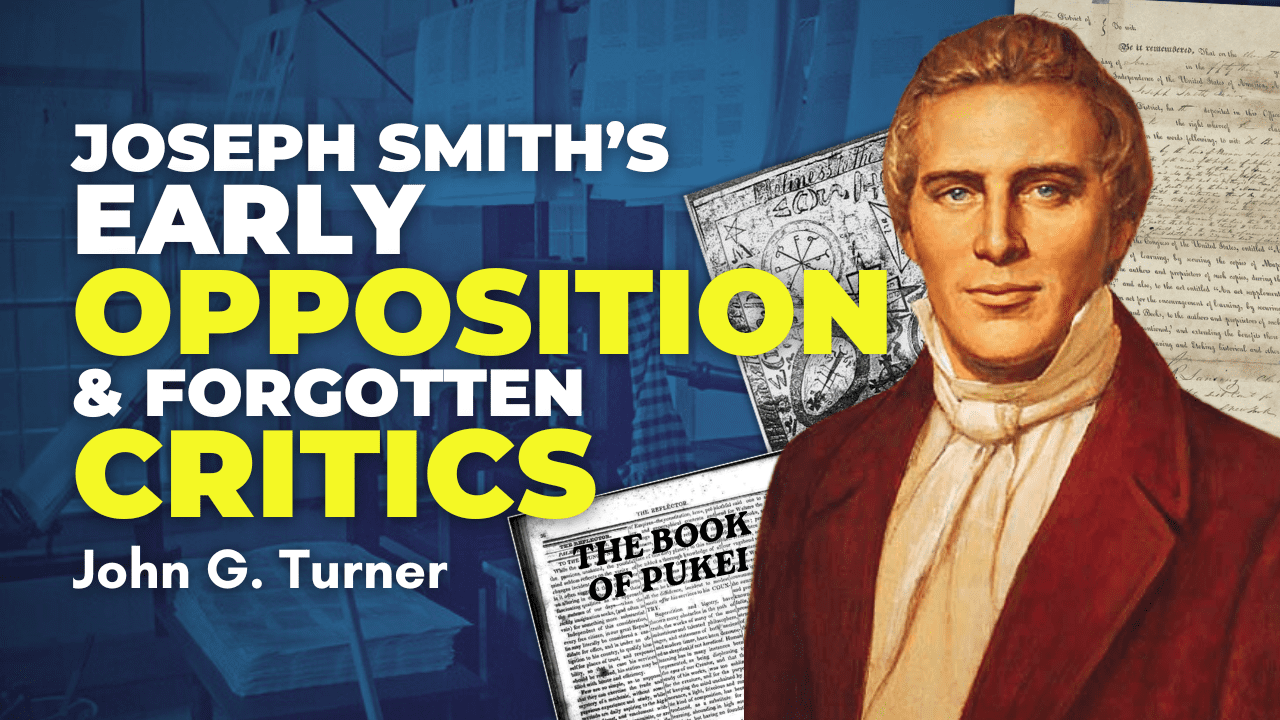
Joseph Smith’s Early Opposition & Forgotten Critics
Listen on Apple Podcasts Spotify YouTube Download MP3
About this episode
In this episode, we dive into Chapter Seven of Joseph Smith: The Rise and Fall of an American Prophet by John G. Turner. The chapter is titled “Moses” and covers the 1830 period and the transition from New York to Kirtland, Ohio. We explore early public criticism of Joseph Smith by figures like Abner Cole, the satirical Book of Pukei, and Luman Walters’ possible influence. We also examine Joseph’s efforts to sell the copyright of the Book of Mormon in Canada, what that reveals about his intentions, and the revelation that supposedly authorized it.
We discuss how Joseph’s financial motives, revelations, and treatment of Martin Harris raise important questions, and consider the book’s early lack of demand—even as Joseph continued to pivot and adapt. From legal troubles and claims of treasure seeking, to his revisions of the Bible and the rise of anti-Masonry, this episode looks at how Joseph’s evolving theology and personal ambitions shaped early Mormonism.
We also tackle difficult questions around gender and divine authority: Why were no women, including Emma Smith, called as witnesses to the golden plates? What does Emma’s role—and her sacrifices—say about the story Joseph told? This is a wide-ranging and thought-provoking installment that challenges the traditional narrative while offering rich historical context.
**Topics Include:**
– Abner Cole’s criticisms & Book of Pukei
– Attempt to sell the Book of Mormon copyright in Canada
– Revelations and motives: divine or self-serving?
– Joseph’s treatment of Emma & women’s roles
– Legal issues & treasure seeking
– Bible revisions, anti-Masonry, and theology
– Emma’s loyalty and legacy
Thumbnail Credits: Image of Joseph Smith by Del Parson; Background image of printing press from LDS 365; Other images from the public domain
Originally published on mormonstories.org.
Transcript
Machine-generated and lightly edited. Click any timestamp to jump the audio to that moment. The audio is authoritative; please check it before quoting.
Welcome and Series Introduction
John Dehlin Hello, everyone, and welcome to Mormon Stories Podcast. I'm your host, John Dehlin. It is July 9, 2025, and today you are joining us for part seven of our series on what I'm calling the Joseph Smith podcast. We are seven now episodes in to interviewing Dr. John Turner of George Mason University, who just released a book called Joseph the Rise and Fall of an American Prophet from Yale University Press. We are so grateful for everyone who has contributed to make this possible, for all of the base Mormon Stories donors, but also for everyone who stepped up to donate to this campaign. Specifically, I'm happy to announce that we've raised $4,500 so far. That pays for nine episodes. So we'll be able to do at least this one and three more. And if any of you want to see this series continue, just go to donorbox.org Joseph Smith become a monthly donor and we'll keep doing these episodes for as long as you value them. We have covered so many important topics so far. Six episodes to be exact. These episodes are best consumed in sequence, and you can find the sequence at the Joseph smith podcast on YouTube. It's a playlist under the Mormon Stories Podcast channel. We're also going to be releasing these on Spotify and on Apple podcasts as well, but of course, they're integrated into the Mormon Stories feed. We've covered the first six chapters of this important book, and we've covered everything from Joseph Smith's family background to Joseph Smith's first vision, to the golden plates, to the Book of Mormon translation, to the lost 116 pages with Martin Harris, the three witnesses, the eight witnesses, and just Joseph generally as a translator, and of course, Book of Mormon historicity. Today we are going to be covering chapter seven, which is entitled Moses, and it's covering the 1830 period, which I believe is around the time that Joseph Smith is transitioning from New York to Kirtland, Ohio. But I don't want to give away any spoilers, so without any further ado, bring back Dr. John Turner. Hey. Hey, John. Thanks for coming back to the Joseph Smith Podcast and the Mormon Stories.
John Turner Hi, John Dehlin. I am excited to be back. I'm actually somewhat excited that we are stretching beyond 3-18-30. You just listed a whole lot of fascinating topics pertaining to Joseph Smith's early life. But fear not, more fascinating topics ahead.
John Dehlin Now, you, you actually believe that the interesting, the most interesting, interesting stuff is yet to come, is that right?
John Turner Well, to a certain extent. I mean, I, I do think the production of the Book of Mormon is significant. And I mean that that in and of itself is a remarkable chapter in Joseph Smith's life. I am hoping we get to the early 1840s. I think the story really accelerates as we get to the later years of Joseph's life. And his kinetic energy is bouncing in a number of controversial directions at the same time, but plenty to talk about in 1830 as well.
John Dehlin And I'll just remind everybody who hasn't been listening to the previous episodes. One of the cool things about this book and about this series is the John Turner is, is not an ex Mormon, an anti Mormon, and he's not a faithful apologetic Mormon. He's just a top notch historian that is interested in LDS Church history. He did a biography on Brigham Young and now he's doing one. Now he's releasing one on Joseph Smith, which you can buy at Benchmark Books or on Amazon or at Yale University Press. But what I love about doing this series with John Turner is we've got a neutral observer who doesn't really have an axe to grind or a faith position to buttress, but instead he's calling balls and strikes, balls and strikes, as he sees them as just a top notch objective historian. So should we, should we dig in, John?
John Turner Yeah, absolutely. I'm hoping not to be replaced by an AI umpire now that you've framed it that way, John.
John Dehlin No, AI's got a long, long way to go before they're matching you. All right, John Turner. Well, what's chapter seven about? Why is it called Moses? Let's jump in.
The Book of Mormon's Prophetic Framework
John Turner Yeah. Two reasons. To hearken back to the last chapter, the Book of Mormon predicts the emergence of a choice seer named Joseph who will in some way, in some respects match the significance of Moses. So Joseph's self identification is as a seer, a choice seer at, you know, significant in the way that Moses was significant, who can bring forth revelations and commandments. And then also in, in these months, he begins the dictation of a revelation that becomes the basis for what Latter Day Saints know as the Book of Moses.
Abner Cole and Early Anti-Mormon Opposition
John Dehlin Okay, well, let's go ahead and jump into the chapter. And I thought it was really interesting that you start discussing Abner Cole and his opposition to Joseph Smith and the Book of Mormon. Just want to tell us the, you know, at least this beginning Abner Cole story because I think it's kind of fascinating.
John Turner Yeah, so Abner Cole is a colorful and a bit pugnacious newspaper publisher in Palmyra. He publishes the Palmyra Reflector and, you know, he likes to skewer Religious targets in particular, he, he doesn't like sort of wealthy, well heeled Protestant ministers. You know, there are a lot of people in Palmyra who take issue with Presbyterian ministers, for instance. But Cole also doesn't like upstart prophets who he thinks are preying on the gullible both in terms of faith and perhaps money. So he, he very much identifies Joseph Smith as an imposter, as a fraud, someone who, whose tales of a gold Bible are going to hoodwink the credulous.
John Dehlin And I, I'm, you know, I'm curious to know your take on my experience with anyone who criticized Joseph Smith in the church, especially in the early years, within a Mormon context, immediately becomes discredited as anti Mormon and is having an axe to grind and is just hating on God's chosen people and inspired by the devil. As you read Abner Cole, is that a fair characterization? Do you see genuine motives here? I know you just listed some, but do you see him as just a blindly hate spewing anti Mormon with an axe to grind? Or do you think he has, especially within the context of 1830, has credible concerns with Joseph Smith and with the Book of Mormon?
John Turner Well, I mean, we might bump up against the limits of what I know about Abner Cole. But I also, I think of him for starters, he's a satirist. So you know, in 1831 he publishes something that he calls the Book of Pukei, which is, you know, a sort of satirical take on the Book of Mormon, you know, meant to be insulting and funny. So I think, I think there's some of that. Cole thought of himself as a free thinking, skeptical, rational individual. He, you know, who could sort of stand up to religious hypocrisy and puffery. So I think he sees himself like that. I mean, I think the reality is In March of 1830 it would be hard for anyone to foresee Joseph Smith as a figure of great significance, anyone outside the pretty small circle of men and women who had accepted him as a prophet and as their religious leader. So I don't think Cole necessarily fingers Joseph as someone of tremendous significance or a great threat to the established order, but somebody worth poking fun at and someone who got his hands on what he thought was a good story.
The Book of Puke and Luman Walters
John Dehlin All right, well, because I was curious, what I did is I googled the Book of Puke because he releases at least two chapters in the reflector, in the Palmyra reflector. And what I'm going to show here is I'm just going to show kind of what I'm seeing. And interestingly, this is found at BYU's library. They have both the facsimiles or the photographs of the Palmyra reflector, but also kind of the transcriptions. I just wanted to review a couple things with you really quick. John Turner, Chapter one of the Book of pukei begins by basically telling the story of a man it calls Walters the Magician. And I believe it's referring to an actual real historical figure that was poking around the Palmyra area in the years prior to Joseph Smith creating the Book of Mormon. Lumen Walters, do you. Do you happen to have fresh in your memory bank, you know, anything, anything that, that you know about, you know, who, who this Abner Cole guy calls Walters the Magician in the Book of pukei?
John Turner Yeah. So Walters. I mean, I don't know a ton about Walters. Walters, like a lot of, a lot of people who we've been talking about, moved from Vermont to western New York either in the 18 teens or early 1820s. He settled somewhere near Sodus Bay, which is just about, I don't know, 30 or 45 minutes from where I grew up. So I kind of like, I kind of like that. He was a man who practiced some of the treasure digging and sort of folk magical practices that the Smith family was familiar with. I actually, I can't quite remember what his primary treasure digging pursuits were. I think he also had a reputation as a fortune teller, and I think he must have had enough of a reputation regionally that he traveled around the region a bit. There are some accounts of him being on the scene sort of in the mid to late 1820s in and around the Palmyra area and taking an interest in the story of the gold plates.
John Dehlin Yeah. And if you read this Book of pukei by Abner Cole, I'll just read a few of the verses in chapter one, verse three. And again they're making chapter and verses like the Book of Mormon. It says, and the idol and slothful paid tribute unto the magician and besought him, saying, O thou who art wise above all men and can interpret the book that no man understandeth and can discover hidden things by the power of thy enchantments. Lead us, we pray thee, to the place where the Nephites buried their treasure and give us power over the spirit and we will be thy servants forever. And the magician led the rabble into Dark Grove in a place called Manchester, where after drawing a magic circle with a rusty sword and collecting his motley crew of ladder demalians within the center, he sacrificed a cock, a bird, sacred to Minerva for the purpose of propitiating the Prince of Spirits. Yeah. And so it's basically. It's basically saying that Lehman Walters was almost like a mentor to Joseph Smith. It's giving the impression that Lehman Walters sort of taught Joseph Smith or the people in Joseph Smith's day, this practice of treasure digging, that he claimed that there was a spirit guarding the treasure, that gullible people followed him and even paid to follow him, and that ultimately he was never really able to produce anything, but that maybe he either mentored Joseph Smith or gave Joseph Smith the ideas, and that thus when Abner Cole learns about Joseph Smith in the Book of Mormon, he's like, you're just doing what Lumen Walters did before you. He was probably your mentor. Is that, is there any credibility to that possibility of a narrative?
John Turner So you can find that, I guess you could call it an allegation from Abner. Cool. You can find it not just in the Book of Puke. I don't know if it's Pukey or Pukei, John. I think Cole made that charge in the reflector in early 1831 as well. You can find, I think, the entire run of the Reflector online in good quality scans. I mean, I don't think there's information that's credible just to prove that that is how Joseph Smith got the idea for the Book of Mormon. I mean, I think that's Cole's accusation. He clearly is, you know, he's at odds with Joseph smith early in 1830 because he's published. He's purloined and published some unauthorized excerpts from the Book of Mormon. Who knows? I think Walters probably did intersect with activities in Palmyra, perhaps in late 1827. Perhaps he was friendly with some of the men who became Joseph's, you could say, treasure seeking companions turned rivals in late 1827. I think we don't. I think we don't really know. Know too many details. So I, I would say I'm not willing to take that at face value from Cole. I do think, though, if I can push in just a slightly other direction. I mean, Cole, he doesn't, he clearly doesn't like Joseph Smith and they had a hostile encounter in early 1830. I can also, at the same time, I can imagine Cole having a great time composing this satirical account. And I know that both Joseph's contemporary critics and followers, you know, see, see all of this as extremely serious. And I'm not saying it's not important, but I think, you know, satire. It has such a long and Perhaps even enjoyable connection to the Book of Mormon. And this is a fun early example that's certainly continued into the 21st century.
John Dehlin That's helpful. I'll just read verse one of chapter two, because I have one final question. So Abner Cole writes in the. In the Book of Puke. And it came to pass that when the mantle of Walters the magician had fallen upon Joseph, surnamed the prophet, who is the son of Joseph, that the idle and slothful gathered themselves together in the presence of Joseph and said unto him, lo, we will be thy servants forever. Do with us our wives and our little ones, as it may seem good in thine eyes. I guess the final thing I just want to say is why would Abner Cole just make this up out of whole cloth if there wasn't really a Lumen Walters? If Lumen Walters wasn't likely a significant influence on Joseph Smith, why would he spend the entire first chapter making the association if there wasn't some credibility or legitimate association to Joseph Smith in the Book of Mormon?
John Turner Yeah, so, I mean, I think that again, I think Walter's path may have intersected with events in Palmyra, Manchester in 1827, late 1827. I don't think there's. I just don't think there's a lot of evidence for Joseph Smith having had a, any sort of significant relationship with Walters prior to that. I think, I think most of the later discussion of Walters and Smith, it probably originates with color Cole's accusation. I mean, I would contrast this with the fact that we know a lot, a fair amount about Joseph's relationship with other treasure digging companions like Willard Chase, like Samuel Lawrence. There are, you know, a number of sources that point to those as having been significant relationships for Joseph Smith. I think there are some accounts that corroborate or at least point to some of Joseph's rivals having had Walters on the scene in September and October of 1827. There are some possible hints of this in Lucy Mack Smith's account and some later comments by Brigham Young, who referred to, I think, a magician or a fortune teller in terms of Walters having been a formative influence on Joseph Smith. I don't think we have a lot to go on outside of Cole's account. And I will say, you know, Cole and Joseph Smith have an angry confrontation in early 1830. By 1831, after the church of Christ has grown into something more than a few dozen individuals, you know, Cole might have a greater motivation to discredit Joseph. I think that's, that's definitely possible.
John Dehlin I guess the meta point I'm trying to make is we as Mormons have been conditioned to just dismiss out of hand any criticism by someone like Abner Cole or Ed Howe and just say, yeah, anti Mormons, you can't take anything they say seriously. I've almost started to feel like, as I've dug into the documents, that some of the most credible witnesses were people like Isaac Hale, Abner Cole, Ed Howe, because they were there, they understood the context, they had access to neighbors and friends, and again, the historical context. And they wrote at the time what their immediate responses and reactions were and could speak to reputation. And so that's kind of all I'm saying is I don't like that we've been conditioned to dismiss these people. And it seems like, if anything, we should be giving them more credibility than, let's just say, Joseph's believing followers or apologists or later accounts. It almost seems like the immediate critical accounts provide us with some of the best, most accurate and most reliable information about Joseph and the times he was living in and his reputation. Is that unfair?
John Turner Well, I think I, I would, I guess, want to take a little bit of a middle ground on that one. So, for instance, at the outset to rough stone rolling, Richard Bushman states that among other sources, he wants to privilege the accounts of those who were closest to Joseph during these pivotal events. And, you know, I thought, you know, that that's a fair point. We don't want to just out and out discredit evidence because it comes from people who had a vested interest in Joseph Smith or in this movement from the beginning. I agree with you that we shouldn't just, on the face of it, dismiss evidence from Isaac Hale, who clearly had, you know, an opportunity to observe Joseph in a pretty intimate way for those years in the late 1820s. I agree that, you know, that he's an important witness. Abner Cole, I would put in just a slightly different category. I, I agree we shouldn't dismiss what he has to say about Joseph Smith. I don't think he was, he, he wasn't close to Joseph. He certainly had the opportunity to, to talk to many people in, in and around Palmyra about him. So I, you know, I think in a case like this, I don't see any reason to dismiss his accusations or allegations out of hand. But as a historian, we feel better if we get some, you know, good corroborating evidence.
John Dehlin Excellent. Okay, thanks for, thanks for addressing that. As the chapter continues, it seems like there's a real, there's a real, well, Martin. Martin Harris becomes concerned that he's not going to recoup his investments. And so there's discussion about selling the Book of Mormon copyright in Canada and, and also there's an ongoing discussion about what the price of the Book of Mormon should be. Do you want to tell that story or that series of stories?
Martin Harris, Book of Mormon Sales, and the Canadian Copyright Mission
John Turner Sure. So, you know, at the outset, both Martin Harris and Joseph Smith, they are hopeful that the Book of Mormon is going to sell well. In Harris's case, he's hoping that it will sell well, well enough so that he won't have to forfeit the property that he mortgaged to Grandin, the publisher of the Book of Mormon. I think also there's. There's some clear, ongoing tension between Harris and Joseph Smith. It isn't entirely clear who stands to get the profits from potential book sales. Harris seems to think that, you know, he should be getting the profits. He's sort of advanced the property guarantee. I think Joseph is hoping that the book sales, that he will reap those proceeds to support himself and the church and the two men sign an agreement that they will essentially split the sales. And I think, you know, I think that annoys Joseph. You know, by revelation, he had commanded, or God had commanded Harris to give his property freely. And it doesn't seem that. That Harris quite understood. Quite understood it that way. So I think they have, you know, they have a disagreement. I mean, honestly, the argument was a bit moot because the Book of Mormon didn't turn out to sell as well as they were hoping. This might not easily resonate with contemporary book buyers, but Joseph had set the price at a dollar and 75 cents, which was really a steep asking price for a book in 1830. It turns out they don't sell well. Joseph does eventually lower the price, but it's, it's years before, you know, the, it becomes a little bit easier for the book to, you know, reach a, reach a larger audience.
John Dehlin So that's like $60 in today's dollars. 175 is like $60 in today's dollars, according to what I just Googled.
John Turner Yeah. And I, I think also it was a little, it was more out of, you know, that sounds like. Well, that's twice as much as basically what you. What my book would cost. But I actually think for ordinary people in 1830, it probably seems. Seemed like a really high price. More than, probably more than even that $60 figure would suggest. You know, I do think Joseph is still, as of early 1830, he's still thinking about the Book of Mormon as in part a money making project. It was his, you know, financial next plan beginning in 1827 and it's been a long time coming. And I think accordingly, that's where the idea of selling the Book of Mormons Canadian copyright originates. You know, that's a way to get some immediate proceeds from the book.
John Dehlin Can I ask you before we jump, jump into the Canadian copyright, I guess I have two questions. If, if this was a book given to Joseph Smith by an angel and by God to transform the world, basically, why would Joseph really care? Well, where did Joseph Smith even get the idea that he should make money from it? Did God ever say you are to charge $1.75 and make as much money as you can to fund the book? Like, which is it? Is it, is it, you know, translated scripture from God and an angel? Or is it a money making scheme? Or could it be both? And if it's both, where did he get the idea for it to be a money making scheme? And then the second part of that question is we just talked last episode about Martin Harris being one of the three witnesses literally claiming to see an angel in a vision, telling him that this book, you know, was a, was authentic and of God. I would, I could imagine a scenario where if I had seen an angel tell me that this book would, was from God, I'd be like, well, if I make money, great, but I don't care. Like I've literally seen an angel from God telling me this book is supposed to transform the world. So why were Joseph and Martin caring about the money if this was primarily, you know, God's holy scripture?
John Turner Those are great questions and I don't know if I could answer them satisfactorily. I think first of all, it's hard for human beings not to care about money, right? So there aren't a lot of religious enterprises, well intentioned that don't have financial components to them. And I think that's almost inevitable. It actually, if you can forgive a really brief digression, I wrote a, once wrote a history of Plymouth Colony which, you know, first and foremost was an attempt to establish a religious colony that would be attractive to other Protestants in England for religious reasons. But one of the foremost goals of the colony was to make money in the fur trade. And one of the colony's founders, a Mayflower passenger named Edward Winslow, he specifically said this should be a place where religion and profit jump together. And so I don't think that's, you know, I think in a general sense those sorts of mixed Human motives aren't unusual. I think one of the things that has always struck me about this as it pertains to the Book of Mormon, it was such a terribly harebrained idea. It's really hard to make money selling books even for super talented authors. Not a lot of people can pull that off. And the idea that Joseph Smith was going to be able to pull that off was certainly preposterous. But I, you know, as we talked about in prior episodes, I don't think that Joseph Smith received gold plates from an angel. I do think he had a religious message that he wanted to get out into the world. The Book of Mormon was one of the vehicles for that. At the same time, he needs, you know, he needs some economically viable plan for himself and his household moving forward. I do think he sees the Book of Mormon as, as that plan as well. I don't know if, you know, I don't, I don't know if that can be resolved satisfactorily for, you know, in terms of a faithful lens into this episode. But I do think both of those motives were there for Joseph Smith.
John Dehlin So let's go ahead and shift instead of just saying, hey, friends, you know, you believe in my cause. Any chance you could help me go to Canada and sell the copyright? Joseph, you know, Joseph ends up employing a different strategy. Can you tell us about the revelation?
John Turner Sure. So he has a revelation that instructs several individuals, Oliver Cowdery, Hiram Page, I think David Whitmer and Joseph Knight, that they are to travel to what was then called Upper Canada. Essentially, they're to go east around Lake Ontario to what is now Kingston, Ontario, and sell the Book of Mormon's copyright for that jurisdiction. And, you know, speaking of, you know, a mixture of motives, the revelation itself is explicit that this will be for their temporal, this worldly benefit as well as their spiritual benefit. And, you know, I. Actually, one of the really funny things about this revelation, or sad things about the revelation is there's a, there's, there's some shade for Martin Harris in it. The revelation states that essentially Joseph's followers, Joseph and his followers have pleased God, except for Martin Harris. You know, he hasn't pleased God, and I think he hasn't pleased God because he's been quarreling with Joseph about, you know, sale proceeds from potential book sales.
John Dehlin And you, and you mention in the book that the group that Joseph calls together intentionally don't tell Martin Harris about the trip to Canada. Tell us why you understand it to be that Martin was not notified of the Canadian trip.
John Turner Well, you know, there's only going to be so many proceeds from a potential copyright sale. And Joseph, he doesn't want to, he doesn't want Martin Harris in on this deal. So, I mean, at least that's according to a later, later report from Hiram Page, who is one of the principals. And you know, I, I, you know, I think if you read between the lines of what are admittedly fairly sparse records, you know, Joseph was badgered by Harris into agreeing to split the money from potential book sales. And I don't think he, he didn't, it doesn't seem to have liked having to make that agreement. So I think he doesn't want Harris to get any of the proceeds from potential copyright sale. As in, you know, Harris has, has gotten enough or stands to get enough. He doesn't need to get anything from this. And you know, I do write, you know, I make a point of not trying to pass moral judgment on Joseph's actions page by page in the biography. I do write and I do think that Joseph's treatment of Harris is uncharitable during, during these years. You know, Harris has enabled a great deal for Joseph Smith. The two men never really seem to have had a positive and harmonious relationship after the summer of 1828. And I think Joseph's treatment of Harris is a bit callous.
John Dehlin Yeah. Because literally the Book of Mormon wouldn't exist. They wouldn't have copies to even, they wouldn't have a copyright to sell if Martin hadn't have funded the whole thing. And so again, we mentioned this in past episodes, but now Jesus, according to Joseph Smith, is condemning Martin Harris even though he funded the whole enterprise. And they're doing some sneaky, shady escape to Canada to sell the copyright. But don't tell Martin, even though again, he seems to have every right to some of the profits from selling the copyright, but it doesn't matter because it's a fool's errand anyway. So really quickly, this revelation to go and sell the copyright, remind our viewers and listeners who's, who's speaking in the revelation.
Revelations, Scripture, and the Voice of Jesus
John Turner So it's been a while since I've looked at the exact text, but for the most part, in Joseph's revelation, in Joseph's revelations, they come in the words of Jesus Christ.
John Dehlin So. Jesus Christ. Oh, keep going. Sorry.
John Turner Yeah, and sometimes that's explicit, sometimes it's contextual. It might end with something like, I'm the alpha and the omega, some clear New Testament reference to Jesus Christ and, or simply the Lord, but, you know, for the sake of our discussion, we'll presume it's in the words of Jesus Christ in this case.
John Dehlin And so let's just, with the benefit of the doubt, believe that Jesus told Joseph to go send some men to sell the copyright of the Book of Mormon to Canada. It sounds like they didn't do their. Jesus didn't do his due diligence because tell our viewers and listeners why that didn't work out.
John Turner Well, I guess you could say imperial copyright law, it's really complex.
John Dehlin It's hard. It's, it's, it's more difficult than God couldn't, could understand.
John Turner Well, I don't know, I could quip and say maybe, maybe Jesus is 1800 years out of date on copyright law or something like that. I don't know. But essentially Joseph would have had to register a copyright in London rather than in Canada. And honestly, it was a fool's errand anyway because throughout, I think pretty much all of the 19th century International copyright is almost impossible to enforce. It's often a real problem for authors who might have a copyright in the United States and then have someone publish their book in Canada. So it's often a problem rather than a financial opportunity. But this was, this was going nowhere. It's not, it's not exactly clear how many of the men go to Kingston, but they, they find out that, you know, this is, this is not a viable plan. And, you know, they, they are perplexed. According to the accounts of David Whitmer and Hyrum Page, they're perplexed that Joseph, Joseph has given them this revelation and they want to know why they're not able to succeed when they obey. Obey it.
John Dehlin Yeah. And they come up with a reasonable question of Joseph Smith after they've gone to this effort, spent a lot of time and money to go all the way up to Canada to sell the copyright based on Jesus's commandment. What do they ask Joseph and what does Joseph say in response to the failed. To Jesus's failed prophecy? Basically, yeah.
John Turner So according to Whitmer, they asked Joseph, you know, why hasn't this succeeded? And Joseph responds with a line that, you know, this is according to Whitmer's recollection that is quite remarkable. Some revelations are from God, some revelations are from man, and other revelations are from the devil. So, you know, apparently, you know, this would be, oh, I guess this, it could be either from man or the devil. But Joseph, Joseph has not correctly discerned the will of the Lord. And Paige has a similar recollection which I think Adds some credibility to these accounts that Joseph had confused God's will with his own carnal desires, in this case a desire for money. I do think it's worth, worth saying that Joseph does end up having some clash with Paige later the same year. But for the most part, both Hiram Page and David, along with Cowdery and Joseph Knight, this doesn't rupture their trust in Joseph's leadership. There are a number of points like this in Joseph's life where either a revelation doesn't pan out or a prophecy or prediction by Joseph doesn't. Doesn't isn't fulfilled or simply an initiative of Joseph's fails. Typically that, that causes some, some of his followers to question him or lose their faith in him. The majority typically in those scenarios don't, doesn't, doesn't necessarily lead them, it might lead them to ask questions, but it often doesn't rupture their, their faith in Joseph.
John Dehlin And, and, and this is just a good example of why I personally conclude that what Joseph learned from his treasure digging years is that he had the ability to convince people that he had special powers to, to see things even when he was unable to prove to them that he was able to see things. And this is a classic technique of sort of the house always wins because if the revelation does come true, well then Joseph really is a prophet of God, you know, because the revelation came true. But if the revelation doesn't come true, he can somehow still get people to believe in him and he can just say, well that must have been of Satan or of me. But regardless, they're still believing after. And that, that seems like a special power of, I don't know, charisma of persuasion.
John Turner Yeah. So there's a, there's a scholar of religion at the University of North Carolina named Molly Worthen who just wrote a book called Charisma. And it's about the charismatic relationship between leaders and followers in the history of American politics and religion. It's a great book. And you know, that relationship, that charismatic relationship is hard to understand. And I, the way I would think about it in the case of Joseph Smith and early Mormonism is that Joseph invited followers like Martin Harris, Oliver Cowdery, these other men. He invited them into his story, if you will. You know, his story of gold plates, of the Book of Mormon, of himself as a choice seer, as a prophet, translator, revelator. Once individuals entered that story and were in that prophetic relationship with Joseph Smith, depending on the individuals, you know, sometimes that relationship was very durable and a lot of these men, as the years passed, they would get pressed to a point at which that relationship broke. But it didn't usually break on a single first instance of, you know, prophetic failure. You know, if. If you accepted that Joseph Smith was the choice seer chosen by God to bring forth the Book of Mormon, you know, a failed plan to sell the copyright wouldn't necessarily rupture that belief.
John Dehlin Yeah, all right, well, you know, the. The gentleman come back from Canada. Martin tries to sell his own copies. What was the response to Martin's attempt at selling the book, and what should we take from both the Canadian response and Martin Harris attempts to sell the book as it relates to general interest in the Book of Mormon?
John Turner Yeah, so. Yeah, so the. There's this rather poignant account that comes from a history written by Joseph Knight Sr. One of Joseph's stalwart supporters during these years, in which, you know, he takes Joseph from Harmony back to Manchester in March of 1830. And on the way, who should they encounter but Martin Harris? And he's looking downcast, and he's got this big stack of Book of Mormons in his arms, and he's just laments, you know, nobody wants them. And I don't know if Harris is, you know, I don't know what he's doing, if he's going door to door trying to. Trying to sell these books or if they're, you know, they're advertised for sale and Palmyra, you know, Joseph reassures him that they will sell. Well, they don't. There's not a lot of. Not a lot of people are willing to plunk down a dollar or two for the Book of Mormon in the early 1830s. It's certainly, you know, there's demand for the book as this movement grows, and. But I think it's something that more often ends up being given away than soldiers.
John Dehlin What do you make of there being just little interest in purchasing the book? I mean, we're taught as Mormons that it's the most correct book on earth, that it's a genius, that no man could have written it. It's so brilliant. And that it's the most inspiring and important religious text on the planet. Why wouldn't it sell?
John Turner Well, yeah, well, as you know, I'm really sympathetic to authors. It's just hard to sell books. True. In 1830 and in 2025, I think, you know, there's a lot of curiosity about the Book of Mormon. People loved, and I'm speaking in general terms about Americans, you know, from the start, newspaper editors Loved the story. The Book of Mormon and Joseph Smith, they were always good copy. Joseph was through throughout his life and beyond. But the idea of motivating men and women to purchase a, you know, religious text at considerable expense, that was going to be, that was going to be a tough sell. So I think it's just, it's just not that surprising. You know, there are well known, you know, well known authors of this time period like Nathaniel Hawthorne and Herman Melville. They have a very hard time selling enough books to support themselves. So it's hardly surprising that the, that the Book of Mormon doesn't sell. It's such a quixotic literary project and it's attractive to satirists and critics, but it's not as if there's a, you know, there's a large market for it. There's not, there's not a lot of natural inherent interest in this text.
John Dehlin I mean, whether it's the claim that an angel or God provided it to Joseph or its attempt to resolve so many doctrinal theological disputes of the day, you know, why I just, why, why wouldn't there be a lot of people either wanting to read a book from God or wanting a book that, that speaks, that clarifies the truth of what the true Christian principles are? And is part of the answer found in Mark Twain's response, which we've referred to in previous episodes, that maybe it just wasn't a good read.
John Turner So that's a great question. Well, I think just first of all, this is, this is a niche audience in a sense. So, you know, the message of the Book of Mormon and the early Church of Christ is that existing churches are in apostasy and there's no true Church of Christ or there hasn't been a true Church of Christ on the earth. There are a fair number of other American of other Americans who believe that existing Protestant churches are in apostasy and they're open to the recreation of a church patterned on the New Testament. Those individuals are not especially open to the idea that Joseph Smith has found gold plates with an ancient record written by the indigenous peoples of the Americas or anything like that. So I think most people, when they encounter the story of the Book of Mormon, they, you know, they think it's preposterous. And that might be a fun thing to talk about, but to spend money on is, is just a different proposition.
John Dehlin Okay. And then just the, the idea that it's just this compelling, masterful piece of, of literary prose sounds like it wasn't found to be that.
John Turner No, I Mean, there certainly aren't. There aren't early reviews along those lines. So individuals who, you know, quickly accept the Book of Mormon as containing the fullness of the gospel and who accept the Church of Christ as Christ's true church and who accept Joseph Smith as a prophet, those individuals definitely find the Book of Mormon a compelling read. Parley Pratt talks about staying up all night reading it when he first encounters it, but Brigham Young takes him a couple of years after first encountering the book to accept its message and to be baptized. So even those who come into the Church of Christ, they have a variety of responses. I'm sure most of them are positive, but no, I mean, I don't think anybody's out there claiming the Book of Mormon is a page turner.
John Dehlin I guess now that I'm thinking about it, it's kind of bizarre that so few people were willing to buy the book, but that by the time Joseph dies, tens of thousands are willing to give their life to the movement that the book started. That's kind of interesting. Last question about the Book of Mormon for now. Do you sense that it was an important motivator or that its place in the founding narrative of the church and or of Joseph's power? Do you feel like, you know, as the church gets formed, which is what we're going to talk about next, that the Book of Mormon's creation and production, or at least the story of it, if not the text itself, were pretty critical to enabling or bootstrapping Joseph Smith's eventual ability to start a successful church?
The Book of Mormon's Role and Joseph Smith's Ability to Pivot
John Turner Yeah, I do think that's the case. So, you know, historians of Mormonism have discussed this at some length. You know, how important is the Book of Mormon as a symbol of the restoration and of Joseph as a prophet? How important is its content to early members of the Church of Christ? I think the Book of Mormon, it is very much an important, important symbol. You know, that's definitely the case. It makes Joseph Smith. It gives him a unique place on the American religious landscape. You know, there are a lot of movements, there are a lot of reform movements, there are a lot of sort of restorationist movements. You know, Joseph Smith, Joseph Smith's movement is the only one with this hefty new book of Scripture. So I think that it actually gives the movement a lot of. A lot of heft, even if it doesn't give it credibility to those who are outside of it. It's also. It is a great. In a way, it's a. It's a great missionary tool. You know, early missionaries, you Know, they had. They bring the Book of Mormon with it. They attest to its truth. They encourage other people to read it. That's another kind of unique thing that members of this church are doing that, you know, the Campbellites aren't doing. It doesn't necessarily mean that this movement mushrooms or anything like that, but it. It certainly makes the Church of Christ distinctive.
John Dehlin All right, well, let's go ahead and move on. So one of the things that I think was another one of Joseph Smith's superpowers was the ability to pivot. And while it seems like everyone was disappointed with the sales and the uptake of the Book of Mormon, it seems like Joseph's like, next, he's moving on, and he's starting a church. So let's go ahead and have you share what you think is important and interesting about Joseph, what I call Joseph Smith's great pivot to pivot, from author to founder of a new church and a new religious movement.
John Turner So that's great. I like the way you frame that, because I actually think Joseph's ability to pivot, especially in the face of adversity or failure, is really significant. I mean, in a way, he's been done with the Book of Mormon since, you know, the summer of 1829, so he's been ready for this pivot. There's been talk about forming a church, but you're right, he doesn't miss a beat. Book of Mormon is published in 1830. I. I can't imagine Joseph totally gives up on book sales within weeks. You know, authors need to have a stiffer backbone than that, I think. But no. April 6th. The church is organized in Fayette at Peter Whitmer Sr's home. It's just several dozen individuals at a time. I think these are very heady, significant, and emotional days for Joseph, you know, either right after or sometime around the church's organization, he gathers with Joseph Knight Sr. And with his own father and Martin Harris at the. At the Smith farm in Manchester. Those men with whom Joseph has very significant relationships, they are baptized. It's clearer they accept his. Joseph Jr's spiritual leadership. According to the account of Joseph's mother and others at the scene. I mean, Joseph has just overcome with emotion. When Harris and his father are baptized, he just weeps uncontrollably and has to go off into the woods to. To be by himself. So, you know, whatever else we might think about, you know, you know, some of Joseph's activities during these years, there is a lot of. There is a lot of emotional investment and for Joseph, I think a lot of poignant meaning that his family members in particular accept his leadership.
John Dehlin Why do you think tell our viewers and listeners why Joseph's dad getting baptized would be such an emotional moment. I almost like really felt for Joseph. He weeps at his father's baptism and I don't know how many times in the, you know, the next 14 years we'll find Joseph weeping. Maybe it's a lot, but I don't know of a lot. Why would Joseph weep at his father's baptism?
John Turner Yeah, Joseph has a very tender relationship with his father and, you know, at times I wish we, we knew a little bit more about it. I, I think a couple of things come to my mind and I'm, I'm reading between the lines and engaging in a bit of speculation. Number one, you know, I think a lot of that tenderness is the fact that, you know, Joseph Smith Sr's life really since the early 1800s has not been outwardly successful. You know, he had that disastrous investment that threw away the, you know, his farm and his wife's money and he never really got back up on his feet. And I think he was sort of worn out and spent by the time the family gets to New York. Joseph, however, he doesn't. I. This is something I really admire actually about Joseph Smith Jr. He doesn't have contempt for his father and his failures. He instead really has, you know, a great tenderness for Joseph Smith Sr. I think he appreciates the fact that his father had been with him every step of the way. His father had been part of that treasure digging operation in harmony. His father had accepted the story of the golden plates and here's his father being baptized under, under his leadership. The second thing I'd say about it is Joseph, you know, he has been, you know, part of this whole story has been about the spiritual fracture within the Smith household of Joseph Smith Sr. Being inclined toward universalism and also simply aloof from all of the existing churches. Joseph's mother and some of his siblings joining the Presbyterian Church in Palmyra. And here's everybody coming together to join the Church of Christ that Joseph and his followers have organized. So I think, particularly in the case of Joseph's dad, here's this man who's always stood aloof from all of the churches and he's willing to join the one that his son organizes. I think that was just deeply, deeply and emotionally meaningful to Joseph Smith.
John Dehlin Yeah, if I had to distill a sincere motive that, that from all of Joseph Smith's work, I do think he was genuinely disturbed by all the religious contention and variability both within his family specifically and with society at large. And so I do think he felt like there should be one church. This confusion should be clarified. There needs to be one true church to rule them all. And why not me to start it? But also how happy he'd be if he could reduce the religious conflict not just in the world, but amongst his own parents, you know, and grandparents.
John Turner Right, yeah, well, and I think a lot of, you know, a lot of us understand that. Right. I think a lot of the Mormon stories community understands how painful it can be to have, you know, people going in different directions and it can be a source of intense conflict and, and anguish. Absolutely. I, you know, I've experienced that in my own family. You know, my dad was, you know, more of an agnostic who probably only came to church because my mom strong armed him at times. She was far more pious. You know, he, he was more of a skeptic. I didn't solve the problem by forming my own church. I think that's what a really remarkable solution. That's not the typically typical way that families resolve these things. But Joseph, you know, he's, he is someone who usually has an audacious solution to problems. And it's remarkable in a way that the whole, you know, the whole immediate family accepts his solution.
Founding the Church and Newell Knight's Spiritual Experience
John Dehlin How bold was it not just to claim that you're starting God's one true church, but to start producing scripture where you're claiming to channel the words of Jesus? And what do you make of the thought that this was just a way for Joseph to control people and to get them to do what he wanted them to do by starting a church, claim to be a prophet and then claiming to speak for Jesus?
John Turner I think in terms of controlling people, I think, I mean, I think that's, that's a great question. I do think for individuals there wasn't anything more compelling than words and instructions from Jesus Christ. Um, you know, which is a good reminder that for all of the religious controversy and confusion, if in the United states in the 1820s and 1830s, the vast majority of Americans revered the figure of Jesus Christ. So, you know, this was, you know, you couldn't have a better authority. And I, you know, I think to the question, yeah, I mean, I think you can't. It's impossible to untangle perhaps times where Joseph sincerely felt that he was conveying, if not the very words, at least the ideas of, of Jesus Christ versus times where Joseph wanted somebody to do something and a revelation was the most convenient and effective way of bringing about compliance. I don't know that it necessarily has to be all of one or all of the other, but it was. It was an effective leadership tool for those who accepted his authority.
John Dehlin So the church is founded. And tell us about Newell K. Knights or Newell Knight. Is it Joseph Knight?
John Turner It's. I think you want to hear about Newell Knight, who's a son of Joseph Knight Sr. Who's one of Joseph's stalwart supporters. So one of, you know, after the organization of the church, Joseph, throughout these months, he's sort of shuttling between Manchester, Fayette, Harmony and Colesville, which Colesville is. Is essentially across the New York state line from Harmony, Pennsylvania. That's where Joseph Knight Sr. Has his property. Newell Knight's a son of Joseph Knight Sr. And there's a pretty remarkable story. Newell attends some meetings essentially organized by Joseph and his followers. They're probably pretty informal, and these are meetings at which those in attendance pray together. Night went to the meetings, but he apparently didn't feel comfortable praying out loud. It's actually a little bit like the canonical account of the first vision in which Joseph struggles to pray vocally and feels gripped by Satan. So Knight goes off from this prayer meeting to pray by himself. He wants to pray quietly by himself, I think, in the woods rather than with everybody else. Then he feels guilty about his lack of spiritual courage. And Satan just, you could say, grabs a hold of him. He descends into, you know, this spiritual fit and his visage and limbs become distorted and twisted. And apparently he's. He's just like, tossed around as if possessed. And Joseph grabs a hold of his hand. Knight asks Joseph to cast the devil out of him. Joseph rebukes the devil in the name of Jesus Christ, and night cries out that he can see the devil leave. Now this finds its way into a history that Joseph and his associates produce in the late 1830s. Apparently the account. This account pretty much comes from Newell Knight himself. And Knight tells other people this story in. In 1830 as well. So this story's in circulation. So it's first an exorcism and then secondly a. A levitation. After the devil is cast out, night sees the heaven opens. He. He feels himself rise up into the air and press against the roof or the beams of the. Of the house they're in. And when he eventually comes to, you know, his friends lay him on a bed and he recovers. And not surprisingly, after all of that, he's baptized into the church.
John Dehlin How does a. How does a historian make sense of a story like that? How do you make sense of that story? Are you like, huh, maybe it happened or I doubt it happened, but here's how I would explain it.
John Turner So that's a great question. You know, in this case, I mostly simply narrate it. You know, we have Knight's account. We have, you know, and I think the fact that it's in, in Joseph's history, you know, is sort of in a, in a way it's, it's his corroboration of it. Knight also, he tells a similar story in Court in 1830 in which he sees the devil depart and attests that Joseph did it by the power of God. So it is a remarkable story. I don't think, I don't think as a historian I want to really weigh in on whether or not, whether or not Newell Knight rose into the air and pressed against the ceiling of a house. I think it's quite possible he could have, he could have simply been in, you know, an altered psychological state. The, the account in Joseph's history, it makes him sound like he comes out of a trance at the end of it. I think, you know, in terms of an experience of demonic possession and exorcism and spiritual release, I think a historian can simply narrate that while recognizing that there, there are naturalistic explanations for those sorts of phenomena. But I think one as a historian also doesn't have to close the door on, you know, genuine religious experience either. So I guess I've sort of prefer to narrate it and not really pass judgment about whether it transpired exactly as Knight said or not.
Joseph Smith's Legal Troubles and Trials in 1830
John Dehlin Got it. Let's go ahead and jump to a really interesting section at the bottom of page 76 where Joseph finds himself in legal trouble again. I kind of thought that his treasure digging days were behind him, that he had given up the glass licking or the peep stone treasure digging, you know, by his Bainbridge Times, and that now it's 1830, he's, you know, making the pivot from New York to Kirtland. I would have thought his going, you know, his sort of going to jail days, getting arrested days, getting into legal trouble. Days were over, but they weren't. So what happens?
John Turner So he gets arrested twice and it's either June or early July of 1830. There have been a number of converts in southern New York in Chenango and Broome counties, so sort of near the night property. And you know, there's some people who aren't, aren't pleased about this. And we're not talking about a great wave of converts, but, you know, some family members, I think, didn't like these developments. And, you know, they complained to the authorities that Joseph is engaging in the same sort of illegal behavior that had gotten him arrested in 1826. And just as a reminder, you know, glass looking or looking into a seer stone or a glass in order to find buried treasure as a form of employment was illegal according to New York State law. So I think, I think it's fair to say that in this case, Joseph has some detractors who get him into trouble with the law. Interestingly, you know, the, the reports of those trials, that they are a little bit sketchy. We don't really have good contemporary documents. Some of those present later published accounts, in some cases just a couple of years after the fact, in some cases decades later. But it's interesting to me that at these trials there's a lot of interesting testimony. Oliver Cowdery apparently testifies that Joseph translated the Book of Mormon by looking into two transparent stones. And in a sense, you know, this sounds like Joseph's up to his old tricks from earlier, earlier years. He's not convicted of anything because there's no evidence that Joseph engaged in these illegal activities and the counties in question in more recent years. So he, you know, he's not, he's not actually in serious legal danger, but these twin cases convince him that it's. It's probably a good time to. To, you know, move on from, from these areas.
John Dehlin So was he. Was he violating the law? Was he breaking the law in 1830? What's your guess? Based on the evidence was like, seems like getting arrested twice. I mean, they wouldn't just arrest him if he wasn't doing anything, right?
John Turner Yeah. So he's, you know, so he's arrested for pretending to discover where lost goods may be found. So, you know, in 1826, looking. Being paid to look into a stone to find lost objects was definitely illegal. I wouldn't put it in like, you know, a serious category of crime, but it was something you could be arrested and fined for. I think Joseph is, in 1826, the judge in the case allows him to simply, you know, leave town. You know, this isn't that big of a deal, but sort of beat it, you know, get out of here. So I don't think in terms of, you know, looking into a stone to dictate the Book of Mormon and sell it, I don't think. I think it would be a little harder to construe that as illegal. And you know, there, there's some kind of technical legal points here. You know, Joseph's not really at legal risk in these jurisdictions because he hasn't been engaged in the, you know, treasure digging for hire since 1826.
John Dehlin Yeah, I'm reading, I'm reading sort of what, what you write about what's said in the second trial in front of justice of the Peace Joel K. Noble. And you write Newell Knight testified that Joseph could see in a stone, but that he did so with honorable motives. Formerly he looked for money, Knight explained, but latterly he had become holy. And then you write, as evidence of Joseph's righteousness, Knight related that the defendant had cast a devil out of him. He had seen, quote, the devil as he departed and knew that Joseph Smith did it by the power of God. But you write Knight's testimony did not convince Noble of Joseph's holiness. The justice later commented that he considered Joseph a, quote, vagrant, idler, liar, deceiver and a nuisance to good society. Now why did Noble conclude this about Joseph Smith? Why did justice of the Peace Noble conclude this and was he referring to Joseph smith's behavior in 1826 or in 1830?
John Turner I think it's his general assessment. Yeah, Noble didn't see anything Noble in Joseph Smith. So, you know, those minutes of the trial. Noble publishes an account in a newspaper in 1832, which is good because it's only a couple of years after the fact. So I think it's a fairly, it's a fairly trustworthy account of the trial. And you know, that testimony, it is pretty remarkable from, from Newell Knight, you know, about the exorcism, but also, you know, Knight sees this trajectory in Joseph Smith as someone who had had a gift of being able to see in a stone and had formerly used that gift to make money, didn't really work out, but had since become holy and righteous. Noble, I think, simply believes this is all bunk, whether it's searching for buried treasure or producing the Book of Mormon. Those comments come from a number of years later. It's when Smith is in Nauvoo and is a much more notorious figure in the United States. But I, I imagine his assessment was the same in 1830, that this was a man who was both preposterous and an imposter.
John Dehlin Okay. And for me, what it seems like is if I'm trying to read the tea leaves, Joseph starts with a well known con that he could convince people that he could find treasure digging, find treasure with the Seer stone like Lumen Walters and Like the type of thing Benjamin Franklin made fun of. He got in trouble for that. He pivots to created the Book of Mormon with the same stone and then eventually starts a church, which then he's no longer treasure digging with the stone, but he's still using a stone to claim that he's speaking to or for God and that he can basically just get people to obey him, which will include giving him money, but also joining his church and going to Canada to try and sell a copyright, whatever he wants. But he's pivoting from claiming to, to find buried treasure to claiming to speak for God or kind of spiritual motives, which gets him money, but gets him money by getting people to join his church and follow him as a prophet instead of getting people to pay him to find buried treasure that he never finds. So it still seems like a money making venture just shrouded in the, the claims of spirituality or sort of religiosity. And the judge kind of sees through it. And so Joseph realizes I gotta get rid of the stone thing altogether because clearly the stone stuff is getting me in trouble. Which begs the question as to why God would want him to be doing anything with stones to begin with. But it also answers the question why Mormon prophets today don't use stones to justify their revelations or their, you know, teachings. It's because Joseph stopped and Joseph stopped because it kept getting him into trouble.
John Turner Anyway, I don't, no, that's a fun comment. So I, I, I don't know, I don't know if anybody uses stones today or not, but probably not. No, I do think there's, there is, there are a couple of interesting things here and I think what you said at the end is, is among them. So, you know, sometimes there's a desire to perhaps protect Joseph's reputation by conceding that when he was really young he was a bit misguided in terms of using a seer stone to search for treasure. But then he matures and there's sort of a break with this kind of youthful, somewhat scandalous activity and the story of the Book of Mormon and the early revelations. I do think, you know, the records are pretty clear that Joseph's self understanding and methods are pretty consistent between, let's at least say 1825 and 1830. He purports to have a gift of seeing things in a stone and he can look into a stone and he can see the location of buried treasure, see the location of the plates, at least according to some accounts, he's able to discern the location of the plates by looking into his stone. He can look into the stone to see the words that he dictates that become the Book of Mormon and look into the stone to see the words or receive the words that are the basis for the revelation. So there is a lot of continuity. I think it's interesting that Oliver Cowdery at this first trial and Newell Knight at the second trial, they, they see that continuity. Now, why does Joseph stop doing that? Why does he switch his method, which he does in the, in the months and years to come? Could be to avoid scandal, I think, and we might get into this in the next chapter. You know, other people can look into a stone. And we've mentioned Hiram Page's know, being present and part of that Canadian copyright venture, you know, Hyrum stage later in 1830, he's looking into a stone and dictating revelations. And, you know, that sort of raises the question of, well, does revelation hinge on a prophet or does it hinge on simply having a special stone? And so, you know, I think there are a number of possible advantages for moving beyond that method. One might be to avoid scandal or the whiff of criminality. I think also in a way, it enhances Joseph's prophetic authority to set the stone aside.
John Dehlin All right, well, he clearly seems to set it aside at least, you know, in the 18:30 time frame. Let's go ahead and move to Joseph's idea to revise the Bible. How, how bold, how novel or not bold and not novel was the idea to retranslate the Bible. How did it come about? And, you know, how did it, how did that go in, in the 1830 time frame?
Revising the Bible and Masonic Connections
John Turner Yeah, so I do think this is, this is one of the, one of the more, for me, one of the more enjoyable activities of Joseph Smith. Now, I suppose as a Protestant Christian, I should be pretty scandalized by Joseph's Bible translation, which, by the way, I think that, you know, that the term is very misleading. This is Joseph's expansion of the Bible at points and corrections to the Bible. It's not a retranslation of the Bible from its original Hebrew and Greek into English. I think it's, it's, it is a, it is, it's a remarkable new path really, for, for Joseph Smith. I think there actually are long traditions of Jews and Christians expanding on stories in the Bible and puzzling over the gaps and contradictions in them and creating new texts in order to resolve them. You could see some of the ancient Enoch or Enoch books as ways of filling in you know, that really terse account of Enoch in the book of Genesis. So there's a long history of Jews and Christians approaching biblical texts in this fashion. But for an American Christian to do so is far more unusual and distinctive, I think. And I talk about this at a bit of length in the biography. In a way, Joseph lived at a time in which almost everybody revered the Bible. But he wasn't the only American who found fault with the Bible as it existed. A lot of listeners are probably familiar with Thomas Jefferson and what became known as the Jefferson Bible, which was Jefferson's attempt to, you know, preserve the parts of the Bible that he valued, the ethical teachings of Jesus by, you know, basically taking a razor and eliminating all of the more supernatural and in Jefferson's mind, far fetched bits. There were also Americans who were, you know, they, they, they weren't satisfied with the archaic language of the King James and wanted to breathe sort of new life into the Bible. Alexander Campbell's an example of that. But what Joseph ends up doing is so different from what his contemporary Americans do with the Bible that I do find it, you know, of great interest. So what Joseph ends up doing is really adding to the Bible and sometimes correcting it on the basis of revelation
John Dehlin is the Talmud from Jewish traditions, basically biblical commentary.
John Turner So the Talmud's a little bit different. It's mostly commentary and debate rather than expansion. But there's all sorts of Jewish midrash and other texts that either add to or reinterpret biblical passages. So you could find some parallel examples. I do again think the ancient Enoch literature is a pretty good example. Those are even more extensive. But becoming fascinated by a passage in the Bible and you know, wanting to resolve a question or add an additional narrative to it. That's definitely not unprecedented. It's just sort of unprecedented in the United States of 1830.
John Dehlin And do you have a sense for when Joseph begins analyzing and commenting on the Bible, what his intent ultimately is to what he's going to do with this commentary?
John Turner So yeah, so he, at some point, you know, there, there's six, there's evidence that Joseph intended to work more on what he called his translation of the Scriptures. He intended to publish it. I don't, you know, he didn't work on it intensively or really at all after I think 1833. But according to the reports of some of his associates, he intended to get back to it, never finished it. He worked far more intensively on some parts of the Bible than others. So he worked intensively on the early chapters of Genesis worked with some intensity on the Gospel of Matthew, I think also some on the Gospel of John, but there are other bits he sort of just breezed over. I don't think. I, I don't, I don't think in his mind he was actually ever finished with the project.
John Dehlin Okay, talk about. There's a little blurb at the bottom of page 79 on top of 80 where the Masonic Lodge sort of enters into the conversation. I, you know, we're all familiar with Joseph eventually joining the Masons and then incorporating a lot of the Masonic rites into the Mormon Temple ceremony. What do the Masons have to do with the 1830 time period as it relates to Joseph Smith and Mormonism?
John Turner So, great question requires just a, a few minutes worth of answer. So the Book of Mormon takes its shape at a time of really cultural uproar surrounding Freemasonry. In the year 1826, not too long before Joseph embarks on this project, a man in Canandaigua, New York, which is very near to Palmyra, named William Morgan, is abducted and presumed murdered. Morgan intended to publish an account of the rights of Freemasonry. I mean, ironically, I think a lot of what Morgan intended to publish one could have found in circulation elsewhere. But it seems that members of a local Masonic lodge kill him for his publishing plans. And that leads to the rise of anti Masonry as a cultural and as a political force. Course, there's a significant anti Masonic political party that attained some clout in the late 1820s and early 1830s. You know, prior to this time, Masonry wasn't necessarily totally uncontroversial, but it was understood as something that, you know, upstanding Christians could involve themselves in without scandal. But the murder of William Morgan, you know, changes that for, for a number of years, you know, scholars of the Book of Mormon argue about this, but the, you know, motif of secret societies as a danger certainly led some early readers of the Book of Mormon to conclude that it was anti Masonic.
John Dehlin And I'm. And so, okay, so really quickly, what does that have to do with his attempts to comment. Comment on specifically what Genesis in the Old Testament. Is that right?
John Turner Yeah. So one of the passages, you know, so Joseph is really interested in the early chapters of Genesis. One of the passages that attracts his attention is the fourth chapter of Genesis, and that's the story of Cain and Abel. So, and to make a short story short, in the fourth chapter of Genesis, Cain murders Abel. Cain's upset because God prefers his brother's sacrifice to his own. It's a really terse story in the biblical text. So what's going on? Joseph expands that chapter in his, what I tend to call his Bible revision. And instead of simply being about Cain being consumed with anger and sin, Cain is part of a Satanic conspiracy. Satan is not present in the original biblical text at all. But in Joseph's revision, Satan promises Cain that he will deliver Abel into his hands and he essentially inducts Cain into something that sounds like a secret society. Swear unto me by the throat, Satan instructs Cain.
John Dehlin Okay, now wait a minute, that does remind me because when I did the temple ceremony in 1988, I had to swear and slit my throat as part of my original, you know, Mormon endowment. They've since taken that out. But what I was told is part of the reason why that was taken out is because that was part of the original Masonic Temple ceremony that Joseph would have been a part of and would have introduced into the temple ceremony. And so, yes, swearing by thy throat, that does sound Masonic to me.
John Turner Yeah. So I mean, I think in a way you could read this as, you know, an 1830 critique of Masonry. Now, as you just alluded to in that comment in the early 1840s, this anti Masonic furor has died down. Joseph takes an interest in Masonry and its rights. But I think, you know, any, anybody in 1830 would have known that the, you know, the Masons swear on the point of either having their throats slit or their, or being disemboweled not to reveal these secrets. So, you know, that's part of what Cain swears to Satan. If thou tell it, thou shalt die. And you know, Cain agrees. And according to Joseph's revision, he became Master. I'm not quite sure how to pronounce it. Mahon M A H O N. Which might have just been sort of a clumsy substitute for Master Mason.
John Dehlin Yeah. So I'm trying to like, you know, we ask you to call balls and strikes here. You know, on the one hand, there's this idea of parallelism or parallelomania, which is just if you want to prove the Church is true or false, you just find any parallel you can where a word sounds like another word and checkmate, you've proved whatever you wanted to prove. That's not a good way to do history. Let's just say that that's on one side of the spectrum. The other side of the spectrum is, whoa. These, these parallels are so substantive and meaningful that they're not likely just coincidences. They likely have influence. So I guess I'll ask you, do you think that the throat slitting Masonic oath was prevalent enough in 1828, 1829, 1830 that Joseph would have likely known about it. And that when they say, when Joseph writes something as specific as swear, you know, swear by your throat or whatever and uses the term Master Mahan, that that's not just, you know, a possible parallel, but a likely parallel that Joseph was influenced or inspired by the Masonic ceremony and the Masonic lodge at the time. What's your take?
John Turner Yes, I mean, I think so. Yeah, I think it's a flashing, you know, that's a, that's a flashing parallel. And the way you, not a coincidence,
John Dehlin a likely inspired sort of quote revelation,
John Turner I think that is, is, I think it's pretty obvious in this case. I think, you know, I think discussion about the Book of Mormon and Freemasonry is actually a little bit more complex because it's not quite as blunt. But I think this is, this is a really blunt example. So yeah, I think, I think it's a, it's a pretty clear parallel because
John Dehlin I don't know if you've studied the work of Grant Palmer at all. Have we talked about Grant Palmer yet on the podcast?
Book of Mormon Origins and Emma Smith's Relationship with Joseph
John Turner We have not talked about Grant Palmer. I haven't studied it in depth. I have looked at it, but it's been a while.
John Dehlin Grant Palmer wrote a book called An Insider's View of Mormon Origins. He was a CES director instructor for 30 plus years. He basically claims that he tries to come up with sort of explanations as to where Joseph Smith drew his inspiration from for the Bible. So you know, he'll say things like his own personal stories, you know, his dad's dreams, Joseph Sr's dreams, his own family dynamics. You know, he would say the Holy Bible, the Old Testament, Isaiah, but also obviously the New Testament and the Sermon on the Mount, that type of stuff. And then he would also say, he would say the sermons, the Protestant sermons in the Burntover district that make it make their way into Alma and Helaman and those types of sermons, they sound very much like the types of sermons Joseph would have experienced when he was, you know, in New York. And I think he also lists the wars, the constant wars of 1812 and that sort of thing and the, and the mound builder myth that was all inspiration for the Book of Mormon. But I think one of the last things that Joseph mentions, this whole secret combinations, gadiant and robbers stuff, I think Grant Palmer claims that Joseph would have derived the Gadian robbers and the secret combinations narrative in the Book of Mormon directly from the Masons as well. Do you think that's also a stretch or do you think that's a pretty solid finding?
John Turner I think it's a. I think that's a pretty solid finding. And I think. I think it would be probably be hard pressed to find non Mormon scholars and historians who wouldn't recognize and accept that. That influence. I'll also say John. So, you know, Joseph's. Joseph's textual productions are kind of. Are a bit of a mixed bag. You know, we've talked before. You know, Mark. Mark Twain calls the Book of Mormon chloroform in print. Well, you know, the opening is pretty exciting, and there are some sections that I think are lovely or profound and, you know, then there are some snoozer sections. And in terms of the Bible revision, which is, you know, it's a less. Less systematic project. You know, the. The passage we just talked about, I. I think it's. It's blunt, it's not terribly artful. You know, it's not for me. It's not a. It's not a beautiful or profound expansion of the Cain and Abel narrative. You know. You know, there are other passages that are simply, in some ways seem more creative and attractive, if not necessarily more inspired or with that passion parallel. So, you know, Joseph lays out this idea of Adam really being the first Christian on the earth, of being privy to a single plan of salvation for all men that, you know, there's this idea of bringing everything together in one eternal round, which is a phrase you can find Protestants and probably others use in the early 1800s. I think. I think it's just, you know, there are some bits that are just a bit clumsy or in artful. I would actually put the Cain and Abel expansion in that category.
John Dehlin Okay, perfect. All right. Well, to conclude this chapter, on page 81, there was actually a part that got me really upset. And, you know, we've already talked about in previous episodes D and C132, and how upsetting it is for both you and me. Sort of what Joseph claims Jesus says to Emma, which is basically, you'll be destroyed if you don't let Joseph practice polygamy. But what I found in page 81 was almost a precursor to that. And so basically you asked the question about why hadn't Emma seen the plates? And I think that's a really good question. God chose 11 witnesses to the Book of Mormon, not a single female, not in the three witnesses and not in the eight witnesses. Why would God not want any female witnesses to the Book of Mormon? But even further, why not? Emma, like Emma, lost children, supporting, at least in part supporting this effort. And so I get the sense that Emma's like, hey, I've been staying at home sacrificing for you, Joseph. I've been pregnant. You've been off finishing the Book of Mormon, doing what you're doing, starting a church, leaving me at home. I didn't even get to see the plates. I'm not a witness. Kind of what's my role? And let me. Let me let you take the story from there and then I'll tell you why. Maybe you could guess why. It's a little bit outrageous for me, but I would like to see if you have any idea and just how you would tell that story you tell in kind of mid. Mid. Page 81.
John Turner Yeah. So again, I think the way you framed it is. Is helpful. And I actually wish I had had this in mind a bit more a couple of episodes ago when we talked about Joseph's errand to the hillside and his return with the plates. I do. And this is, as I'm sure most of your listeners know, this is in the Doctrine and Covenants. I think it's, you know, that sentence is. Is really suggestive. Murmur not because of the things thou has not seen, which does suggest to me. I can't remember the full context in the revelation now, but it does suggest to me that Emma hadn't seen from the start and that she was at least on some level, disgruntled about that. And there were times in the previous several years where, you know, she'd been left behind when Joseph pursued this project or when other men materialized and perhaps for stretches of time became more significant to her husband. I think sometimes she felt left out. I returned to some of those themes when we get to the Nauvoo period of the book. And I think, you know, one of. One of the frustrations I have as a biographer of Joseph is often not knowing what Emma is experiencing. So I do find this of note. You know, she wants to have a role of significance alongside her husband. I think there's been some discontent because she hasn't always been central. So. Murmur not. But then there is also, you know, she's also told that she is going to have some important roles to play. She's gonna choose the selections for the church's hymnal at some point. She's going to expound the scriptures and exhort the church. Exhort, you know, does suggest some. Some sort of public leadership, I think. Also, I just also would say, you know, Emma has also been apprehensive about how Joseph is going to provide for her and hopefully a potential family. And the revelation also addresses that, you know, don't fear your husband's going to support you from the church. So it's. We don't have a lot to go on, but I think this revelation points to some of the struggles that Emma had had over the previous several years.
John Dehlin Well, I'll. You know, I. I clearly bring biases to this conversation, but I think there's a. There's a few reasons why this is annoying to me. You could argue that the only person who made more sacrifices than Martin Harris, who we've already acknowledged has been pretty mistreated by Joseph Smith. Maybe the only person who made more sacrifices than Martin was Emma. And it feels to me like this scripture is both invoking God and Jesus, but also trying to put Emma in her place by kind of shutting her up, making her promises, but also, you know, kind of limiting her. And I'll just read a little bit of it. So this is canonized. It's in section 25 of the doctrine and Covenants, and it says, again, beginning, this isn't just Joseph Smith. This is the Lord God, right? So hearken unto the voice of the Lord your God, while I speak unto you, Emma Smith, my daughter. For verily I say unto you, all those who receive my gospel are sons and daughters in my kingdom. A revelation I give you concerning my will. And if thou art faithful and walk in the paths of virtue before me, I will preserve thy life and shalt receive an inheritance inside that could almost be read as a death threat. Because basically, if she doesn't obey, God won't preserve her life, which means she dies earlier than she normally would. I don't know if I'm just. If that's a bad faith reading, but, you know, it reminds me of some lines from the Godfather a little bit. Make him an offer he can't refuse. Goes on to say, behold, thy sins are forgiven thee. So it's kind of like saying, hey, look, you're a sinner, but I, God, really, Joseph, remember that you're a sinner. And I'm going to sort of benevolently forgive your sins, right? And I'm going to love bomb you and call you an elect lady whom I have called. And then immediately, you know, in my mind, Joseph's using God to put Emma in her place. Murmur not. Maybe she's got legitimate concerns or objections. Maybe she legitimately felt like she deserved to see the plates after all, she had sacrificed but it's murmur not because of the things which thou hast not seen, for they were withheld from thee and from the world, which is wisdom in me. In other words, it's not Joseph, it's God. You know, it's just like the priesthood and temple ban for black people, you know, oh, it wasn't. You know, it wasn't Spencer W. Kimmel. It wasn't David O. McKay. It wasn't Joseph Fielding Smith. It wasn't Brigham Young. It was God, you know, and who are we to argue with God, right? So murmur not because this was God's will. And then this was the part that really incensed me. God basically says, and it's Jesus, and the office of thy calling shall be for a comfort unto my servant Joseph Smith Jr. Thy husband in his afflictions, with consoling words and the spirit of meekness. Now I'm thinking, how does a wife primarily comfort her husband? Like, is this literally Jesus telling Emma to have sex with Joseph and to be kind to him and to listen to him and to nurture him because he's got it rough. So, Emma, know your place. You're a sinner. Great things are in store for you, but your main role is to just be there for Joseph when he needs you. Maybe that's an uncharitable bad faith reading, but how else does a wife primarily comfort her husband in his afflictions other than verbal and likely physical affection? Is that an uncharitable reading or is that a reasonable reading? John Turner?
Revelations to Emma and Church Support for Joseph
John Turner It's not a charitable reading. So this is what I would say. It's a lot better than his second revelation to Emma. The second thing I'd say is I wouldn't. I would not produce one of these and give it to my wife. But I. But I actually. I actually think in a way, I actually, I'm gonna say you're being a little uncharitable in this case. Only in a couple of respects. I actually, I do think it does point to some of the ways that Joseph has created a lot of anxiety and discontent for Emma between really their marriage and this point. You know, there's been uncertainty about his provision for the family. You know, he tells her here, don't worry about it. But clearly it's saying that because she's been worrying about it. It's saying, don't murmur because you haven't seen the plates. Well, that suggests she hasn't been happy about that. Also, perhaps there's a suggestion that she would have loved to have been Joseph's Scribe, But Oliver Cowdery had filled that role. Maybe she can do it when Cowdery is not available. But I think, I would say, and it does also say that, you know, her primary task is to comfort and console Joseph, to delight in him. Now, I think that's, it's a bit much for a husband to deliver that message to his wife. I would say. At the same time, it also does promise or suggest that she may serve as his scribe at times that she's going to get to choose or make selections for this hymnal, that she's going to be able to do some public leadership in terms of expounding the scriptures and exhorting the church. So I think, you know, given in general how husbands and wives related to each other in the United States of 1830, it's actually carving out some, you know, beyond the marriage and the household responsibilities for, for Emma that, that I think are noteworthy. I, I, you know, I don't particularly like the idea of, you know, telling someone, you know, don't worry about how I'm going to provide for the family, you know, by revelation. Yeah. And Joseph doesn't seem to have made that, made that a pattern. Maybe, maybe Emma didn't respond to this one well. She didn't like the next one. So, you know, that's, that's possible that, you know, he doesn't, he doesn't continue to do this. So. Yeah, I think on, on the one hand, you're a little uncharitable perhaps here in terms of the specifics of the revelation. At the same time, I entirely agree with you that Emma, I would say even more so than Martin Harris, nobody sacrifices more for Joseph than Emma. Nobody's more stalwart in their support for him. And, you know, her, her sacrifices are really just beginning as of 1830.
John Dehlin All right, well, I don't mean to be uncharitable. I, you know, I, I want to be fair. But at the same time, knowing what's going to come, where Joseph uses threats of damnation, but also promises of exaltation, not just to Emma, but to the women that he propositions as plural wives. You know, this early stuff invokes the later stuff that I find really disturbing. And I'll also just say if he is channeling God and Jesus, I'm like, really? God and Jesus? You don't want Emma to be a witness to the plates or to the Book of Mormon. And the best role you can give a woman, you know, is, is that she'll put a hymn book together and maybe occasionally Exhort like it, it feels like. Is that unfair to say that God and Jesus don't think much of women, you know, in 1830, if this is the best that God and Jesus have for, for Joseph's right right hand woman, you know what I mean?
John Turner Yeah, now I hear you. And I mean, I'm not, I'm also not trying to be, you know, critical of you and saying it's a little bit uncharitable. Yeah, I mean, I think if we, if we see all of these revelations as purely the product of Joseph's will, mind and wishes, then you know, there's, there's something unsavory about using the words of the Lord to ask large numbers of people and then also people close to him like Emma to undertake sacrifices and to accept his leadership. I mean I, you know, that's, that's certainly the case. I think also in, in the case of Emma, she does seem to from the start accept her, accept her husband's prophetic leadership. There are times in their lives, as you've already alluded to, but even before that, in which Joseph deeply disappoints Emma. One of the either heartbreaking or heartwarming things about Emma, depending on your perspective, is that none of those things rupture, you know, really in the end, rupture her faith in her husband and in her attachment to him. And that's either, I think, to her credit or her detriment, depending on your perspective.
John Dehlin Yeah. And I, on the one hand, I want to be inspired by that or encouraged. On the other hand, many of Warren Jeff's wives were super loyal to her, to him as well. And so spousal loyalty can come about under all sorts of circumstances, not all of them honorable, but.
John Turner No, no, that's a really fair point. I think one thing that I'd say is a little bit different in the way that Emma, especially toward the end of Joseph's life, that is perhaps noteworthy about the way that she relates to Joseph is her loyalty is not simply, you know, take whatever this guy dishes out, but very much to contend against him. Sometimes with some successes, it doesn't, you know, I think we don't know to what extent she does that in the late 1820s. I think there's a lot more be beneath the surface here or between the lines than we're privy to. There's probably been a lot of murmuring, there's probably been a lot of fear. All of these things that the revelation tells Emma not to do. She's probably, that's what she's been doing right. That's the reason for the. The revelation. I wish we. I wish we knew more about the ins and outs of their relationship during these years.
John Dehlin Absolutely. All right, well, this chapter ends by you saying that Emma accepted Joseph as a Syrian, a prophet, but started to worry about his ability to put food on the table. And this is where again, the verse is probably made to pacify Emma, but it's also a signal to the church that is really going to come to fruition in the next few chapters, which, which is either God and Jesus telling the church members because this is canonized, or Joseph subtly communicating, giving the members of the church a foreshadowing of what is to come. Because in verse nine it says, and thou needest not fear Emma, for thy husband shall support thee in the church. Which basically ends up meaning that the church is going to pay Joseph's salary and be the way that Emma is financially supported. So Emma needs to stop worrying about Joseph being a successful farmer or making money off the Book of Mormon. The church according to Jesus. The church is now officially the way that Joseph is going to make his income and provide food and shelter for Emma. And this is now enshrined in the Doctrine and Covenants. And it's basically putting all the church members on notice that they are going to be providing Joseph and him as income in perpetuity for the rest of their lives. Is that fair?
John Turner Well, it might have been a better idea than farming, I don't know. You know, the interesting thing about Joseph is that is largely true, although, you know, he's often engaged in side attempts to make money either in terms of merchandising or land sales. So it kind of always keeps his hand in other things. But yes, there's a pretty clear expectation that is, it's much clearer by the time Joseph moves to Kirtland. You know, there are additional revelations that instruct church members to provide him with a home and. And to. To meet his needs.
John Dehlin When you say merchandising, I'm thinking like T shirts or bobbleheads. Was there a Joseph Smith bobblehead back in the 1830s?
John Turner Sadly, a lunchbox.
John Dehlin Or wait, you're too young to know what a lunchbox.
John Turner I am absolutely not too young to know what a lunchbox is. I'm struggling to remember what lunch boxes I had as an elementary school student, but I know I had them. John Dehlin. It was not a Joseph Smith lunchbox, although I would get one if I could.
John Dehlin I had a Robin Hood, a Walt Disney Robin Hood lunchbox. That was my lunchbox.
John Turner Very cool.
John Dehlin Although I wished it was a Beatles lunchbox. So. All right. Well, that concludes our coverage of Chapter 7 of your important book, Joseph the Rise and Fall of the American Prophet. Really quickly, please buy this book. Buy it through Benchmark, buy it through Amazon, buy it through Yale University Press. Please buy it. Let's make it an international bestseller. Let's get John Turner on the New York Times bestseller list. Also, if you're valuing this commentary and you want to see it continue, the way to do it, we're paid up through episode nine, so we're going to do two more episodes as of today. But the way that you pay to have this continue is you Simply go to donorbox.org Joseph Smith Become a one time or a monthly donor to this endeavor. And for as long as there's enough money, we're going to pay John Turner for his efforts here. Half will go to John and half will go to the Open Storage foundation to cover our production costs. But John Turner, I can't thank you enough for your patience and your time to help us learn more about Joseph Smith. This is so fun and so interesting.
Closing Reflections and Looking Ahead
John Turner Thanks, John. Lots of fun questions and complex terrain today. And the good news for listeners is that, you know, that's going to stay the case on upcoming episodes. I am confident.
John Dehlin All right, so please email us@mormonstoriesgmail.com what's your email? John Turner?
John Turner JG Turner52mail.com and then we always love
John Dehlin your comments on YouTube or Spotify or wherever you consume the podcast because we want this to be a conversation. We're going to have Julia call some of the questions and comments from past episodes and maybe we'll begin future episodes by reading some comments or questions from viewers or listeners. How does that sound, John Turner?
John Turner Sounds like a lot of fun no matter what they are.
John Dehlin All right, John Turner, thanks again for joining us.
John Turner All right, bye bye.
John Dehlin Have a good week. Thanks everyone for joining us today on Mormon Stories. Thanks to our regular donors who make Mormon Stories possible. If you want to just donate to the Mormon Stories Project because we lose donors every month, you can just go to MormonStories.org, click on the donate button to become a monthly donor. Please like and subscribe this episode either on Spotify or on YouTube. If you can't donate, one thing you could do other than subscribing and liking and commenting on these episodes is to give us a positive review both on Spotify and on Facebook or on YouTube. Wherever you consume Spotify and Facebook. Oh Spotify or Apple Podcasts are great places to give us positive 5 star reviews. That really helps as well. We want to thank Julia Brooklyn for all they do to help us in the OPA Stories foundation and and again, mostly want to thank you, our viewers and listeners, for your support. We hope you enjoyed today's episode. Please be good to each other, be kind, be kind to each other and we'll see you all again soon on both another episode of Mormon Stories, but also on another episode of the Joseph Smith Podcast. Thanks everyone. Stay tuned. We'll see you all again really soon. Take care.
Transcript © 2026 John P. Dehlin. All rights reserved. Brief quotations are welcome with attribution and a link to mormonstories.org; all other use requires written permission.