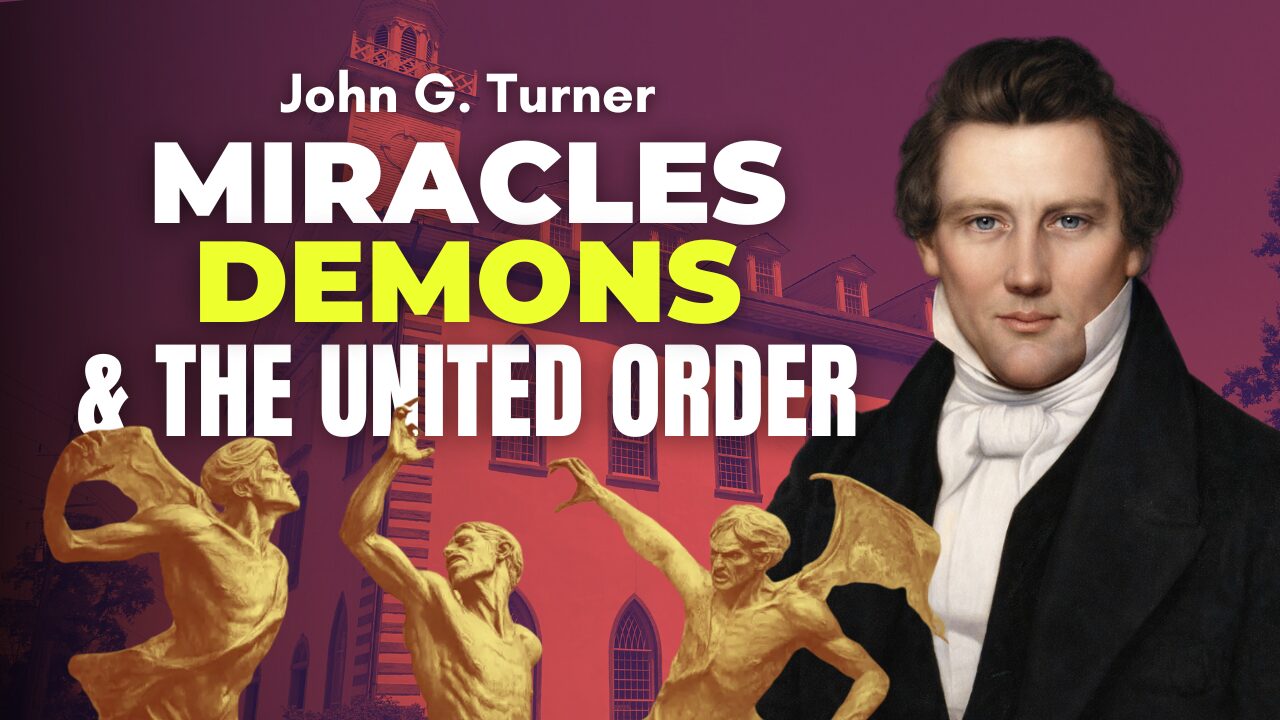
Miracles, Demons & the United Order in Joseph Smith’s Kirtland
Listen on Apple Podcasts Spotify YouTube Download MP3
About this episode
Welcome to another episode with Dr. John Turner! Today we are covering Chapter Nine of his new book “Joseph Smith: The Rise and Fall of an American Prophet.” Chapter nine is titled “Flying High” and covers the year 1831 which mostly took place in Kirtland, Ohio for Joseph Smith and the early Saints.
Topics include:
-Comments from listeners on this podcast series
-Why Joseph Smith didn’t preach from the Book of Mormon
-Early criticism of the Book of Mormon -Demonic possessions and miracles
-The United Order -Missionaries teaching the Lamanites
Non-Mormon historian, John Turner, approaches these topics in refreshing and informed ways. You won’t want to miss this episode!
Thumbnail Credits: Main image of Joseph Smith by Unknown painter, from Community of Christ Archives (public domain); Image of the Kirtland Temple by JonRidinger; Image of demons from FromtheDeck.org
Originally published on mormonstories.org.
Transcript
Machine-generated and lightly edited. Click any timestamp to jump the audio to that moment. The audio is authoritative; please check it before quoting.
Introduction and Pioneer Day Greetings
John Dehlin Hello everyone, and welcome to the Joseph Smith Podcast. I'm your host for today, John Dehlin. It is July 24, 2025. This is a Mormon Stories podcast production. And today we are covering part nine of our series that's beginning with John Turner's new book published by Yale University Press called Joseph the Rise and Fall of an American Prophet. John Turner is a professor of history at George Mason University and we are covering today chapter nine in his book called Flying High. And it covers the 1831 period that includes Joseph Smith showing up in Kirtland. So that's what we're covering. For those who have not already been joining us in this series, there are eight other episodes. We're going chronologically. There are already eight other episodes that we've recorded. This series is best consumed chronologically. So consider Googling Joseph Smith Podcast or finding the Joseph Smith podcast playlist on YouTube. We're going to be releasing all these episodes in a series on Spotify and Apple Podcast as well. There are visuals sometimes, but we welcome you all. The purpose of this series, as we've said before, is to get history based, factual based, evidence based perspective on the life of the founder of the Church of Jesus Christ of Latter Day Saints, which is Joseph Smith. And we picked John Turner to kick off this series not only because this book is new, but also because he's one of the first historians to write a super credible biography of Joseph Smith that wasn't either a faithful, semi apologetic, believing Mormon historian a la Richard Bushman, or an ex Mormon historian like Fon Brody or Dan Vogel. So we're having him call balls and strikes as a dis, I'll say, not disinterested. As a purely objective, 100% neutral, I'm smiling. Tongue in cheek. Third party. Really quickly, before we jump in, I want to thank everyone who's donated to make this series possible. We have received to date 106 donations to this project for a total of $6,311, which means we're paid up through about 12, 13 episodes. Almost 13 episodes. I don't understand how we have tens of thousands of consistent viewers and only 106 donations. But I guess there's a few of you that believe so passionately. You've really stepped up. If you value this series and you want to see it, make it all the way through Nauvoo and polygamy and Carthage jail and, you know, the Danites and all the fun things. Joseph being crowned king of the world, him running for president. If you want the full Joseph Smith experience for, I don't know, 30 plus chapters in this book. We hope you'll continue supporting this project, but a hearty thank you to everyone who has donated so far and to our regular Mormon stories donors, thank you so much. All right, that's the intro. Thanks for joining us. And now I bring back to you the purely neutral, objective, unbiased, clinically astute historian John Turner. Hey, John.
John Turner Thanks. John Dehlin, great to be back with you. Happy Pioneer Day.
John Dehlin I was going to say, did you know it was Pioneer Day?
John Turner I, you know, not being in Utah, it's not, it's not the first thought occurs. That occurs to me in the morning. But I spent a lot of summers in Utah, so I've historically had some really fun Pioneer Days. And why not have an extra holiday in the summer? It's such a good idea, objectively.
John Dehlin So has Virginia, has the state of Virginia adopted Pioneer Day yet or. Or are they laggards?
John Turner Yeah, we're laggards. I'm working on it.
John Dehlin I have a question. This is going to test your Mormon credibility. Are you ready?
John Turner Probably not, but go for it.
John Dehlin What do ex Mormons call Pioneer Day? They have another. They have an alternative name for it. Do you know what that is?
John Turner I do not know. What is it?
John Dehlin They call it Pie and Beer Day. And they eat pie and drink beer to celebrate the 24th of July.
John Turner Well, you know, as long you learn
John Dehlin something, I t you something.
John Turner I am, I am grateful for it. We have some peach pie at home, so I could, I could do that.
John Dehlin Do you drink beer? You don't have to tell us.
John Turner I do not drink beer.
John Dehlin Okay. Okay. All right. Well, then we can continue this series. I also want to note that I've, I'm, I've got my Cosmo, the Cougar be BYU hat going on. My friend who will remain nameless, who remain nameless, gave me this hat, and so I'm representing the Cougars today. Because, you know, you could be a proud Cougar fan, can't you, John Turner? That's okay, right?
John Turner You certainly can be. I mean, I wrote a. I wrote a book on the namesake of the university, so I'm all for it.
John Dehlin All right. Yeah, you did. You wrote a book on Brigham Young, so we need to get you a Brigham Young University hat.
John Turner I've. I've got one at home. I will wear it on a future episode.
John Dehlin Maybe you'll surprise us with some BYU swag. All right. Well, for the past several episodes, we've been promising our viewers and listeners that we would incorporate some of their questions and comments. And John Turner and I have been total slackers in this regard. But Julia saved the day, and she has pulled together some comments and questions, mostly from YouTube, but also, John, you. You've submitted one for today as well. I do want to remind everyone we want to hear your questions, comments, criticisms, compliments, and feedback. So please email or better, yeah, just leave them as comments on YouTube and Julia May incorporate them, but let's go ahead and share a few. Is that all right?
John Turner You got it.
John Dehlin We'll do that, and then we'll go to chapter nine and cover that today. All right, so here's some comments. So the first comment is from the St. Elias. Hearing John Turner speak as an outsider about church history is so fresh and interesting. I thought we'd start with the softball.
Listener Comments and John Turner Responds
John Turner You know, I like that I don't think that my teenage daughter thinks I'm fresh and interesting. So I am. I am grateful for compliments. And I'll just say I am grateful for the many people who have. Who have listened to this and, you know, been motivated to leave a comment, whether whether they love everything, whether they have something critical to say. I think that kind of engagement is just fantastic. It's one of the things I love about Mormon history.
John Dehlin Fun. All right, here's the second one. This is from Mormon Auditor on YouTube. I'm really surprised to hear people thought Turner was acting like an apologist. I think he's been incredibly reasonable and careful, the way a historian should be. So do you agree that you're fantastic, John Turner? The question.
John Turner I am not going to agree with that on tape, but I am definitely not an apologist. So I agree that. I agree with Mormon Auditor. I agree with Dave. I think that's his name, that I am not an apologist.
John Dehlin How about a Christian apologist? Would you even eschew that label as well?
John Turner I. I don't think I am a Christian apologist in the sense of the term being, you know, someone who's eager to get into the public arena and defend the faith. That's just not my. Not my thing.
John Dehlin Not your bailiwick?
John Turner Yeah.
John Dehlin Is that a word?
John Turner It is a word.
John Dehlin Okay. All right, let's go to the next one. R2 Junot writes. Great concept for a series and great first episode. Joseph Smith will never not be fascinating. And then. This is a little rough, John, you may want to cover your ears. Brilliant. Grifter, profit, criminal. So American. More, please. That's kind of a hot take from R2 Junot.
John Turner Yeah, well, my favorite Part is. More, please. Absolutely.
John Dehlin Okay. Here's actually a substantive comment. Rebecca Raven writes, hope you cover the impacts of the Erie Canal on the life and education of. Of the young Joseph Smith. I find that whole story fascinating. And I'll say, did you read. There's an entire book on the Erie Canal and Joseph Smith and the gold plates. Do you know about that book?
John Turner You know, I have to confess, I don't. I haven't read it. It's a great comment. I mean, and so the thing is, the Smith family moves to Palmyra just as the Erie Canal project is starting. A lot of people at the time think it's absurd to attempt it. And it's completed in 1825, which, coincidentally, is the year that the Smiths lose their farm in Manchester on the Palmyra Manchester line. So, honestly, what first occurs to me is that you have what is perhaps a bit of an irony, an unfortunate irony, in that Joseph and his family, they are living in a part of the United States that is really Booming in the mid-1820s all along the Palmyra Canal. Rochester is becoming a bit of a boom town, which isn't too far away, and the Smiths are not prospering. So it's this weird situation where you have this increased prosperity and economic activity, and none of it is benefiting Joseph Smith and his family.
John Dehlin That's got to be frustrating, right?
John Turner I think so. I think it. It brought their situation into particularly sharp relief.
John Dehlin I am. Oh, here it is. I found it. Okay. The book is called Heaven's Ditch God. This is. I actually read it and I actually enjoyed it. I think it was Tom Kimball, the late Tom Kimball, who recommended it to me. It's called Heaven's Ditch, Gold God and Murder on the Erie Canal. And I'll share the tab. Something that's interesting about it is. So it covers the golden plates, Joseph Smith, it covers the Erie Canal. Can you guess what murder. What it's covering with the murder?
John Turner John Turner, I'm guessing the murder of William Morgan.
John Dehlin Exactly. So it covers the Masonic stuff and the. Yeah, William Morgan. Exactly.
John Turner Yeah. That looks. That looks like a lot of fun. I'll check it out.
John Dehlin It is a fun book. It's by a guy named Jack Kelly, and I enjoyed it. So, anyway, that's a good comment. Thanks for the response. Thanks to Rebecca Raven for her comment. Okay, the next one's a long one. And John, you. You received this one and asked me to share it. Do you want to give any context before we read it?
Why Joseph Smith Rarely Referenced the Book of Mormon
John Turner Nope. Just from an anonymous listener, and I really I really appreciate the fact that somebody took the time to craft such a careful question.
John Dehlin All right, I'll read it. Here we go. What do you make of the idea, first of all, is this true? And you can pause me at any time because this is going to be a lot to remember that Joseph Smith didn't refer back to or cite the Book of Mormon much after it was published. And then just a little more. Wasn't this new scripture the reason most early saints joined the movement? Did Joseph just not preach in that manner? Eg, referring to scripture and verse for authority and to create an argument or what was his preaching like as contrasted to his revelations? I'm going to pause there, give you a chance to respond to that so far.
John Turner So I think the premise of the question is at least mostly true. Joseph doesn't refer to the Book of Mormon with any frequency in his sermons or his other, you know, textual productions. You know, you can find a few stray references. There's a reference to the Gadianton robbers in a mid-1830s blessing. Occasionally you can find Joseph referring to the Nephites or something like that. But no, the premise is correct. You know, often when Joseph delivers a discourse, I wouldn't say he really preaches on a passage of Scripture, but there's often a starting verse or a verse that's a starting point. So for instance, in his last sermon in mid June of 1844, which is sometimes called the sermon Sermon in the Grove, his starting point is the Book of Revelation, chapter one, verse six, which is a reference to kings and priests unto God. Now usually for Joseph, it's not an exposition of a scriptural passage, it's a verse that serves as, as an inspiration or starting point. And then you get a pretty wide ranging discourse. But he doesn't typically use the Book of Mormon as a source of inspiration for his sermons or public talks.
John Dehlin Do you have a, do you have an idea about why? Do you have a theory or theories about why? I have a couple, but I want to hear yours first.
John Turner So my first is that he simply wasn't as familiar with the text as he was with the Bible. Now that might, Even though he wrote it. Yeah, yeah, that might, that might sound counterintuitive, but to, to be fair, you know, I've, I've written a few books which are, you could, you could say maybe they're just forgettable, but it's a lot, it's a lot easier for me to recall familiar biblical passages, you know, that I've returned to repeatedly in my life than it is for me to remember the, in any way detailed comments of contents of something that, that I've written so I can kind of understand that. It does also then, you know, raise the question, if the Book of Mormon is the keystone of the religion and it restores plain and precious truths to the Bible, why wasn't Joseph motivated to spend time becoming more familiar with the contents that he had dictated? And there are definitely passages that could have served as a fruitful starting point for sermons and even for some of Joseph's later doctrines, but he didn't. I don't think we necessarily know precisely why. I think he did have this lifelong engagement with and curiosity about the Bible that the Book of Mormon simply doesn't displace.
John Dehlin Love it. Can I share a couple theories that are. I'm kind of writing down on a yellow sticky as I think about him.
John Turner You got it.
John Dehlin So, okay, so one is like, if you, if you just look at the way his theology evolves from like, you know, submitting the printer's manuscript or whatever it's called to the Grandin Press, to then like meeting Sidney Rigdon and then Sidney Rigdon's influence on the, the types of things that Joseph's going to be doing in early Kirtland. Just that you can see Joseph Smith's own personal theology evolving. So on the one hand, the Book of Mormon, Mormons know it as containing the fullness of the gospel, which I think we were just trained to just accept hook, line and sinker as just face value. True. But then you realize, wait, it doesn't have three degrees of glory. It doesn't have baptism for the dead. It doesn't have the endowment. It doesn't have, you know, theosis and humans becoming gods. Like, it doesn't have the Melchizedek priesthood. Like, there's so much, much of the distinctive Mormon. It doesn't even, it doesn't even have like, God and Jesus being separate beings. So, like, there's so much that the Book of Mormon doesn't have. So I could see Joseph not wanting to be constrained by it. I could see Joseph cringing and saying, whoa, I wrote that and now I believe something totally different. And I could also see him not wanting to remind people that the claim was it had the fullness of the gospel when clearly he's riffing as he goes from 1830 to, to 1844. So that's a first theory. Do you think there's any credibility to that, John Turner?
John Turner I think there is. I'd also maybe push it in a slightly different Direction. So the Book of Mormon I would take as a snapshot of Joseph's thought and theology in 1829. And as you say, a lot of Joseph's theology continues to develop and go and new directions over the next 15 years. Now that the thing is, that doesn't interfere with his ability to use the Bible as a site of ongoing theological reflection. I've never thought about this in depth, but I wonder if simply functionally, the Bible worked or works better for that purpose than the Book of Mormon. Perhaps it was just a richer source for that, you know, ongoing theological reflection. I don't know. That's a good thought.
John Dehlin Yeah, I just, I just, I just could see him, you know, innovating and then saying, wait. Having people go, but wait, you wrote in the Book of Mormon, you know, the Book of Mormon says this, but now you're saying that. And I could see him saying, well, it's like the Mormon Church has evolved to say the words of a living prophet trump the words of a dead prophet. Like that's probably a good policy, right? Like it allows you flexibility. But the Book of Mormon with the positions it takes, I could see it as Joseph feeling locked down and constrained by that.
John Turner Yeah, no, that could be.
John Dehlin I mean, I know what we're theorizing. I know.
John Turner Yeah. No, I mean, we don't know why he just didn't. Doesn't seem to have spent a lot of time with the text over those last 15, 14 years of his life. I mean, there's definitely teachings and doctrines in the Book of Mormon that do stay fixed, at least during Joseph's lifetime. You know, the age of accountability for children, that infant baptisms and abomination, that spiritual gifts persist. So there's some things that are, that are built in that, that, that don't change. But I think when Joseph is engaged in theological exploration, he always goes back to the Bible. He finds those texts, you know, to be the ones that animate his thinking and push it in new directions.
John Dehlin The only other theories I had was that the Book of Mormon is associated with the treasure digging, the seer stone in the hat. I, I imagine he, he would appreciate distancing himself from that part of his history. But I was surprised to learn the very peep stone and hat he used to, to treasure dig. He used to translate the Book of Mormon and not the seer stones, you know, I mean, not the urimum Thummim, not the breastplate. So, like, I imagine if those questions about not just his method of translation, but also of like, did the Witnesses literally see the plates or see what they're spiritualized. If those questions not only continue into the late 1800s, but literally persist until today, I could imagine him not wanting to be constantly asked those questions. Right, Yeah.
John Turner I mean, at the same time, it's not like the Book of Mormon becomes unimportant to the church. I mean, they bring out additional editions of it during Joseph's lifetime. It's still a very important missionary tool. So it's not as if he's, he's backing away from it, but, and, and therefore it still invites scrutiny and it is a bit of a mystery why, why he doesn't engage with its contents in at least an intensive way going forward.
John Dehlin Yeah, all right, well, that was a good question. Let's see, there's more to. Just seems to me that if Joseph had such a miraculous experience with the book as the words flowed through him in whatever manner they did, it would have been so incredible, so affirming of the reality of the God in the work, that he would be referring to it at any possible moment. Then they go on to write. If Joseph had personally crafted the book, spinning the ancient divine origin story and developing the narrative in all the language through its own research and skill, continued the ruse to get it published and sent missionaries out to preach. Seems like Joseph would have been even more committed to it, huh? Yeah.
John Turner I mean, maybe part of this is simply Joseph is. He is a prophet who is always going in new directions. I mean, there's always, there's always a new project. He, you know, he moves right into this, you know, revision and expansion of the scriptures. He moves into that a few months after the publication of the Book of Mormon. There's, there are always other, you know, new activities that he's undertaking. I think to a certain extent, he moves on and he moves on to, to new things. I agree. I, I agree that on the face of it, it doesn't make, it doesn't make sense. One would have, well, one would have expected perhaps the sort of engagement that Latter Day Saints are encouraged to have with the Book of Mormon today. I think there's evidence, and historians have been rooting around with this. There's evidence that for some church members, the contents of the Book of Mormon did become and remain important for Joseph Smith. He does seem to largely have moved on to the next project.
John Dehlin Yeah. All right, we'll read a couple more. We're not going to try and read them all this time. We're going to save some. I love this one. Fate Meets Sluck writes I am thinking about canceling my Hulu to donate to the Joseph Smith podcast with John Turner instead. Far more interesting and informative. Any, you know, concerns about that people? Piece of feedback, John Turner?
John Turner I don't have any concerns about that. Yeah, I mean cancel, cancel everything else, but pretty good to actually be more informative and interesting than everything on Hulu. I like that idea.
John Dehlin All right, couple more quick ones. I am just saying. One writes, I appreciate John Turner acknowledging that those who have had the misfortune of being members of the church and experiencing great harm as a result impacts how we perceive Joseph much differently than Turner does. Right. As, as a never Mormon, it's important that he hear the immense damage this man has done. From the perspective of the person writing this comment, a narcissistic abuser can be rakish, fun, charismatic, etc, but that pales in comparison to the abuse. Joseph Smith was manipulative, lying, was a manipulative, lying, power hungry man with little in the way of morals and claiming the power and voice. And I. There may be more to that comment, but I think you get the picture. So what's your general response to that?
John Turner You know, I appreciate a few comments along those lines. I know that there are elements of the Joseph Smith story that I simply enjoy and I talk about that with some frequency. You know, Joseph's chutzpah, his audacity, his mirth, his recklessness, his, his sociality, his hospitality. And I think sometimes when, when I am, you know, lifting up those parts of the story, it can be uncomfortable for people who feel betrayed by Joseph and the church that he founded. I think as someone who is not connected to the church or to the tradition, I think I did not fully appreciate those depths of feelings. I probably, you know, should have been a little bit more aware. So I appreciate those comments. I think I would also say that I, I try hard not to either give Joseph the benefit of the doubt or to assume the worst. I think, you know, the flip side of the comment is, is also true that, you know, for people, you know, there, there are large numbers of people who feel betrayed and hurt. There are also large numbers of people who feel fulfilled, led, filled with the spirit through the tradition that Joseph established. And so there's just this wide range of emotional and personal and human response to this story. And I like being reminded that, you know, this really matters to people. It's one of, it's, that's actually one of the things that has always pulled me toward Mormon history more broadly. It's fun to write about Something that matters to people but at the same time this isn't just fun for, for a lot of people. So, you know, know all of, all of those things are, are things that I, I try to try to keep in mind.
John Dehlin Yeah, here's a. And we're almost done. Here's a cousin comment. Yams317 writes. After listening to this episode, I'm convinced John Turner hasn't met enough scammers in his time. Successful scammers commit 100% to the bit and the lies become more and more grandiose. It may seem implausible at face value, but when you put stories of religious or cult founders to next to each other, you see a pattern. So John Turner, I'm just joking, but what's your, what's your exposure to scammers and charlatans and frauds?
John Turner I mean, I'm glad I haven't met enough scammers. I, I certainly glad I haven't. I don't think I've ever fallen for any just truly horrendous scams. And you know, occasionally I will click on an email I shouldn't click on, despite all of the warnings and trainings that my university makes me endure. Yeah. So, you know, my basic perspective on Joseph Smith is if you've listened to the prior episodes, that yeah, there's deception involved in terms of the coming forth of the Book of Mormon. And I, I think as we go forward, you know, we might, we might, we might talk about other, you know, analogous instances. At the same time, I'm resistant to reducing the Joseph Smith story to one of fraud and deception.
John Dehlin Only that, right?
John Turner Yeah, exactly. To only fraud and deception. I think this is a complex individual who did have this mixture of motivations that's not always easy to untangle.
John Dehlin Love it. Okay, really quickly because you know, Dan Vogel is, you know, he's read a few books, he knows a little bit about the stuff we're talking about. I, I feel honored that he would pay attention to anything I'm involved with. And you may feel at least somewhat similarly. He's been commenting here and there, so. Hey Dan, we love you. One thing Dan writes is nice to see a non believing historian struggle with these issues. Usually they sidestep them. So what do you think about being a non sidestepper, John Turner?
John Turner You know, I'll take that, I'll take that as high praise. I, you know, I really, yeah, I mean I get, I get, I get also the, the thought behind the comment. I think when you're, you know, you're an academic scholar of religion. There, there are certain schools of thought that you should, I don't know that you should sometimes bracket truth claims. And I do think there, there are instances in which we have to, as, as scholars or just observers of something say, you know, we really can't know. We can't, we can't penetrate to the heart of that. I'm not in a position to, to judge or to, to make a judgment, but I've tried hard to not do that unnecessarily. So if there's something that, that I think, you know, Bear is commenting on in Joseph Smith's life, you know, I want to give my best judgment while acknowledging that it's, it's my judgment and, you know, other people might come down on it differently.
John Dehlin Love it. Okay, one more comment from Dan Vogel and then we'll jump to chapter nine. Dan writes, when Joseph Smith couldn't bring Alvin to the hill in 1824, that was the end. There was no yearly meetings with Moroni. That was invented in Joseph Smith's 1838 history to connect it to 1827. He revived the story in 1827, as Turner relates, when he came home from Manchester and told his parents that he had been chastised by the angel messenger, it was a surprise to them. They weren't expecting yearly visits. Now, you're allowed to disagree with Dan Vogel. I would say be careful. No, I'm just kidding. What would you like to say about Dan Vogel's comment about the four visits?
The Plates, Fraud, and Joseph's New Directions
John Turner So that's a great comment, and we alluded to this in prior episodes. One thing that struck me about Joseph's life, life in the mid-1820s is the story of the plates wasn't central to it. You know, when Josiah Stowell hires Joseph as a treasure seer, he hasn't heard about the story of the gold plates. He hears other things about Joseph's gifts that attracts him to this young man. So this certainly wasn't front and center in Joseph's life in the mid-1820s. It does seem that the story does originate at least around 1823. What happens in between is uncertain. There are some references from some of Joseph's detractors to the effect that he may have brought other individuals to the hillside, such as his fellow treasure digger, Samuel Lawrence. So I'm not totally ruling out either annual or at least irregular visits to the hillside, but it very much is a new direction for Joseph in the late summer, early fall of 1827, when, at the very least, the story of the plates RE emerges and, you know, becomes his central focus going forward.
John Dehlin All right, well, great. Well, that's just. That's. Well, thanks to everyone who's written those comments, and thanks, John Turner, for being willing to respond to them. Thanks to Julia for collecting them. We'll have Julia do this before each episode, and maybe we'll. We had a bit of a backlog, so today was maybe a little longer than we'll do. Future sessions possibly. But can keep those questions and comments coming, everybody, and we'll include them. And especially you, Dan Vogel. We expect at least two comments each episode. Just kidding. I'm sure you have a day job. Okay, John Turner, should we talk about chapter nine of your book?
John Turner Let's do it.
Chapter Nine Overview and Joseph's Hubris
John Dehlin All right, everyone go buy a copy of Joseph Smith the Rise and Fall of an American Prophet. Let's make it an international bestseller. We're to chapter nine, which is called Flying High. And it covers 1831, mostly in Kirtland. A little bit of New York in there, a little bit of Missouri, little bit of Kansas. And we begin by Joseph and Emma arriving in Kirtland and Holy Moly. I've got thoughts, but do you want to start out and kind of set the stage?
John Turner Sure. So Joseph and Emma roll into Town on February 4th of 1831. And I do like, you know, a story that is. Is commonly told. You know, Joseph was someone who. He clearly knew how to make an entrance. He essentially, he rolls into Kirtland and their wagon stops by Newell K. Whitney's store. And Joseph just bounds Inside, looks at N.K. whitney, extends his hand and says, you know, I'm the. I'm Joseph the prophet. You've prayed me here. Now what do you want of me? And, you know, the. The preface to that story is the Whitney's. They had been Campbellite Christians, people who'd been interested in the restoration of the New Testament Church. They had then become attracted to Joseph Smith and the Church of Christ through all of the missionary activity in and around Kirtland. And apparently they had prayed to know how they might obtain the Holy Ghost. And the answer they got from the Lord was that they should prepare to receive the word of the Lord, for it is coming. And then Joseph shows up as the answer to that prayer. You know, this is a. This is an important encounter for Joseph. The Whitney's are maybe 10 years older than he and Emma. N.K. whitney's a, you know, pretty successful, prosperous merchant. And Joseph's new in town. He's going to end up needing somewhere to stay. And the Whitney's become very important supporters going forward.
John Dehlin Yeah, I, I, you know, I was struck by that hubris. A little bit later he receives a revelation basically where he says he has Jesus basically saying I will be your ruler. But clearly Joseph isn't cool with other people knowing or deciding what Jesus is saying. So in effect him receiving a revelation that Jesus is saying I will be your ruler. To me I just use, I don't know if it's associative or commutative property, but it's kind of like Joseph saying I will be a ruler. Like that combined with I am Joseph the prophet. That's a level of hubris that, that feels kind of new in the, in his developing saga. Is that, is that, did he have that before or was this kind of, is he like, man, I'm really going to step up my game here, you know what I mean?
John Turner So we, in the last episode we talked about that challenge from Hiram Page and Oliver Cowdery which leads to a revelation that, you know, no one else is appointed to receive commandments and revelations for the church except Joseph. I'm paraphrasing. So you know, that same basic point has been there. But what I think is actually either brash, impressive, hubristic, whatever is. Joseph shows up in a new place on February 4th. And the next day he begins governing by revelation. And there are a large number of new members of the Church of Christ here. It's grown really by comparison, spectacularly. In northeastern Ohio there'd only been, I don't know, 60 people at a church conference the, the previous fall. Now there are hundreds of local converts. These are people that Joseph has never met. Things are a bit unruly, a little bit uncertain. And Joseph does, he just shows up and he begins, you know, dictating a series of, of revelations really the deliverance of law for the church in northeastern Ohio. And I agree it's, it's, it is quite something.
Joseph's Financial Needs and Finding Housing
John Dehlin You know, I, you know, going to my next bullet point, you know, Joseph needs, you know, needs a place to stay, needs a bedroom. Tell us, tell us what, how he finds a bedroom. And then I have got a question.
John Turner Sure. So he's, you know, I think on a temporary basis he and the family, Emma stay with the Whitney's and, But you know, that's not going to be the long term plan. So part of Joseph's first revelation in Kirtland just the day after his arrival is that Joseph should have a house built in which to live and translate. That's a reference to the translation of the Scriptures. The Bible Expansion and Correction project, also in that same revelation, is that Sidney Rigdon should. Should get a comfortable room. I have to say that that's the part that actually does make me chuckle a little bit. Joseph could have dictated a revelation that both he and the Rigdon should have houses built for themselves. But, you know, the. There is a hierarchy here. And so house for Joseph, room for the Rigdon.
John Dehlin Yeah, so that. So this was my initial comment, and this in question, and this. This actually is going to reappear in just a few bullets. But, you know, I run a nonprofit, and nonprofits depend on the donations of people. And I can just tell you I've never been comfortable raising money. I've held a few fundraisers in the past 20 years. I hated every minute of it. I haven't done it in years. Probably seven, eight years. I haven't held a fundraiser. I don't fundraise anymore. I don't even ask people for money. Other than, like on the podcast, I'm like, I'll give you this content for free, and if you want to throw us a bone, you can. But other than that, I'm just uncomfortable asking anyone for money. He's comfortable having someone give him his master bedroom in his own house. Like, I know that on the one hand, religions and nonprofits rely on the generosity of wealthy people. On the other hand, I look as a sign of character how comfortable someone is sort of asking people to. To sacrifice at high levels. And you get the impression, and I just want to know, is this inaccurate? That Joseph was supremely comfortable asking people to make tremendous sacrifices. And as soon as we get into Missouri and then Nauvoo it, it just. It goes to 11. But tell me if I'm right or wrong there.
John Turner I mean, I think you're right. So I think then the question is, what do we make of that? You know, there people in. It's not just religion, religious institutions and nonprofits in which founders ask people for money. There are plenty of entrepreneurs in your neck of the woods, right? Or to the north and east. You know, if you're. If you're starting an enterprise, you believe in it. You ask people to commit their resources and to risk a lot sometimes. Now, I think a difference there is in those circumstances, you're asking people to, you know, usually who have a lot of means to give you some of them with the early Church of Christ and the law of consecration, you know, Joseph very quickly asks people to, you know, in some instances, consecrate all that they have. And that is you know, that is a supreme, that's a supreme ask. I think, you know, as we move forward, I agree Joseph is comfortable making that ask. I'm not aware of him having, you know, qualms about it. I, you know, and I think one theme that I tease out in later chapters is some of the time it does feel a little uncomfortable because Joseph is asking other people not just to risk their financial resources, but to risk their lives. At the same time, there are circumstances in which Joseph is also willing to risk everything. So one could, one could simply say that, you know, he believes in, in the truth of what he's doing and is therefore comfortable making those requests. There are, are also some instances in which members become disgruntled because, you know, maybe Joseph in certain instances isn't sacrificing the way that they are. Or, and we'll talk about this later, in the Kirtland period, people do invest a lot financially or give a lot financially and you know, they sometimes encounter financial ruin. And that's a, that, you know, that in some instances that's tragic for individuals.
John Dehlin Yeah, yeah, that's fair. And you're right. Politicians and you know, entrepreneurs absolutely are also fundraisers. It's not just religion and nonprofits. It's, it's all sorts of things. If I, if I told you my sex, money and power hot take as it relates to religious founders have already mentioned that on the podcast.
John Turner I don't think exactly, not explicitly.
John Dehlin I'll share it with you really quick. So this is just an aside, but I think it's actually relevant. So you know, a lot of people, so let me bracket. I'm never okay. You know, obviously things like abuse of children, non consensual, you know, sexual assault, fraud, none of that's ever okay. So please don't misunderstand what I'm about to say. But here's what I will say. I've. I once, once I lost, you know, once the church wasn't going to work out for me and I was seeing it not work out for a lot of people. Long story short is I spent many, many years trying to create secular community for ex religious people. And I found it to be impossible, difficult, tedious, thankless, excruciating. So much conflict, so many crazy people and difficult situations and you know, thrive still exists. This community we put together, there's a little bit of this oasis stuff that is still around that I helped start. But, but in no way has secular community blossomed in any way like I thought it would in 20 plus years of doing it. And what I realized is, is it's so incredibly hard to create community just because you're dealing with people. And oftentimes you're dealing with traumatized people. It's such a thankless and almost impossible job. And it almost made me think. A lot of times when people want to reduce, you know, the motives of a cult leader or a church leader, they'll say it's all about sex, money and power. And the thought I had, which is kind of a hot take, which I only think in my most cynical moments, is the creating community is so hard that why else would anyone do it, but not to get sex, money and power? Because the rest of it is so incredibly impossible and difficult and painful and thankless and tedious, like, good for them. At least they can get something out of it. And if they get a little bit of sex, money and power out of it, like I almost say, religion seems to be so valuable for so many people. Maybe they deserve it. Now, that's. It's probably a terrible. That's why I call it a hot take. But anyway. Yeah, you don't even have to respond. But I thought.
John Turner I don't have any particular, you know, wisdom or even humor in response. You know, one of the. One of the statements I make in the introduction to the book is that I wouldn't trust Joseph with my money, my wife, or my daughter. And that seems. That seems pretty harsh. I follow. You know, I follow in the next paragraph with some things that I do find admirable about Joseph. You know, in terms of the money. I don't, first and foremost, see Joseph as a scoundrel and swindler in terms of money, or as a. As a grifter, per se, like, as in someone who's pursuing these activities simply to accumulate wealth. Maybe I say that in part because he's not that successful at becoming prosperous, at least until the Nauvoo period. I just, you know, I think Joseph. I say that in part because Joseph wasn't. Wasn't good with money. He took on all sorts of risky debt. He took on more debt than he could. He could manage for a variety of reasons. Yeah, I mean, I'm with you, John, and that I'm, you know, I feel discomfort asking people for money, even if it's for some cause that I strongly believe in. Joseph had a comfort with that. I do think to some extent, anyone running a religious institution or other institution, you sort of have to make. Make that ask. And Joseph just asks an unusually large amount from his followers. And you Know, so that's, you know, that's. That's a big difference. We talked about, We've talked about Martin Harris before. He certainly doesn't think he was swindled. You know, but Martin Harris is not the only one who gives up a lot of prosperity. You know, Edward Partridge is another example of someone who comes up in this chapter. I mean, he wasn't super rich, but he owned. He owned a Hattery in Painesville. I don't know how you get rich from selling hats. It was probably easier in 1830, but he also had property and, you know, he had been. I think he'd also been a Campbellite, although I could be misremembering. His daughter Emily, who became a plural wife of Joseph Smith. She commented many decades later that his, you know, when her father converted to Mormonism and joined the Church of Christ, you know, his friends of the world thought he was insane. You know, it was that big of a leap. It wasn't like joining one of the other churches in the area. And, you know, I think Joseph called on him to sell his business and to sell his property. And apparently, according to his own daughter, who was a faithful member of the church, he. He sold his property for a pittance. You know, he lost. He lost a lot of money in the process and you know, never. And you know, he suffered great personal cost. He was tarred and feathered in Jackson county. And so he sacrificed a lot financially. He risked his life. He did not think that Joseph Smith swindled him. And so I think we have to, you know, know, we have to again, recognize that, you know, there are a lot of different human experience and responses to the way that Joseph leads in this respect?
John Dehlin Absolutely. Can we at least agree for sure that neither of us would want the job of being a prophet of a. Of a Christian emerging Christian sect in the 1830s and 40s.
John Turner Absolutely. And I think one thing we have to say is that Joseph's personality was. Was much better suited for it than min. Fine. I'd be such a, you know, Presbyterians would make terrible profits. Were so dull. You know, the least interesting religious group in the United States.
John Dehlin Well, just once, once things start going on in Missouri, I don't mean to like, no spoilers, but like I'm reading, no man knows my history separately. And things get. Things get real really quick.
John Turner Yeah.
John Dehlin And so this stuff gets really serious. Those. So stay tuned everyone. You do not want to miss Missouri Zion's Camp, you know, Liberty Jail and Far West. You know, it gets. Gets really intense right Am I wrong?
John Turner No, you're not wrong at all.
John Dehlin That's not even Nauvoo right.
John Turner I mean, this is. This is, you know, we're in the winter and spring of 1831, the next. The next March, you know, Joseph is dragged out of his house. He's, you know, seriously assaulted. He's tarred and feathered, he's beaten up. And this is. This is real. This is not. This is not, you know, make believe stuff.
John Dehlin And Sidney Rigdon's dragged around with concussions from his head being banged on the cement or whatever. Yeah, serious stuff. All right, so. So when the Saints start coming to Kirtland, it swells. Do you want to talk about, like, because that reap, that repeats in Independence, this idea of the Mormons descending upon a town. Do you want to talk about, like, anything about, like, what that might have meant, especially to the people in the town prior to the Mormonites, as it's written in the book appearing and Edie Howe. Feel free to discuss Edie Howe.
The Saints Arrive in Kirtland and Early Opposition
John Turner So, you know, this is. It's actually a bit of a unique situation in the history of the church because in Missouri and then in Illinois, you have large numbers of church members moving in. You have some of that in Kirtland and surrounding areas that, you know, you have dozens of people moving from different locations in New York State. But what's. What's sort of singular about this, which also creates local tension, is you have a high percentage of people in and around Kirtland who convert. They are people, in some cases, who'd been followers of Sidney Rigdon or they'd been Campbellites or Methodists. And very quickly, I think numbers are a little bit dicey, but perhaps a third of the residents of Kirtland join this new movement. And the same thing happens in some neighboring areas. And so the one thing that stokes tension is you might have a Baptist or a Methodist church in the area, and a large percentage of its members might sort of switch sides. They. They go over to this new movement. And that's one of the. One of the things that's, you know, in the air in Kirtland in the early 1830s is you just have a lot of people attracted to this new movement. You do have some other new people moving in, but this is really the epicenter of this. Of this new movement.
John Dehlin Yeah, it sure is. What do you want to tell us about Edie Howe and his opposition that begins right around this time?
John Turner Yeah, so Edie Howe is a publisher in Painesville, so nearby, he's really most known in Mormon history because of his publication of Mormonism Unveiled a couple of years later that, you know, includes. Includes a lot of material from Joseph's early detractors. You know, one thing that I hadn't known about how before working on this book is that. And I don't think this was the. The only thing that. That drove his criticism, but he had family that was part of this movement, including his own wife, who apparently had donated some money to the Camp of Israel, to Zion's camp in 1834. So this was also, in a way, this was real and personal for how. I think a couple of his sisters belong to the church as well. You know, how is. He was a little bit like Abner Cole in Palmyra. He was a bit of a religious skeptic. He didn't like spiritual excess and he didn't like the idea of gullible people, including his own family members, gullible in his mind, giving money to Joseph Smith and this upstart church.
John Dehlin And I've mentioned this before, but if believing Mormons have been conditioned to dismiss and discredit any critic of the church as just being inspired by Satan or having an ax to grind, will you remind us of your position of people like Edie Howe or. Or other. Well, you know, we talked about. Was it Abner Cole? What was it last time?
John Turner Abner Cole was the publisher of the Palmyra Reflector.
John Dehlin And also there's Phil.
John Turner What is it, Filbert, but Dr. Philastis. Hurlbut.
John Dehlin Hurlbut.
John Turner Yeah.
John Dehlin Like should. If somebody's trying to get a clear view of Joseph, ignore those people, Believe them blindly or something in the middle.
John Turner Yeah, well, as you can imagine, something in the middle, right? No, I think. I think we want to treat all sources fairly and I think we don't want to be too quick to dismiss someone who might have been close to Joseph Smith. We don't want to dismiss that person as biased because of that. I also think for Joseph's detractors, we don't want to dismiss them because they might have an axe to grind. Sometimes people have a. Have an ax to grind or an ax to sharpen. And let's just take a look at what they say and try to assess it and see if it lines up with other evidence. How. I don't think this is someone who had a lot of personal contact with Joseph Smith. What he ultimately does with the book Mormonism Unveiled, he combines a number of different sources. Some of those include letters from a disaffected former church member named Ezra Booth, who had spent some time in the company of Joseph Smith. Affidavits that hurlbut gathered from some of Joseph's former Palmyra neighbors. So these include the testimonies of people like Isaac Hale that we've discussed previously, and then some of some of how's own commentary.
John Dehlin All right, so we'll be following them all along. Let's turn to this topic that comes up a few times in this chapter, and that seems to come up a lot during Kirtland. You refer to it in the book as outlandish spirituality. We could call it Gifts of the Spirit. We could call it Pentecostalism as a nod to our dear friend Chris Thomas. You could even refer to the Articles of Faith where it says, we believe in the gift of tongues, prophecy, revelation, visions, healing and the interpretations of tongues, etc. And what I'm curious about is this idea of playing engine or talking engine. So tell us about, you know, charismatic sort of manifestations of the Spirit in Kirtland and how it manifests in 1831.
Ecstatic Spiritual Experiences and Speaking in Tongues
John Turner Yeah. So Kirtland is really a spiritual hot house. And I'm not saying that pejoratively, but there's the practice of what I would maybe call ecstatic spiritual gifts. It's pretty widespread. I imagine this was true of a lot of individuals before they joined the Church of Christ. But people, I think there is speaking in tongues in Kirtland. There are reports of exorcisms, healings, revelations. And then you referred to. And I don't know if I would necessarily put this in the spiritual gift category, but you have some people, you know, these elaborate performances of what really actually seem to be allusions to the Book of Mormon. You know, there's this one recollection of John Whitmer that some would slide or scoot on the floor with the rapidity of a serpent, which they termed sailing in the boat to the Lamanites. So there's. There. There are all sorts of these.
John Dehlin Wait. Sailing in the boat to the Lamanite.
John Turner I don't exactly know what that really, really meant.
John Dehlin What is. What is talking engine mean? So as a spiritual manifestation.
John Turner Yeah. So essentially, when some church members would speak in tongues, one of the common ideas, at least in the early 1830s, was that speaking in tongues meant speaking native languages. And I think that was in part because of the expectation that church members would be able to speak in actual tongues to Native Americans in their own languages. So something that would be an aid to missionary work. And if people were simply speaking in tongues, also as A sign of godly power.
John Dehlin Okay. And I guess that that might not play well today in today's society, but back then, I can. I can see how that would be common. Well, they mentioned scalping. So like mimicking scalping as a form of spiritual manifestation, that seems. That took a dark turn for me. Yeah.
John Turner So maybe there's two slightly different things here. There's the idea of speaking in spiritual tongues, meaning speaking actual human languages, whether that's to Native Americans or in some cases, Latter Day Saints. Early Latter Day Saints believed that they would also be able to do that if they went to Asia or Europe as missionaries. Later on, I think most Latter Day Saints came to think of speaking in tongues simply as speaking spiritual languages or spiritual utterances that other people could interpret. But there was that early belief that was more focused on Native American languages. And then secondly, people simply seem to have had fun, you know, acting in their minds like American Indians. And yes, of course, that would. And that was not. It was not unusual. Super unusual for white Americans to engage in that sort of thing for fun. And part of it is making fun of Native Americans in ways that. That most of us today would find offensive.
John Dehlin Hopefully later in the chapter, you. You, as you mentioned already, you talk about demonic possessions in Kirtland, exorcisms in Kirtland, healings and miracles. To what extent did Joseph Smith himself become involved in demonic possessions, exorcisms, healings and miracles?
Demonic Possession and Challenges to Joseph's Authority
John Turner So, you know, to step back a little bit more broadly, this is actually kind of a tricky situation for Joseph. On the one hand, Joseph and the Book of Mormon and the church, they teach in the persistence of the spiritual gifts that are described in the. In the New Testament. So speaking in tongues, casting out demons, miraculous healings, prophesying, you know, the whole shebang. And so, you know, Joseph is. He doesn't want to quench the spirit. On the other hand, Joseph doesn't want spiritual chaos in Kirtland. He doesn't want everything simply to be out of control. So, number one, he doesn't want revelatory competitors. You know, there are a number of individuals in Kirtland, men and women, who claim the gift of revelation, especially if they are bringing forth revelations that might try to guide the church or compete with Joseph's own authority. You know, he. He wants to put an end to that, as he. As he previously did with Hiram Page. I think Joseph also is a little bit uncomfortable with some of the more extreme physical manifestations of the spirit, of people collapsing or, you know, falling or hanging from the ceiling. You know that it's a source of potential embarrassment to the movement. The same is true of Protestant revivalism during this time period more generally. At the same time, as I said, Joseph doesn't want to quench the spirit. So, you know, he, you know, there's this significant instance in which he heals the arm of a woman in Kirtland, and her family become among his most stalwart supporters. He also exercises and casts out a demon from a woman who is suffering. And he writes about this in a letter to his brother Hyrum. In his words, I went and had an awful struggle with Satan, but being armed with the power of God, he was cast out. And the woman is clothed in her right mind. And for Joseph, you know, a successful exorcism like that or a successful healing, it was evidence that the Lord was working wonders in this land. And that was a big part of the appeal of the early Church of Christ, was its association with miracles. Now, plenty of other people were skeptical about some of those claimed miracles, but for many other, for many converts to the church, they were evidence of the power of God.
John Dehlin Let me just ask you, as a. As a historian of religious movements in the US what value do things like healings, miracles, exorcisms, demonic possessions, speaking in tongues? What. I mean, you know, you've weighed in on whether or not you thought there were actually plates. It would be hard to just claim that any demonstration of a charismatic spiritual gift is valid because, number one, lots of churches don't do it. But number two, how would anyone know other than the subjective experience of the person doing it? But certainly they're not all valid because some are proven to be fraudulent. So, number one, what's the value of a church encouraging or allowing these types of Pentecostal behaviors? Is there a positive, a practical function to the building of the church or the movement?
John Turner So, I mean, I think there was in this case, and I think it wouldn't be too hard to find lots of other examples. You know, Pentecostal Christianity in the 20th century, particularly in the early 20th century, and, you know, in an ongoing way around the world in the 21st century, would be another. Another good example. I think there is a lot of practical value. I think there are a lot of individuals who are not just searching for correct doctrine or correct beliefs, or who are not just searching for meaningful community or a personal sense of purpose. There are a lot of people who are searching for the power of God and for access to spiritual power. And that was definitely one of Joseph's core understandings. Of the church. And I would say, especially as he develops his understanding of priesthood, one of his core ideas about priesthood is that it's access to spiritual power. And, you know, as that term suggests, spiritual power that was, it was powerfully attractive for large numbers of people. And you're quite correct that, you know, it's possible to invalidate particular experiences. But at the same time, I think for individuals who experienced the power of God as they understood, wouldn't necessarily mean that their faith would be unshakable going forward, but it was a strong anchor.
John Dehlin Yeah, I'm thinking, you know, I grew up in Texas and I remember Jerry Falwell, you know, Oral Roberts, Jimmy Swaggart. And then I've seen movies like An Honest Liar where, you know, the Amazing James Randy used to go around and debunk claims of faith healing, of, you know, being able to read the minds of the audiences or channel the Holy Spirit to like, make prophecies when it's literal fraud going on. Like, literally a preacher with a earphone, somebody's feeding him knowledge as they gather it throughout the audience, and then the preacher's communicating to the audience that he's receiving a revelation when he's literally being passed the information through an earth phone. Or the fake healings where they'll hire actors to fake, you know, being in, you know, a paraplegic or quadriplegic, and then the fake faith healing and then they jump up. Like, I could see a functional value of these Pentecostal type activities as engendering faith that God and power really is in the movement when it isn't, when it's not. And there's a. There's a middle territory for that which isn't fraudulent, but it's just people maybe who tend to be dramatic, who tend to maybe be mentally unstable, who are either going to go along with it because there's probably social value. I'm reminded of a Pentecostal, a daughter of a Pentecostal preacher that I interviewed on Mormon stories who told the story of when she was a teenager. She hadn't spoken in tongues yet, but the whole congregation was expecting her to because her parents were the preachers. So she just decided one day I'm going to speak in tongues because everyone's expecting me to and do it as an act of faith, and maybe I'll feel the spirit as I start doing it. And when she was honest with herself, she never felt anything. But then she was confused by people coming up to her afterwards after she pretend spoke in tongues and they told her how much the Holy Ghost, they felt when she was faking her speaking in tongues. And then that made her wonder whether it actually did convey the Holy Ghost, even though she never felt it. But at the end of the day, isn't it epistemologically kind of questionable or unreliable and possibly a tool for manipulation for these gifts of the spirit to be employed as a way to engender faith and commitment to the movement? Can't they be problematic in that way?
John Turner Well, I mean, I think they can. They can be problematic in all sorts of ways. Including the ones that you just mentioned, I think. Sure. In those contexts, there's. There's incentive to fake it. And there's a memoir written by a Methodist female preacher named Nancy Towell, who went to Kirtland, either 32, maybe 1833, I think. 32. And witnessed, as she said, Joseph presiding over, I don't know, some sort of. Of ritual. I don't know if it was a ritual of healing or something else. And, you know, some of the individuals. I'm sort of garbling the recollection, but some of the individuals were reporting, feeling the power of the. Of the Holy Ghost, and Towel alleged that, you know, somebody had had, like, warm water poured on him or something like that. And I don't know. I don't know whether any of that's true or not. But, yeah, it's. It's hard to totally escape the taint of the possibility of fraud. I think at the same time, a lot of people, you know, people do have genuine religious experiences. I don't think everybody, you know, everybody who speaks in tongues is not faking it. And there are, you know, there are naturalistic studies of the phenomenon of people speaking in tongues. It does seem to be a, you know, communal spiritual experience that large numbers of people can have. I've never had it again. I'm Presbyterian. We're really uncharismatic, uninteresting religious movement. But I don't want to. I don't want to. I don't want to say that other people aren't. Aren't having those experiences. And as many people who might have faked healings, other people have genuinely experienced that. And I don't think. I don't think the fact that they might have genuinely experienced it, that's not evidence for a particular religious movement being true in some, you know, trans. You know, transcendent sense. It's just that I do think that religious experience, however we want to define it, spiritual experience, that. That is a. It is a human phenomenon. And I don't think we can. I don't think. I don't think instances of fraud or faking it mean that everybody is
John Dehlin right. Yeah. And I think I heard you say it's easily corruptible or manipul. Manipulable? Is that a word?
John Turner Yeah. Well, and I think also. I think it's also something that is sometimes manufactured, and there. There would be motivation to do so. And I'm not really saying this particularly about the early Mormon context, but, you know, if you are presiding over revivals in which large numbers of people are having families, physical manifestations of the spirit that becomes an expectation, you want to bring it about. So, yeah, there are all sorts of human motives that come into play in religious gatherings and settings.
John Dehlin All right, thanks for talking about that. It's a theme that comes up a lot in this chapter. All right, so Joseph continues to receive challenges to his authority. You mentioned, is it Heman or Heman Bassett?
John Turner Yeah, I'm not sure on the pronunciation. Heman. Heman. Sometimes you see Herman, but in most sources it's without the R. And there's Black Pete.
John Dehlin There's Laura or Louisa Hubble. Several continued challenges to Joseph's monopoly on channeling revelation. Anything worth mentioning there about those particular characters?
John Turner Yeah, so Peter, whom members of the church probably simply called Black Pete, he's a bit of an exception to this story. He's an older man. He's maybe 55 years old, a little bit older by the time Joseph moves to Kirtland. Some of the other. A lot of the other individuals, you know, Joseph's only 25 when he shows up in Kirtland. You know, Heman Bassett, I think, is 16 or 17 years old. There's a lot of, you know, youthful energy and hijinks also in this movement. So Heman Bassett, he really seems to have been just kind of a pain for Joseph Smith in 1831.
John Dehlin I thought the fact that he was 16 years old was interesting.
John Turner Yeah, it is. And, you know, it's. It's a young movement in. In a lot of ways. He, you know, he claims to have revelations from an angel. He also is part of a community that is holding property in common. And there's the story about him taking the pocket watch of another church member and saying, well, you know, we're basically. We're all part of a family. And then, you know, he has some of those really, you know, wild experience, you know, physical manifestations of the spirit and Joseph. And at one point, I think. I don't know if it's In a revelation or just. Or Joseph's just talking. I can just see him pointing at Heman Bassett and saying, you sit still. You know, the devil wants to sift you. You know, sit still. Knock it off. You know, I think sometimes during these. These months with, you know, these unruly new. New and often young converts in Kirtland, you know, Joseph Smith just wants to tell some of them to knock it off and simmer and settle down.
John Dehlin I mean, it is fundamentally a bit questionable to say, believe my revelations, but yours are only valid if they conform and subjugate themselves to mind. Like, I think Mormons, thoughtful, skeptical Mormons today almost have that same conundrum. Because, you know, let's just say a young mother will pray about whether or not she should go back to work, and she'll get a confirmation from the Holy Ghost that she should. But then she'll tell her bishop or her dad or her husband, and they'll say, well, the Holy Ghost tells me you shouldn't. And by the way, the prophet has said, a woman's place is in the home, so that must be from a different source. And, you know, there's always this issue of, yes, there are spiritual gifts, but only if they conform to the leaders and the authority are they valid. And that's sort of like a house always wins scenario, which is a bit of a red flag.
John Turner Well, again, I'd say that as far as Joseph and at least many of his followers were concerned, this is a. This is a feature, not a bug. I mean, this is. Yeah, it's a necessary and distinctive part of this movement that you have. You have a prophet, seer and revelator who dictates messages in the words of Jesus Christ that are meant to be authoritative. I will say that. I mean, I. I agree with you. So one of the. One of the things that I do like about my own branch of Protestantism is there's a strong belief in shared governance in which you have layers of governance that include both ordained ministers and lay elders. I like that. At the same time, I understand if you look at Kirtland in 1831, when Joseph shows up, you have some pretty unruly people practicing these exuberant spiritual gifts. You have groups of people who insist that true Christians should share all of their economic resources, they should share all their property. And if. If Joseph had showed, if he had shown up and had not immediately sought to bridle. It's a strong word, but to bridle this potential chaos, it would have been out of control. And so from, you know, the perspective of, you know, let's look at this. Organizationally, it was necessary to impose some authority and hierarchy. I, you know, my own Protestant sensibilities would definitely bristle against that. But I can. I can also understand why functionally that might have been necessary.
John Dehlin Yeah, absolutely. It's just one of those classic conundrums. Well, let's talk about that. You mentioned a lot of, you know, have we talked about United Order in previous episodes? Do you want to set that up really quick?
The Law of Consecration and the United Order
John Turner So part of Joseph's early Kirtland revelations 1. One part of that is the, as it becomes known, the law of consecration. And again, this is. This is pretty blunt. This is still just a few days after Joseph arrives in Kirtland. In response, apparently, to questions from church members, Joseph dictates answers from Jesus Christ. One of those is, thou shalt consecrate all thy properties unto me with a covenant, indeed, which cannot be broken. The idea was that Edward Partridge, who's appointed bishop for the church at this time, is he would allocate back to church members what they needed for, you know, their family needs, and then the church would retain the residue, the surplus, if you will, and use those funds to assist the poor and for the purchase of land. That revelation came with a warning. You're not getting your property back if you apostatize. This is a deed which cannot be broken. So, again, this is a huge demand. Now, one thing that's interesting to me is that throughout the entire, you know, history of the church, and this is really only attempted in the 19th century, this is really hard for church leaders to implement because most church members are not desirous or willing to deed their property to the church. So there's some, you know, early examples. There's an early convert, Leman Copley, who's prosperous, who owns a farm. A number of church members from New York settle on the farm. And then Copley quickly becomes disaffected from the church, basically kicks everybody off. Now, he hadn't deeded over his property, so he's essentially consecrated it without illegal deed. But that, you know, that's. You know, you find instances like that, there's bitterness on everybody's part. You can find some other instances. Frederick Williams, who's a significant supporter in the 1830s, he consecrates a property to Joseph, really to the church, in 1831. He then sells it by deed in 1834. So there's a lot of individuals who consecrate some property, land or otherwise. It's not so common for individuals to actually deed their land to the church.
John Dehlin Yeah. And I have to say this was a little bit. A little bit disturbing for me. You know, the United Order thing. On the one hand, there's some. Well, on the one hand, I feel like Tevye in Fiddler on the Roof. On the one hand, you know.
John Turner Right.
John Dehlin On the one hand, it's. It's idyllic. It's, let's all share and let's have no, no poor among us, and let's all live as a community. And that sounds beautiful. It almost sounds like what Jesus would want. On the other hand, that's. You know, we all know who grew up in the 80s, how the communism and the Cold War seemed to turn out for places like Cuba or the Soviet Union or China. They basically went capitalistic slash oligarchic, because communism has problems with the distribution of resources. You know, and that's. That's how I was raised. Right. Maybe I sound like a Gen Xer or a boomer, but that's how I was raised. On the other hand, it also seemed like a potential money grab. Like, the other place where this happens is in Far west when Joseph's basically kicked out of Kirtland and they're kicked out Independence. And I'm like, isn't it interesting when Joseph is poor and destitute and needs a house and money, all of a sudden he gets a revelation that everybody needs to give what they have to Joseph. And then Joseph gets to redistribute it however he wants, but he keeps what he wants. And then the final thing that was kind of really disturbing was this idea that you give your property to the church and you don't get it back. Even if you leave, you don't get it back. That reminds me of the flds, like the Kingstons and the flds, these sort of Mormon offshoots, slash cult, polygamy cults, if you're okay using that term. For the Kingstons or the flds, that's core behavior on their part. And so, you know, where. Where you give all. You give everything to the church. We interviewed someone who was a Kingston. She said that when she became an adult, when she started working, the direct deposit for her employment went to the church's bank account, and then they would give her whatever money from her earnings that they felt was appropriate. That was triggering to hear it happening in the 2000s. It was disturbing to see that. That, I guess that the Kingstons and the flds have their scriptural basis in Joseph Smith and The Doctrine and Covenants. Now I don't mean to just lump all that on you, but those were some of my reflections. In addition to the I will be your ruler comment that Joseph somehow channels in into Jesus's mouth. So any reactions to all that, that's a lot to respond to.
John Turner Yeah.
John Dehlin I ask you to be my therapist, John Turner. That's what I'm doing.
John Turner Yeah. Well, yeah, I'd be wary of giving all of your money to anybody, John. That is probably a good caution either. The first thing I'd say is that in a way what Joseph dictates in that law of concentration is meant to be a step away from a more communitarian system. So there are early members of the Church of Christ in and around Kirtland, people like Isaac Morley, who are forming these, you know, family style arrangements of people having everything in common. And your observation is correct that this usually, it's very difficult to live that out because it's easy for people to freeload or to be idle and live off of others. So part of what Joseph's revelation is saying is we're not going to do that. We're not going to, for the church as a whole. We're not going to try to simply hold everything in common and live together. This is going to be a church of families, not like one big family. So I think that's significant in terms of the arrangements going forward. Yeah, I think, you know, I, I think this is an unreasonable ask of individuals. Now I, I understand the, the logic of it. If this is Christ's true church and you have to establish a new Jerusalem before Christ returns and he's returning soon, wouldn't everyone want to give everything and be all in and for fully devote themselves to this movement and not hold anything back? So I get the logic, you know, for a number of reasons this doesn't really work out. You know, I think most, most church members, no matter how committed they are, they're hesitant to consecrate all of their property. When Brigham Young revives the idea in the 1870s, he encounters the same problem. You find a few communities in which a significant percentage of people consecrate their property, but most people just refuse to do so. And you know, on the one hand it seems kind of funny in a sense of these people. Maybe they don't fully trust Joseph or Brigham Young. I just think they're, you know, these are individuals who, who gave a lot of, of their wealth and risked a lot for this movement, but they really still on some level wanted to Control their own, own resources.
John Dehlin Yeah. Well, to me, it again speaks to kind of the boldness of the ask. And I don't know, some people call this type of thing referring specifically to Joseph as grifting. But I guess one man's grifter is another man's prophet of God. Like it's all a matter of your perspective, right?
John Turner Yeah. And I do think at this point, you know, one of, one of the things that Joseph does really throughout the rest of his life is on some level, and he's usually doing it through people like Partridge and others, one thing he's doing is he's managing the acquisition and distribution of production property. So later chapters of this story, you have people showing up to Missouri or later they show up to, to Nauvoo. Can't Joseph provide them with property in return for their property in the east, or for some money, or can he just give them property? So managing the acquisition and distribution of property becomes really a central concern for Joseph for the next three, 13 years. I, I do think I, I'm hesitant to simply call Joseph grifter. I think, you know, there is, there is something more to this in the sense of the, the immediate purpose does seem to be to acquire, especially once you get to the summer of 1831, does seem to be to acquire property in Jackson County. Joseph is not simply asking people to consecrate their property and building himself a massive mansion in Kirtland. But that doesn't get away from, you know, the largeness of the ask. And, you know, as someone who's not a latter day saint, I'm certainly very uncomfortable with the idea of using the words of Jesus Christ to encourage or pressure church members to give their wealth to the institution. Yeah.
John Dehlin All right, well, thanks for, for talking about this really quickly. You know, Joseph thought of himself as a prophet like unto the prophets of old. And I know this is asking you kind of on the spot to, to invoke your biblical knowledge, but do Bible prophets have the degree of power that Joseph is seizing here in Kirtland? To the point of saying, hey everyone, hey, all my followers. Imagine Moses, you know, I know that he's leading the children of Israel around and none of them own property. But like, I don't know, Isaiah or Ezekiel or Amos or Peter, I don't know, Paul, pick your prophet or apostle. Could they have gotten away with, hey, everyone who follows me, give me all your property and I'll let you know how much of it you get back. I am your ruler. Could biblical prophets get away with this, or is Joseph sort of taking the biblical prophet again to 11 in terms of power and grandiosity?
Miracles, Failed Prophecies, and Biblical Comparisons
John Turner That's kind of a fun question. I mean, I think most of the Old Testament figures you mentioned, these are actually fairly, you know, marginal figures. I don't mean unimportant, but they're not necessarily powerful leaders in, in that sense who are in a position to do that. Moses. I mean, the interesting thing about a lot of revered figures from the Bible is outside of kings like Solomon, who accumulates a tremendous amount of wealth, we're generally talking about figures who aren't in a position to do that and who have a lot of trouble exerting authority. So Moses has a lot of authority problems. Paul has all sorts of, you know, competitors, these super apostles that, that he's up against. Maybe the only good analogues would be people like David and Solomon. Solomon, you know, he's still, he's still sort of lumped in with the, you know, lumped in with David as, as a pretty good king, a wise leader. I mean, he enslaves people and takes all sorts of, of wealth from people. So. I don't know. I didn't answer your question very well, John.
John Dehlin No, you did. Like, yeah, when I think of like Amos or Ezekiel or Isaiah, you know, they're either, they either come across as like these crazy dudes wearing bear skins, like almost like a, you know, someone who, you might question their mental health, but they just happen to be prophesying. I mean, that's how Monty Python would depict them in like the Life of Brian. Right?
John Turner Yeah. John the Baptist, you know.
John Dehlin Right.
John Turner He's in the wilderness.
John Dehlin Probably not rotted teeth.
John Turner And like, he's not here, he's not eating well, he's not dressed well. So. Sure.
John Dehlin But if you, but if you, but if you talk about David or Solomon, they were literally kings. And like David, what he, he sent a guy out to battle so that he could take his wife. Right. And they had, I mean, obviously this comes, this is a little bit of a spoiler alert, but they take on multiple wives and concubines, some of these people. So I guess Joseph really is sort of like incorporating the bounds that he perceived in the most powerful of biblical prophets, which would be David. And he probably had less power than David and Solomon in the Kirtland time period.
John Turner Yeah. Now, I'm not saying that, I'm not saying that you're doing this, John, but it's so easy to, you know, we, we know that the contemporary Church of Jesus Christ of Latter Day Saints has a lot of money, you know, that's been in the news. Very successful with investments. I mean, the church in the 1830s is never on a stable financial footing. Joseph, a lot of the time, you know, he's living with, you know, different families. He does eventually get a house. He's not living like a king. There are also some points at which he's still, he's still kind of roughing it. So, you know, things get on a bit. They do get more prosperous for him to some extent in Nauvoo, but especially in the 1830s, it's, it's not, it's not as if Joseph's getting wealthy. They're often rather hard pressed. Now, I will say I'm certainly open to, you know, financial desire being part of Joseph's motivation for, for his activities. You know, to recap from prior episodes, this is a family that was utterly poor in the mid-1820s. Joseph doesn't have a clear economic direction. He then embarks on this quixotic literary project. One of the motivations is to make some money from the book, crazy as that sounds. And he, you know, he does need some sort of viable economic path going forward. It's clear from Revelation that we discussed in a prior episode, he intends to be supported by the Church. Now that doesn't actually require everybody to consecrate all of their property to the church. I mean, most, most ministers, for instance, you know, they, they just, they don't, they don't need that. Joseph has really grand plans in mind. You know, he has the building of New Jerusalem in mind. Obviously that's, that's also going to cost a lot of money. And as we move forward, his plans get grander and grander with temples and communities. So, I mean, I think it's totally fair to think of there being a mixture of motivations when it comes to these requests for property and money.
John Dehlin Yeah. All right, so let's talk quickly about. Okay, you mentioned that Joseph Smith Sr. And Hyrum come to Kirtland in 1870. 31. So his family starting to join him, they become really important players later. You know, as he's trying to balance power and responsibilities and even unravelings of loyalties, his family becomes really important. So it's, I'll, I'll just remind people to pay attention to that really quickly. I love the part about him sending the missionaries to the Lamanites and to Kansas. I think we touched on this in a previous episode, but maybe I brought it up a little bit early, but talk about that because kind of blew my mind a little bit. So say what you want to say about the, the missionaries to the Lamanites, and then I've got kind of a bigger question for you about that.
Mission to Missouri and Early Kirtland Conference
John Turner Sure. So the missionaries reach their destination. They get to Jackson County County, Missouri,
John Dehlin and remind us of the prophecy, like what his vision is for those missionaries.
John Turner So, I mean, his vision seems to be that they are going to fulfill the prophecies of the Book of Mormon, that the remnant of Joseph will return to the. The faith of their ancestors, that they will embrace this gospel, that they will become a white and a delightsome people. So they're, you know, on some level, there's, there are big aspirations of missionary success. And then that just bumps into the reality of, of actual missionary circumstances.
John Dehlin And doesn't he envision them helping to build the New Jerusalem and, like, partnering with the Native Americans to usher in the second coming of Jesus? Like, isn't it. Aren't they central to his plan in 1831?
John Turner Well, they are. So especially in 1830. And this, I think, flows right out of the Book of Mormon. There does seem to be an expectation that native converts will build this new Jerusalem by the fall of 1830. Joseph's revelations, there's, I think, a little bit of a shift, and it's native converts plus all of God's elect, so. Plus other converts to the Church of Christ. And I think very quickly Joseph's mind shifts to not native converts, simply, you know, white American converts to the Church of Christ building the new Jerusalem.
John Dehlin Yeah, and what I, you know, what I wrote. Well, first of all, so what happens when Oliver Cowgill, Parley Pratt and Frederick G. Williams are on the frontier between what, Missouri and Kansas? How are they received? What did Federal Agent Richard Cummins think about it all?
John Turner Yeah.
John Dehlin What did he mean by the missionaries acting very strange, by the way?
John Turner Yeah. So. So first of all, Jackson county, that's western Missouri. And if you cross over the river, you're into what at the time was simply referred to as Indian territory. And Cowdery Pratt and Frederick Williams, they cross over, they apparently spend a night with the Shawnee, then they meet with a Delaware leader and his people. And, you know, we don't, we don't know too much about exactly how the missionaries proceed because they're there really, really briefly. So Richard Cummins, who was the federal Indian agent for the territory, told Cowdery that he would imprison them if they continued to preach without a permit. So I don't know if this was by statute or by custom. But missionaries weren't simply allowed to come into these communities and start preaching. They needed permission from federal agents. Actually, I don't know exactly what Cummins meant when he said that these missionaries act very strange. I don't know how much Cummins really learned about their doctrines or behavior. But, but he essentially this, this mission doesn't really get off the ground. It's, it's, you know, it's a couple of days in, in Indian Territory. Now the one thing that happens though is Cowdery writes a letter back to Kirtland that a, this Delaware chief known as William Anderson and his people had received their preaching with gratitude. And he also suggested that a number of Shawnee believed. So this was wildly optimistic. I mean, I think Cowdery started putting a sunny spin on their initial attempt. Now what happens is when this letter reaches Kirtland, people have the expectation that there are going to be a lot of converts, which doesn't. Which turns out not to be the case.
John Dehlin Yeah. Do you think that qualifies as a failed prophecy?
John Turner Great question. So I think, I don't know. I guess I would say the Book of Mormon and Joseph's revelations, I don't know that they necessarily, I don't know, they, they necessarily contain predictions, you know, according to a certain timetable. So there's probably a little bit of wiggle room. I do think though there, that there was the expectation that these missionaries, missionaries to the Lamanites, they would have success. Now some of that might have already been tempered by the fact that native communities in New York and elsewhere, you know, they, they don't respond with any, you know, particular enthusiasm to any early encounters that they have with church members. So I mean, even once the, even as soon as these missionaries are on their way, I think, I think to some extent Joseph might have already tempered his own expectations. I think what your question points to is that at least some church members, they expected big things from this mission. And there are definitely some members of this early Church of Christ who perceive their failure as a failure of revelatory leadership. And for some people that's a, it is a faith shattering failure.
John Dehlin Yeah, I mean, it just seems to me like Joseph saying the Native Americans are going to join us and build New Jerusalem. Missionaries go out and convert them. Missionaries go out, get told to go home, they retreat to independence. It feels like an open and shut failed prophecy. And to this day, Native Americans aren't really heavily involved in the church. You really won't find more than one leader of the top 200300 leaders of the church, like, feels like a failed prophecy. I'm not trying to force you to say that. Yeah, well, I just want to call it if, you know, he's called a prophet. Like, we just started today's chapter by him saying the prophet has arrived. Right. So I think it's fair to say, how are his prophecies doing? Right.
John Turner Well, so this whole sequence of events ultimately, you know, doesn't end successfully. So the identification of the site for New Jerusalem in independence. There are a lot of people who are very invested right. In that, in that prophecy. And you have hundreds of people who move to be part of it. And I don't think it's a big spoiler alert to say that by 1834, those, those plans, those revelations have been disrupted now. Right. So for some church members, that's a failure of prophecy. I would say for the majority of individuals who moved to Missouri and experienced persecution and expulsion, they're not pointing the finger at Joseph and failed prophecies. They're pointing the finger at their, at their persecutors. So. But I mean, it is an interesting dynamic. And I think one thing that is definitely true of, of Joseph and maybe this insulates him from that charge to some extent is he is always moving. You know, he's moving in new directions. He's usually moving in a bunch of directions. He doesn't even. As important as many of the things as something like that is, you know, he, he always has, he always has other, you know, plans in the work and he's really good at pivoting and responding to setbacks.
John Dehlin Amen. Yeah, that becomes a superpower for sure. Like, he comes, he gets beat down and he comes back tripling, doubling, tripling down, comes back stronger every time. Couple, just a couple quick bullet round questions. I've mentioned this before, but the church tends to count this 1831 time period as the first emergence of the polygamy doctrine. And I think they do that because Fanny Alger, you know, tends to be cited as Joseph Smith's first plural wife in the 1835 time period. But that's before the sealing power is even given. And, OR, or the 1D and C132 polygamy revelation is given. So it looks a lot like, as Patrick Mason says, ph Alga. And polygamy looks a lot like sin to, to many of us, including Patrick Mason. But if you, but if you then cite that letter to the missionaries to the Native Americans where Joseph sort of seems to suggest that if they want to take on a A Native American woman as a concubine. I guess God's going to be okay with that sort of thing. What do you make of that? And I think you've already said that there's no evidence that they ever actually took Joseph up on that offer. But what do you make of that 1831 revelation that seems to be allowing polygamy with Native American women?
John Turner So, great question. I talk about it in a little bit of detail in the next chapter, but just a pointer, you know. Okay, we can save it, but I'll just say briefly.
John Dehlin Okay.
John Turner I don't think there's good evidence for Joseph having received a revelation related to plural marriage in 1831 or in the early 1830s.
John Dehlin Okay. And then we'll talk about what did happen. Maybe next chapter.
John Turner Sure.
John Dehlin Okay. You also seem to suggest that Joseph tells people in 1831 that some of them will live to see Jesus's literal second coming. And so my next question in the rifle round is, did Joseph tell people that? And if he told people that, does that qualify as a failed prophecy?
John Turner So, great question. Yeah. So I'm trying to. I can. I'm trying to remember the exact instance I'm actually more familiar with. There are blessings, I think, from both Joseph and his father and his father in. In the form of patriarchal blessings in the mid-1830s to a large number of people that they will live to see the return of their Savior. And, you know, in 1831, Joseph is revising in his Bible translation this passage in Matthew that suggests that individuals will live in the Bible. It suggests that people will live to see the destruction of the temple and the return of Christ in power and glory. Now, after the temple was destroyed, later generations of Christians have sometimes looked at passages like that and said, well, wait a minute, these people didn't live to see Christ return. And so Joseph, you know, sort of divided that prophecy in two, and he did suggest that individuals living in the 1830s would live to see the return of Jesus Christ. And it was an important theme in early patriarchal blessings and in some of Joseph's other blessings, it didn't happen. I think. Yeah, that question of failed prophecy is I. I engage it a bit more again in a future chapter. I think for a lot of individuals, you know, they accepted. When they accepted Joseph as a prophet, they didn't necessarily do so out of. Out of a belief that all of his words would come to pass. Maybe some individuals thought that. I think a lot of them were attracted to sort of this larger story or narrative that Joseph was unfolding, and they could sort of live with adjustments to that narrative as. As events went in different ways. I mean, to answer your question bluntly, I would say, yeah, Joseph made failed prophecies. But I think sort of an interesting corollary to that question is why was it that so many people stuck with him despite the failure of some of those prophecies?
John Dehlin You know, that's actually a great point because on the one hand you could just say, well, he wasn't a prophet because his prophecies failed. On the other hand, if it bothers us, why didn't it bother so many of them? And it clearly didn't. So clearly they had a different expectation than some of us bring to this story.
John Turner Yeah. And think about, you know, maybe an analogy. An analogy would be politicians and perhaps entrepreneurs, right. Who are often laying out glorious futures for their followers. And sometimes those futures don't come to pass. And sometimes politicians or entrepreneurs are totally discredited. You know, but sometimes there are explanations, and sometimes the. The next grand vision is. Is also attractive. Or sometimes people still see them as, you know, leaders that they. That they respect for a variety of reasons. So I think that, you know, that question, it's a complex one. You know, I think once people. Once people buy into a movement or a leader, I think there's a tendency to make. Make some apologies for setbacks and failures. Different people have different breaking points. Some people, once they accept it as. Once they accepted Joseph as a prophet, they just stuck to him no matter what. I think Brigham Young was in that category.
John Dehlin Yeah, that's helpful. Okay, well, really, a couple more super firing round questions. Josiah Stoll hangs back. If those of. Those of you who pay attention or have been hearing previous episodes, he was clearly the one that kind of helped start this all with the silver mine. That's, you know, where Joseph met Emma and Isaac Hale. You mentioned in this chapter that Josiah still hangs back. Does he hang back permanently or does he eventually meet up with the saint somewhere? And if he doesn't, do we know why he bailed?
John Turner So I don't think he either gathers or bails, in a sense. So there's a letter from Stowell, I think in the early 1840s. I could be. I could be off on the date. Clearly still believes, still accepts that Joseph has gifts, at least I don't know the details of all of his belief. He doesn't break with the movement. He doesn't bail on it. You could find a lot of other 19th century examples of people who Stowell is Different because he's such an early and stalwart supporter. But you can find a lot of examples of people who do believe and convert but don't gather.
John Dehlin Yeah. Okay, so that's not some sign of his apostasy, that he doesn't join them in Kirtland?
John Turner No, I mean, I think his, you know, the last document that we know of that relates to Stowell suggests not that he didn't break from Joseph.
John Dehlin Yeah. Okay, really quickly, the ongoing saga of Martin Harris. You mentioned that he goes broke, that he lost the land that he mortgaged to pay for the Book of Mormon, and he's still got a bunch of Book of Mormons, Books of Mormon that he needs to sell. And kindly or ruthlessly, Joseph Smith allows the price to be lowered a little bit from what he would allow previously. Right. Do you want to talk about that? The continuing sad saga of Martin Harris.
John Turner Well, I mean, it's sort of sad, Right. He originally has been selling these books for $1.75.
John Dehlin You wanted to sell them for two, right?
John Turner I think so. I don't know. I don't think it was priced too. Too low. I don't think that was the problem. And Joseph allows him to discount it to $1.25. So 50 cents off. But by 1830 terms, that still. That's still quite a lot for a book, according to. And it's a. It's a recollection from, you know, a number of decades later. But John H. Gilbert, who was the typesetter for the Book of Mormon, his recollection is that Harris was cleaned out financially. He definitely was distraught that the books didn't sell.
John Dehlin Yeah.
John Turner But, you know, he was on record later saying that he never lost one cent. Mr. Smith paid me all that I advanced and more, too. I presume that Harris meant that he had been repaid spiritually, so he might have been. It wasn't totally cleaned out. You know, he still did have. Have some. Some. I think he still had some property and resources, but he did lose a lot of money on this guarantee. I. He. So I think he's talking in spiritual terms rather than financial terms.
John Dehlin Yeah, well, the last thing I was set to talk about in this chapter was the Kirtland Conference. I'm looking at the time, and it looks like we may have a. May have to save that for later. Dude, do you. You gotta run, right?
John Turner I. I am up against it soon.
John Dehlin Okay.
John Turner But, you know, let's. Let's. Let's try to talk about it quickly because then we'll be we'll be at the end of the chapter. You know, it's. It's a fascinating conference in June of 1831, because Joseph ordains a number of men into what he simply calls the high priesthood, which he's not calling up
John Dehlin Melchizedek at this point, right?
John Turner No, I think you start seeing that word maybe half a year later or even a little bit longer. It does become connected with Melchizedek priesthood, but at first it's simply called high priesthood. Again, it's. It's. At this conference, there are ecstatic spiritual gifts, physical manifestations of the spirit. People apparently being possessed by Satan and then exorcised must have been quite a sight. And then the idea is to ordain these men with the high priesthood and then send them out as missionary laborers. And again, Joseph's asking a lot of his followers. There's this story I include about Levi Hancock, and he didn't want to go because he didn't want to leave behind a young lady that he wished to marry. But then he decides to go. So that's a. That's a tough one. Edward Partridge. Apparently, his family was sick when, when he left. And I think also the conference is a sign that. That in the four months that he's been in Kirtland, Joseph's been able to establish some power and order. By power, I mean both authority and spiritual power. He's sort of putting the brakes on the most unruly behavior. And he's got this cadre of high priests who are going to go out. You know, the northeastern Ohio is really the. The epicenter of the. Of the early Mormon movement, but they're going to go out and be fruitful missionaries.
John Dehlin Okay, I have to ask this super quickly. I've mentioned this before, but later, David Whitmer publishes an 1887 pamphlet called An Address to All Believers in Christ, where, if my memory is correct, he denies that Peter, James, and John ever visited Joseph and Oliver, and he denies that the offices of high priests in the Melchizedek priesthood were ever part of the original church organized. Does he. Did he mean 1830? Was he around in 1831 to see this Kirtland Conference? Because I'm trying to make sense of Whitmer saying the Melchizedek stuff never happened. But you writing that in 1831, Joseph is unfolding the higher priesthood, which he may not call Melchizedek at this point, but it's clearly some sense of a higher priesthood. How do we square those two differences? Or can we.
John Turner Well, so the first thing is this doesn't really pertain to the appearance of Peter, James and John in 1829. So however one wants to understand, Joseph's later recollections of that high priesthood as a concept is at least not introduced to church members until 1831. And one of the things that's characteristic of a lot of Recollections of 1831 is that church members, they don't really understand the concept. Joseph doesn't necessarily articulate it. I don't really think even in 1831, there's much of a distinction between high priesthood and lower priesthood, certainly not between Melchizedek priesthood and priesthood of Aaron, Aaronic priesthood. What I really think is at the heart of this is priesthood equals spiritual power, and men are ordained as high priests. They go out, they work wonders. There's sort of a widespread belief that if one's been ordained into the high priesthood, one can heal injuries, diseases, cast out demons, and one's equipped to be a powerful missionary.
John Dehlin Okay. And as I'm doing a tiny bit of digging. Yeah. What he claims, what Whitmer claims, is that the story of Peter, James and John doesn't emerge until 1834 or later. Does that seem right to you? I'll ask you the three questions. Does that seem right, that at this Kirtland Conference there wouldn't have been. Probably. There's no evidence of there being any account of Peter, James and John giving the higher priesthood. Is that part right?
John Turner That's correct. But what I would say is that that later account, it's not about the events of 1831, it's about experiences in the spring of 1829 during the book of Mormon translation.
John Dehlin Okay, go ahead.
John Turner No, I was going to say, and, and I think, you know, that's. That's something that historians of Mormonism and sort of interested church members often, often want to know. Are there, are there really early accounts of the restoration of priesthood for the spring of 1829? I. I definitely think that, you know, I think those narratives get fleshed out a number of years later. Do I know exactly what Joseph Smith and his associates might have experienced in the spring of 1829? I. I don't know.
John Dehlin Okay. The other two things that Wibmer basically seems to be saying is, at least in 1830, this idea of a higher and lesser priesthood didn't exist when the church was first formed. And then he says that the idea of there being two priesthoods, a higher and a lesser kind of formally structured as such, doesn't emerge until 1834, which a lot of Mormons are like, I don't care. It's an unfolding revelation that's part of the feature, not a bug that things change over time. It seems like Whitmer wants to say, look, either it was all revealed as it should be from the beginning, or there's a problem.
John Turner Right. Well, I mean, I think I know that some church members are troubled by the fact that there may not be good early evidence for Peter, James, and John in 1829 or for this being more clearly articulated or distinguished at an earlier date. You know, Joseph has some really long extended revelations on the subject of priesthood. Over the next couple of years, one of the things that he does become increasingly concerned about is, you know, introducing and clarifying layers of hierarchy and priesthood authority in the church. I think in 1831, what he's really interested in doing is, you know, he connects the general concept of priesthood to spiritual power, power to work miracles, power to preach the gospel and that. And because everything isn't fully articulated, a lot of these early high priests are themselves a little bit confused about what the concept means.
John Dehlin Yeah. All right, well, you've been great, and I don't want to keep you. I do want to give my final shout out. But let me just say, John Turner, thanks again for this wonderful book and thanks for giving us time today. And we've got at least four more that we can promise, so that's kind of fun. We're going to at least get through, what, chapter 13 or so.
Closing Reflections and Listener Support
John Turner I mean, we're looking good for getting into the heart of the Kirtland story. That was a lot of fun, John. Appreciate you. Appreciate all of your listeners.
John Dehlin All right, you take care. We'll see you next week.
John Turner All right, bye. Bye.
John Dehlin All right, and thanks, everyone, for joining us today on Mormon Stories. Again, we've got like a hundred of you who have made contributed to this series. Obviously, if you're a regular Mormon Stories donor, you probably don't feel the need to donate extra. I totally get that. 107 donations so far to the Joseph Smith Podcast. If you value this series and you want to see it continue the way you do that is to go to donorbox.org Joseph Smith, donorbox.org Joseph Smith, and become a monthly donor to this series. And if you do, then we can continue. Right now, it looks like we're paid up through 13 episodes, so we can do at least four more episodes. That takes us through, as John just said, to like, yeah, kind of the end of Kirtland. So if you want to see us go on to independence and, and Zion's camp and Far west and then finally Nauvoo and polygamy and Joseph Smith running for president and the Danites and Joseph being ordained as king of the world and Carthage and all that, his martyrdom. Please donate more or when the donations went out, we'll stop wherever we make it. We're paying, we're paying staff for this. We're paying John Turner for this. I'm not really getting paid for this. I'm just doing it because I think it's fun and interesting. So please support it if you can. If not, I get it. Please buy this book. You can buy it at Benchmark Books. You can buy it on Amazon or from Yale University Press. But buy from Benchmark if you can, because those, those folks are great. And yeah, thanks. Please send us your comments. Please comment on YouTube or on Spotify. Please email us your comments. We'll have Julia include them and we'll try to cover some comments each episode. But we love your feedback. We love your criticisms, your corrections, your theories, your conspiracies. We want to hear it all. And mostly this is just fun. So thanks to John, thanks to Julia, thanks to you who are donors. Thanks to everyone. And thanks for joining us today on Mormon Stories. You guys be good to each other. Be kind to each other. Donorbox.org Joseph Smith to keep this going. We'll see you all again soon on another episode of Mormon Stories podcast. Take care, everybody.
Transcript © 2026 John P. Dehlin. All rights reserved. Brief quotations are welcome with attribution and a link to mormonstories.org; all other use requires written permission.